
Otters, Owls and Old Post Offices

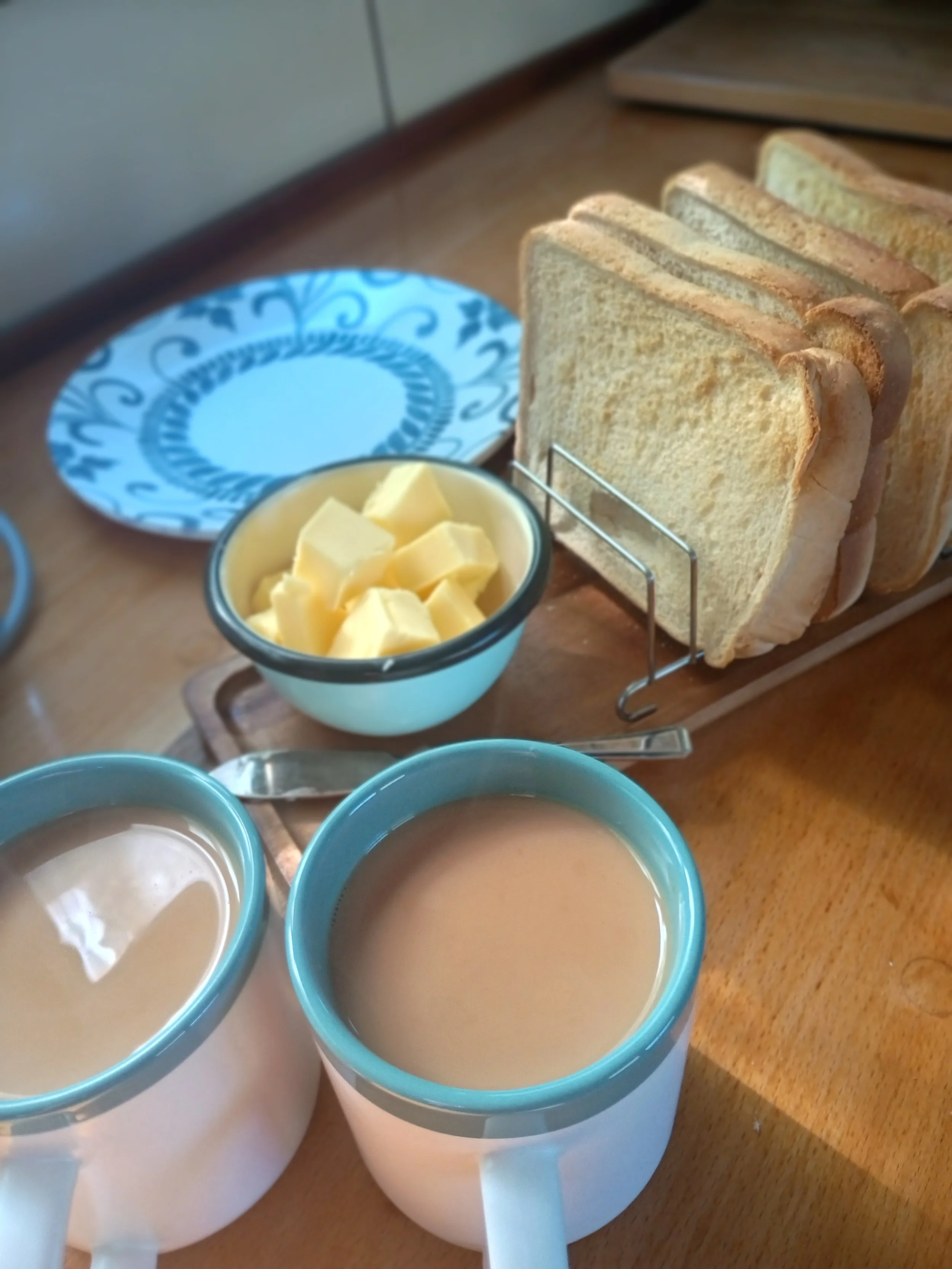
We woke up late and took our time easing our slightly broken bodies out of bed. It was probably a sign that we either needed to improve our fitness levels or choose smaller hills to cycle up. Still, nothing a good cup of tea and some toast couldn't fix.

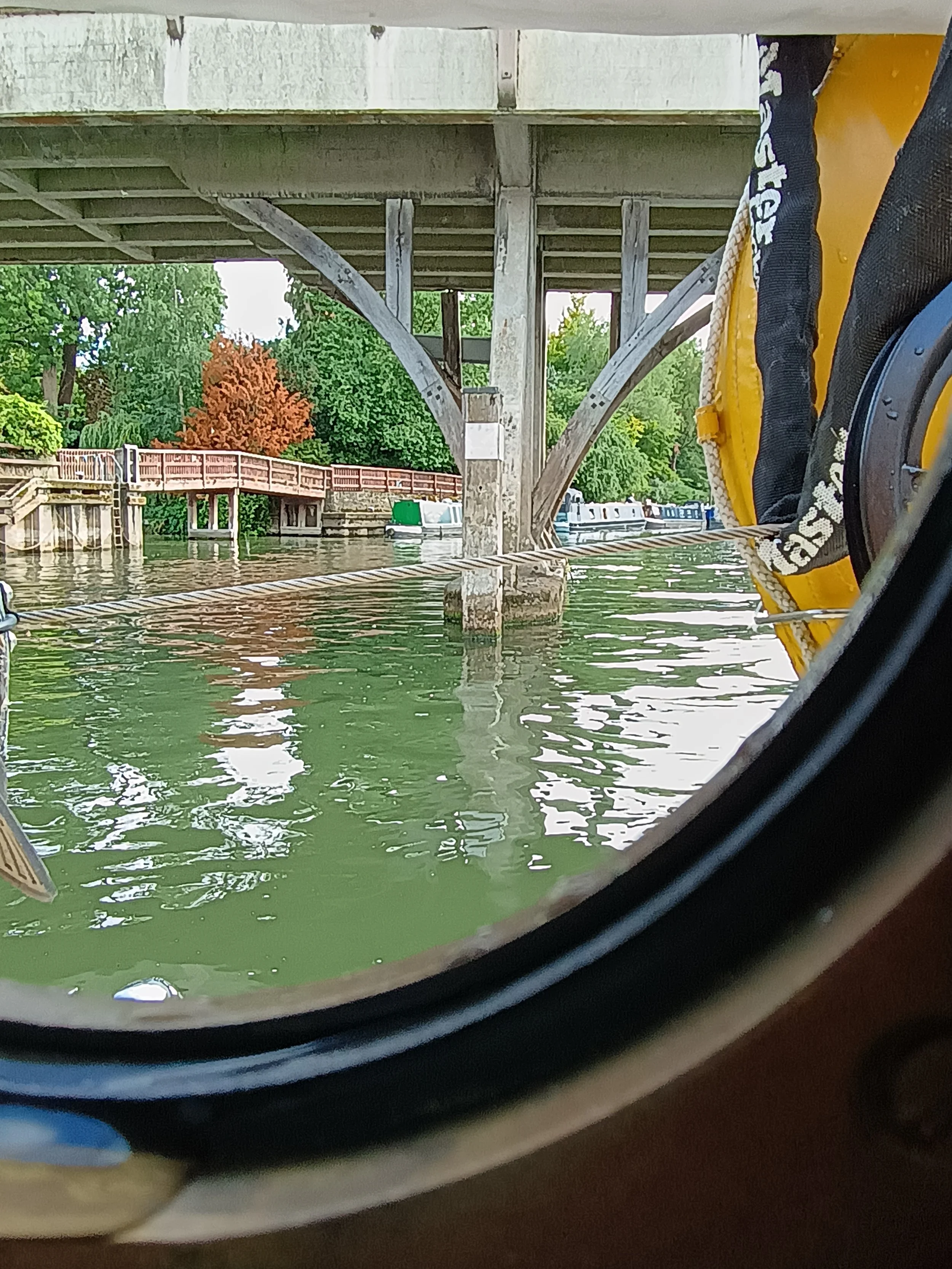
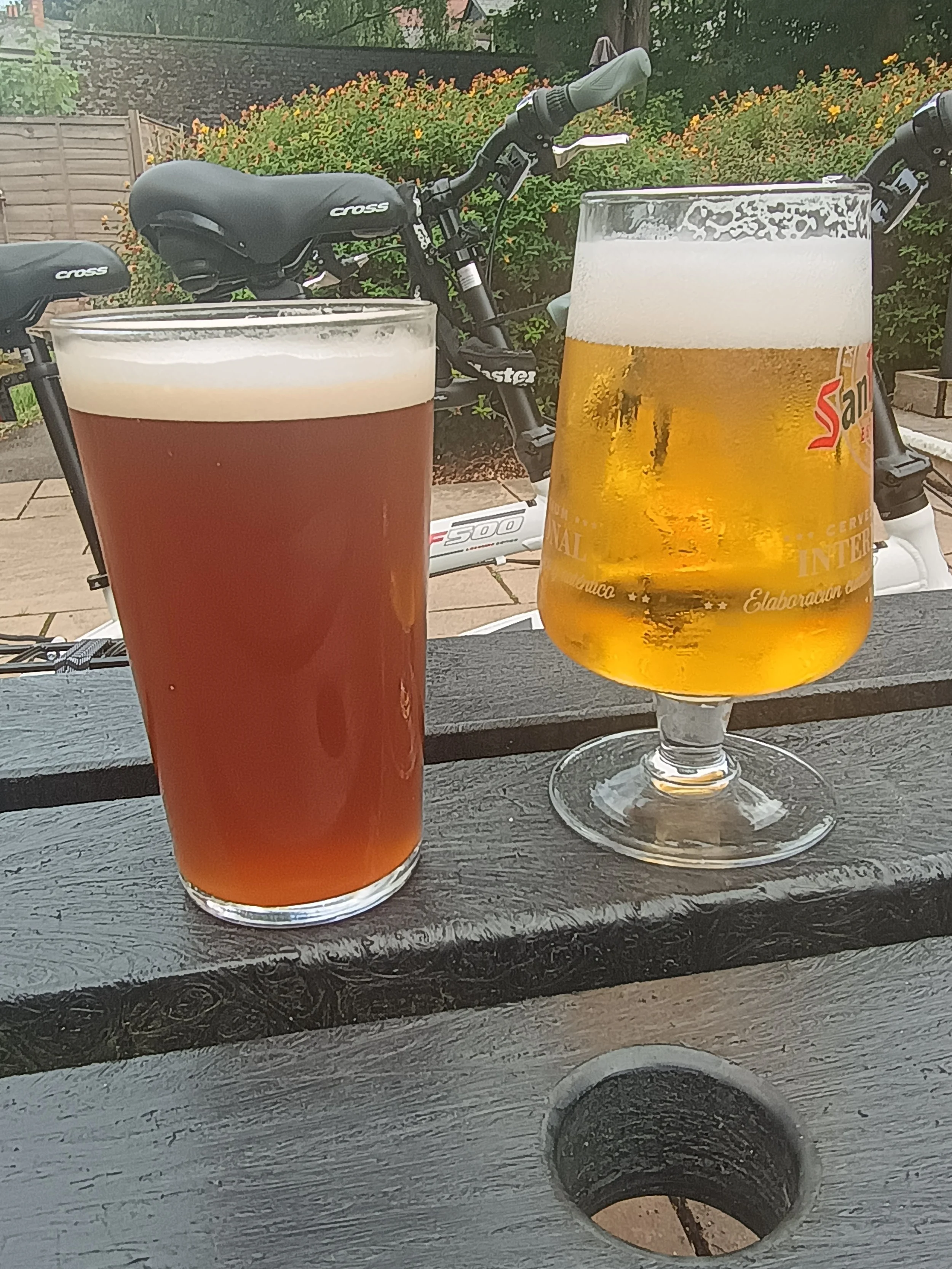
After breakfast, we took a gentle stroll to the station to collect our family guests. The early afternoon was spent showing off Goring, followed by a delicious pub lunch before it was time to cast off and head towards Wallingford.

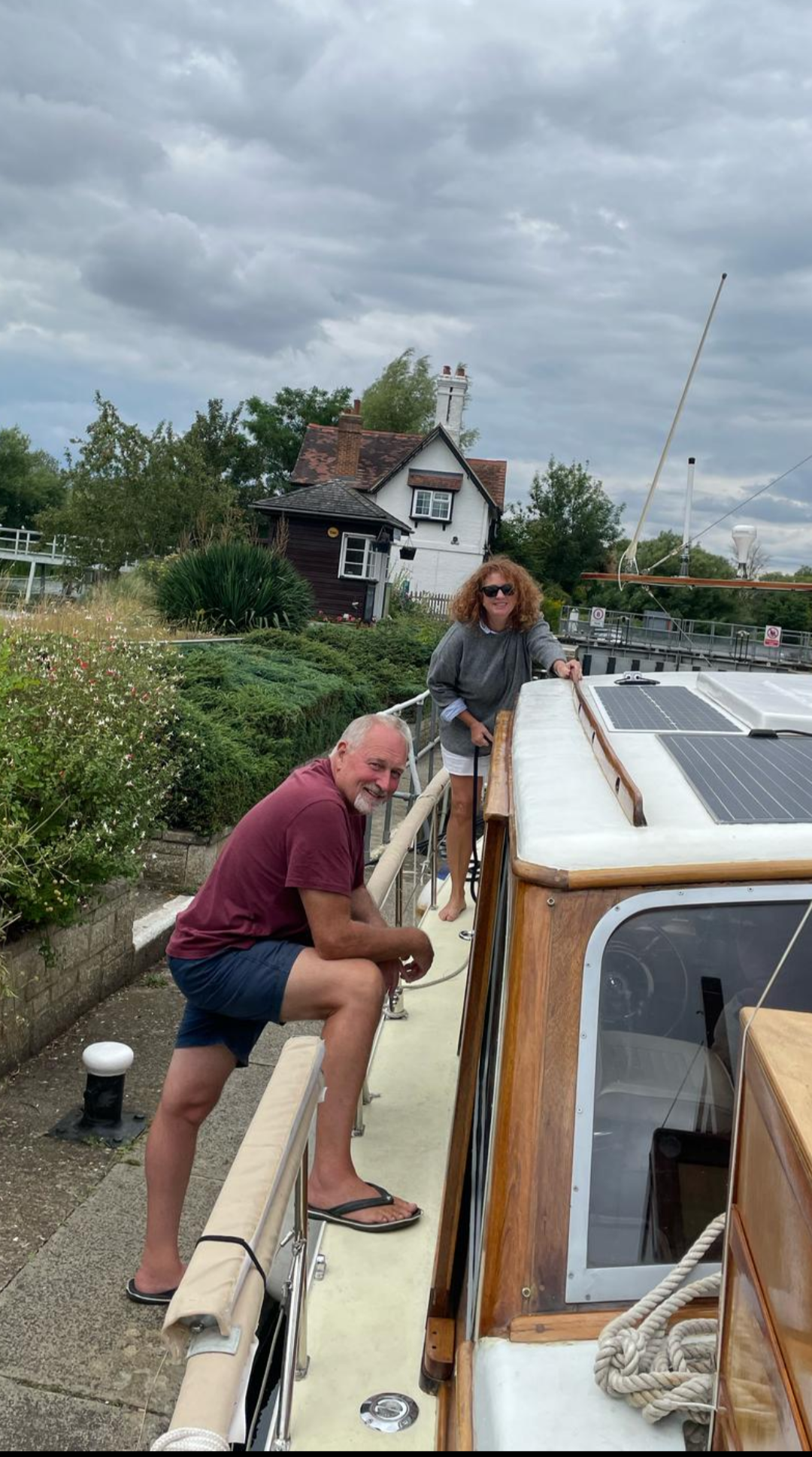
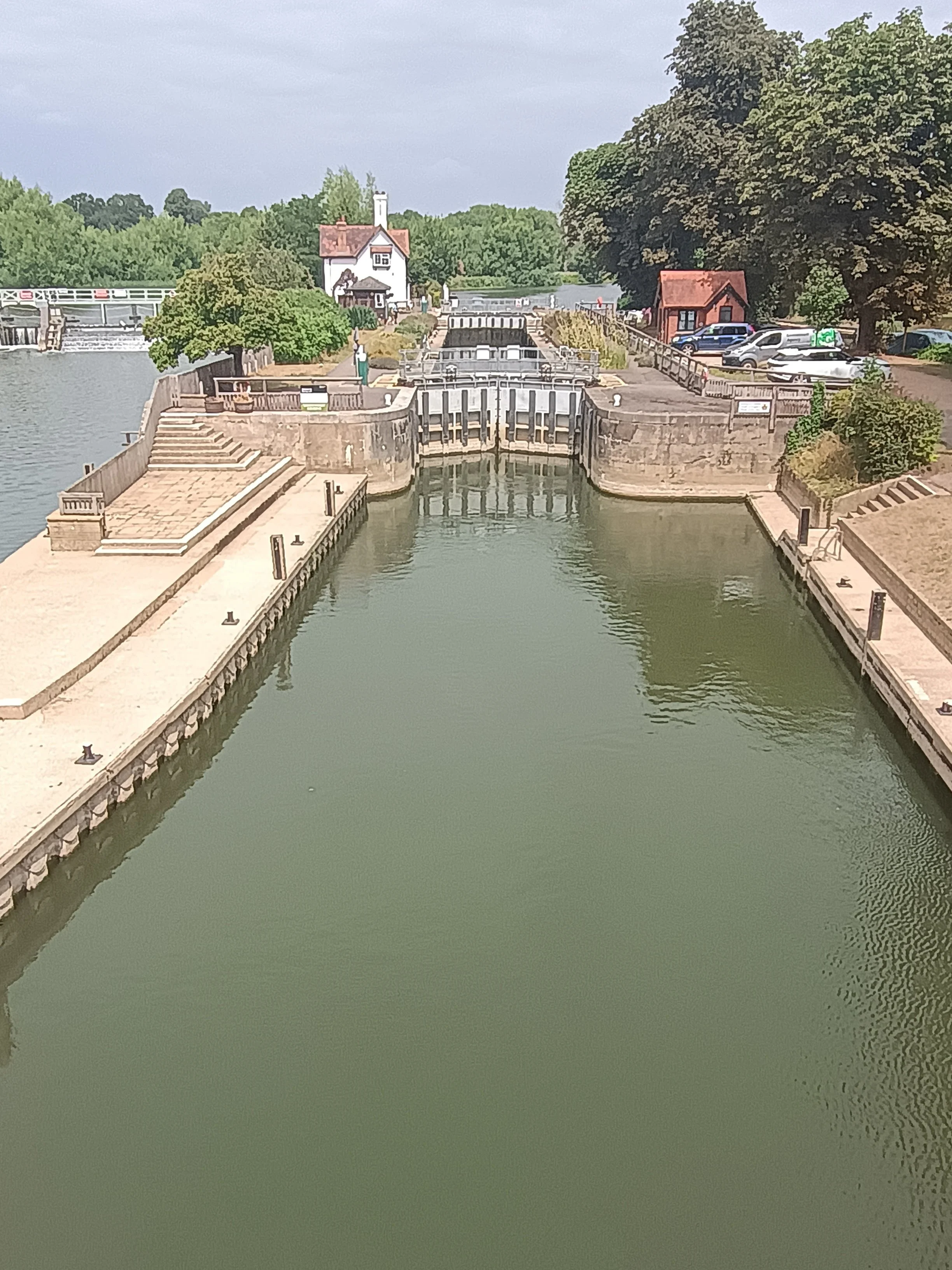
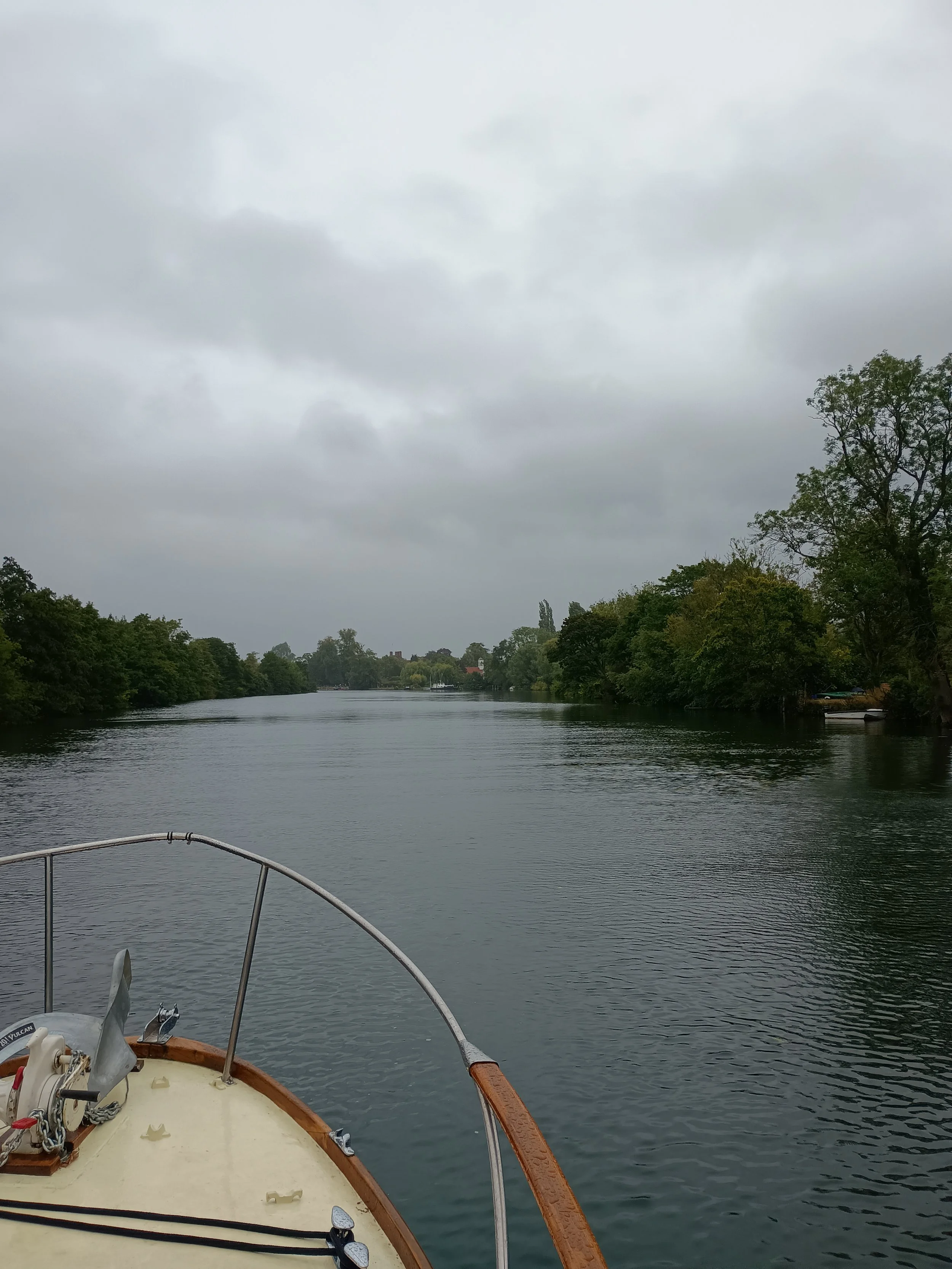
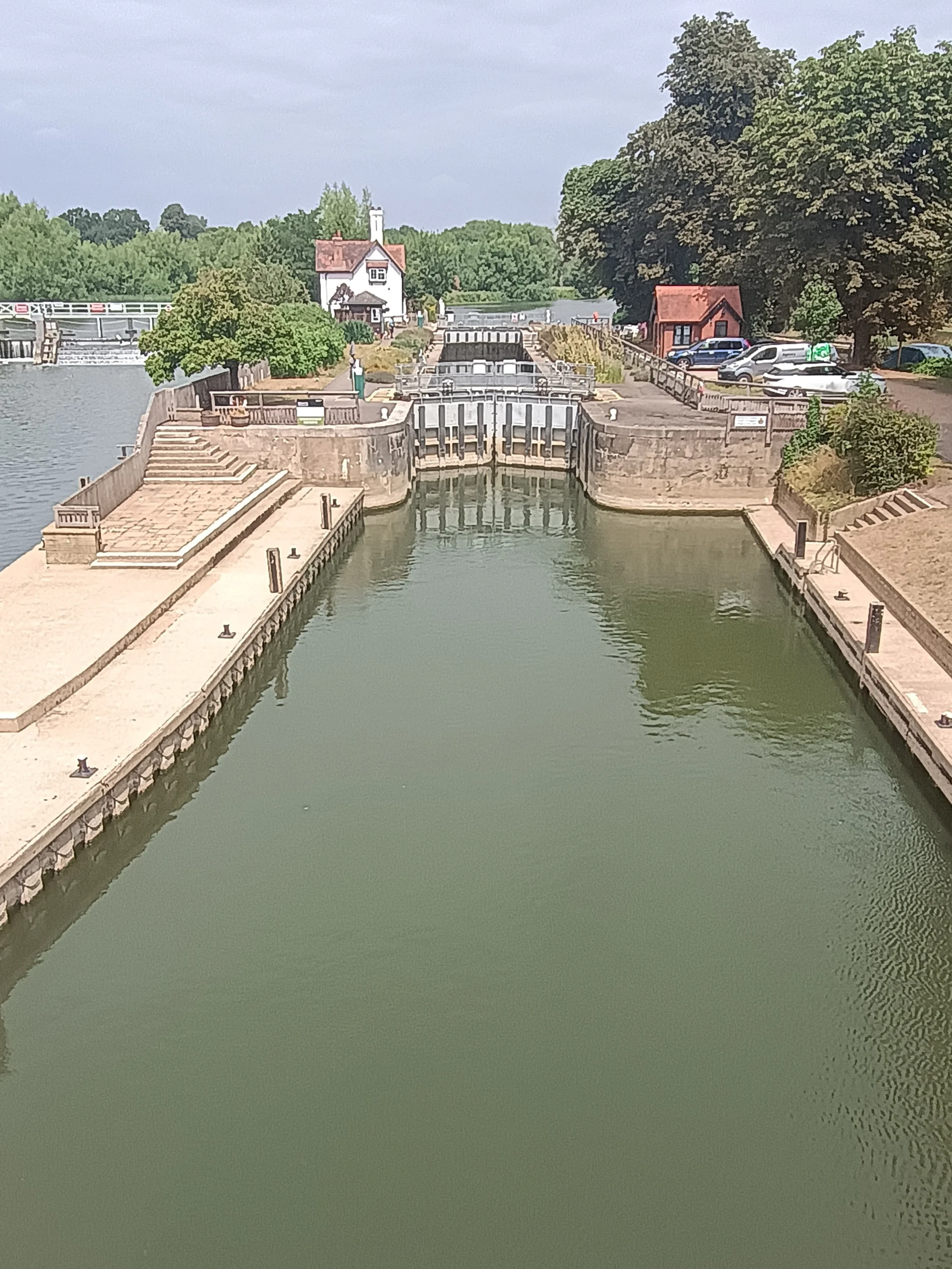
The journey was an easy one. We only had to negotiate two locks – Cleeve and Benson – giving our guests a gentle introduction to lock duty, with the promise of four locks waiting for them on the return trip on Monday. They also got their first taste of life at river pace, gliding through the countryside at four knots (about 4.6 mph / 7.4 km/h), with plenty of time to admire the scenery.

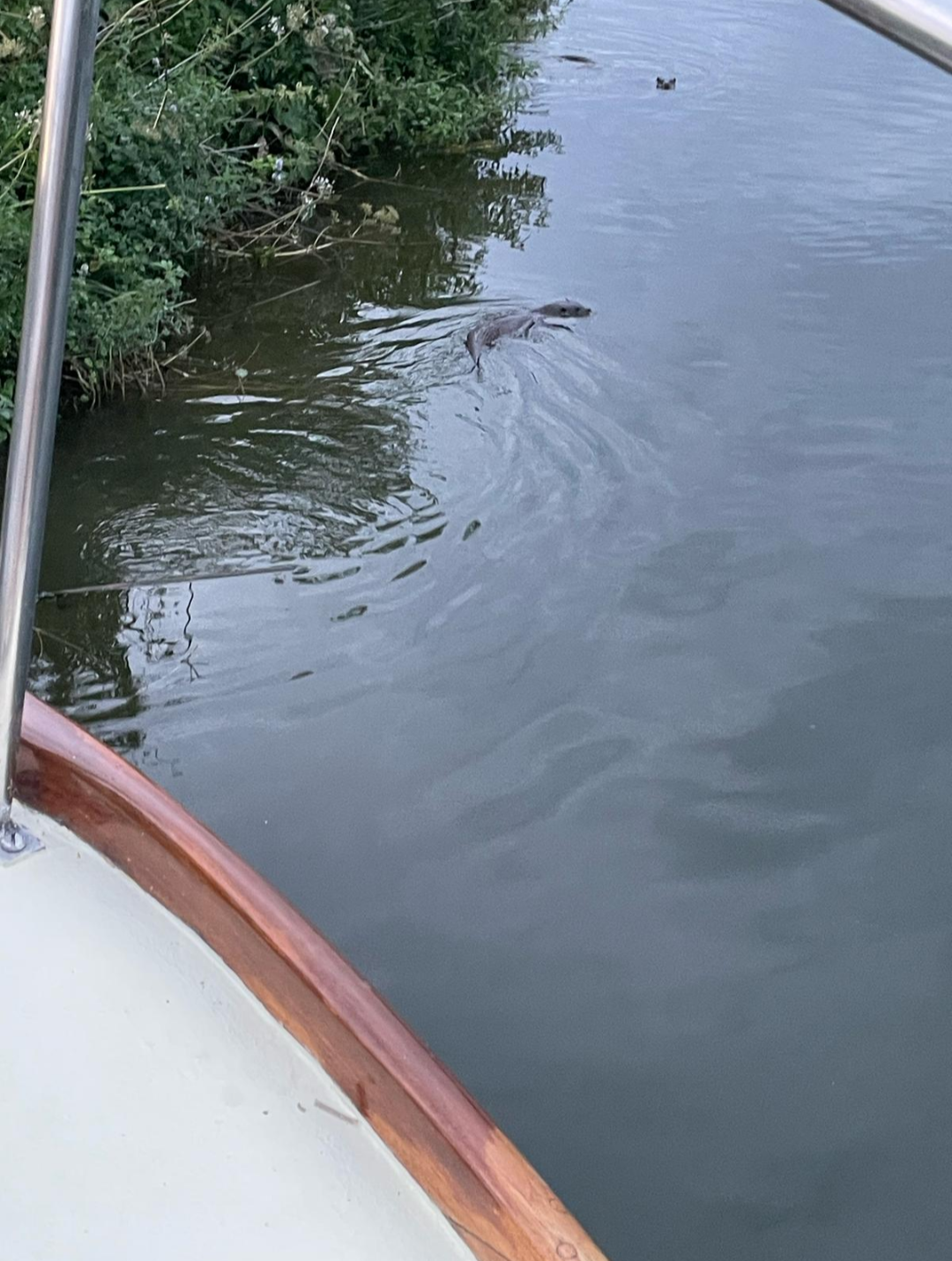
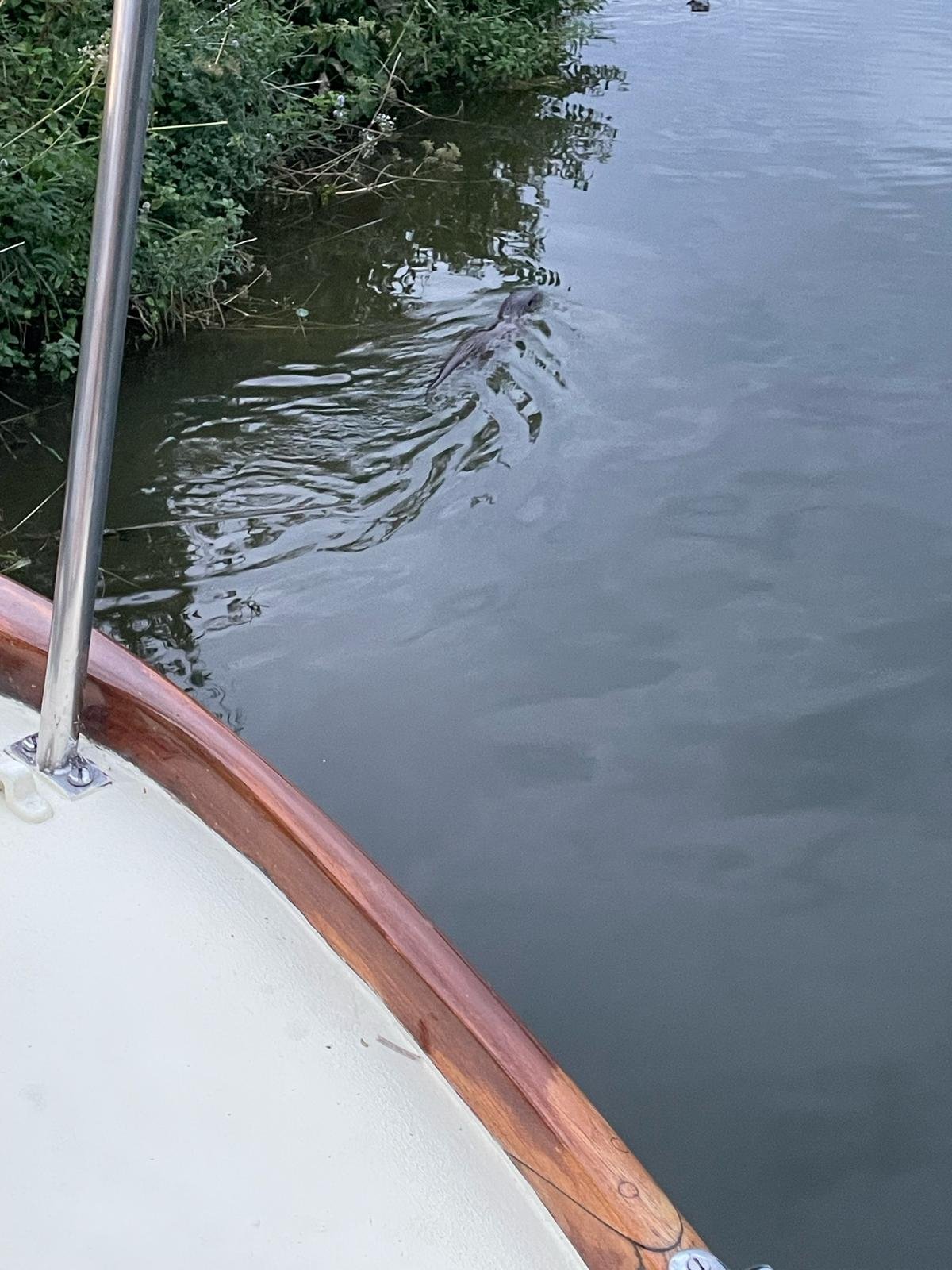
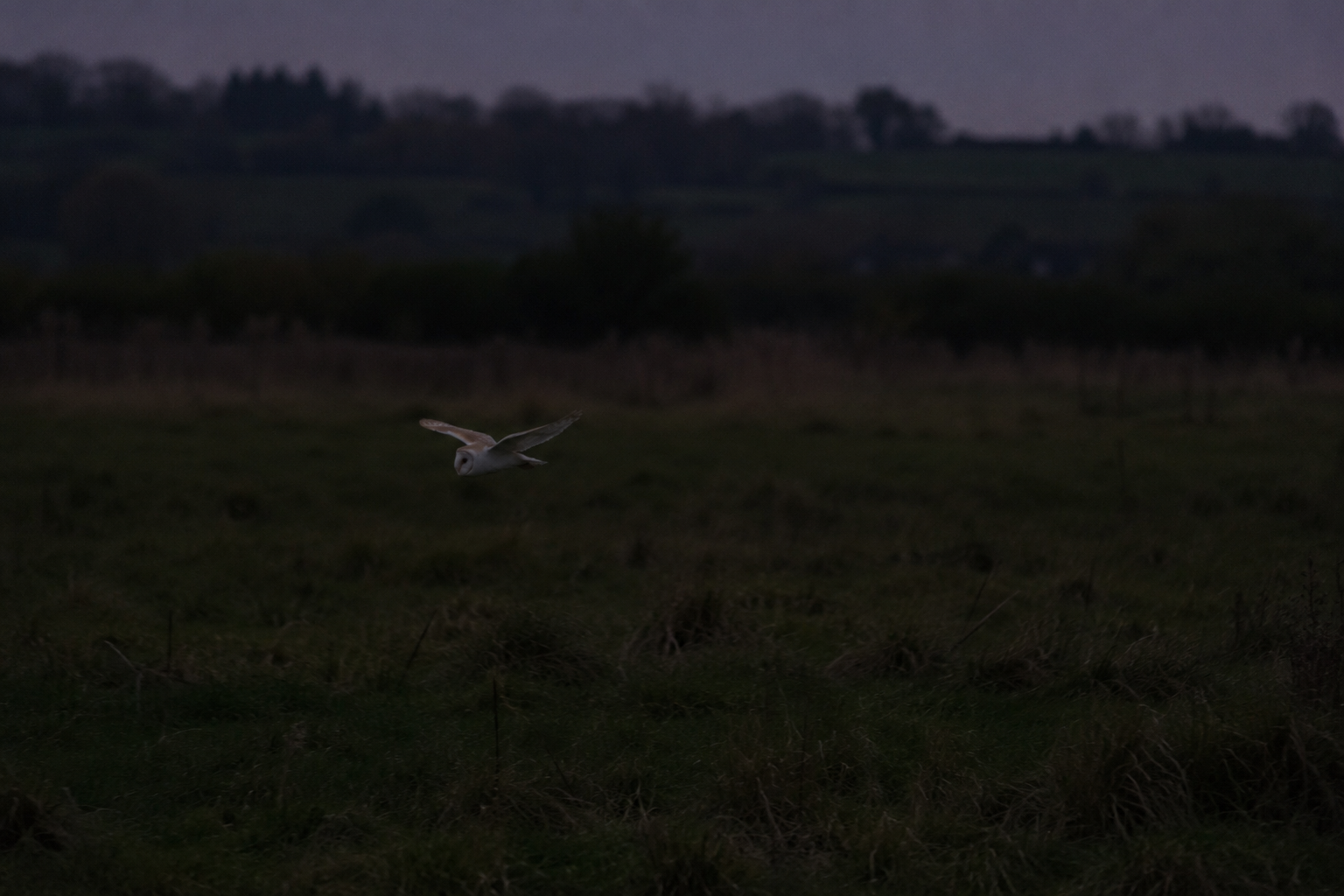
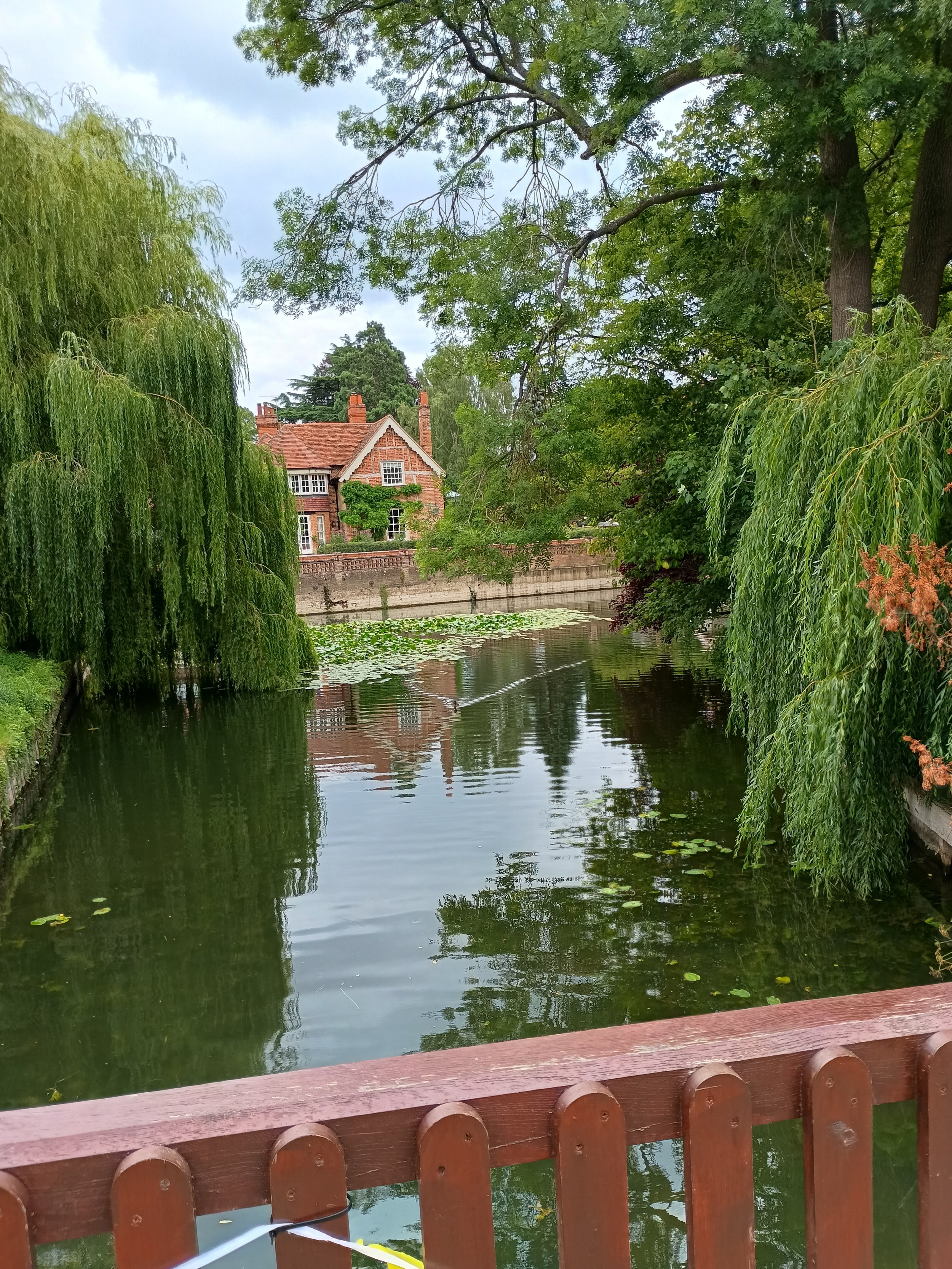
Shortly after Cleeve Lock, we passed a stretch of bank where we had moored overnight with friends last summer. It remains one of our favourite spots on the Thames. We shared stories of otters swimming around the boat at dusk and a magnificent barn owl silently hunting across the meadow as darkness fell. We promised ourselves we would return one day, hoping to witness the same magic again. And if not, simply to enjoy the peace, a beautiful sunset and a sundowner or two on the foredeck.

These are the moments we treasure most about boat life. They more than compensate for the less glamorous realities of boat ownership – varnishing, bilge cleaning, laundry, sanding, de-cluttering and, of course, more varnishing.

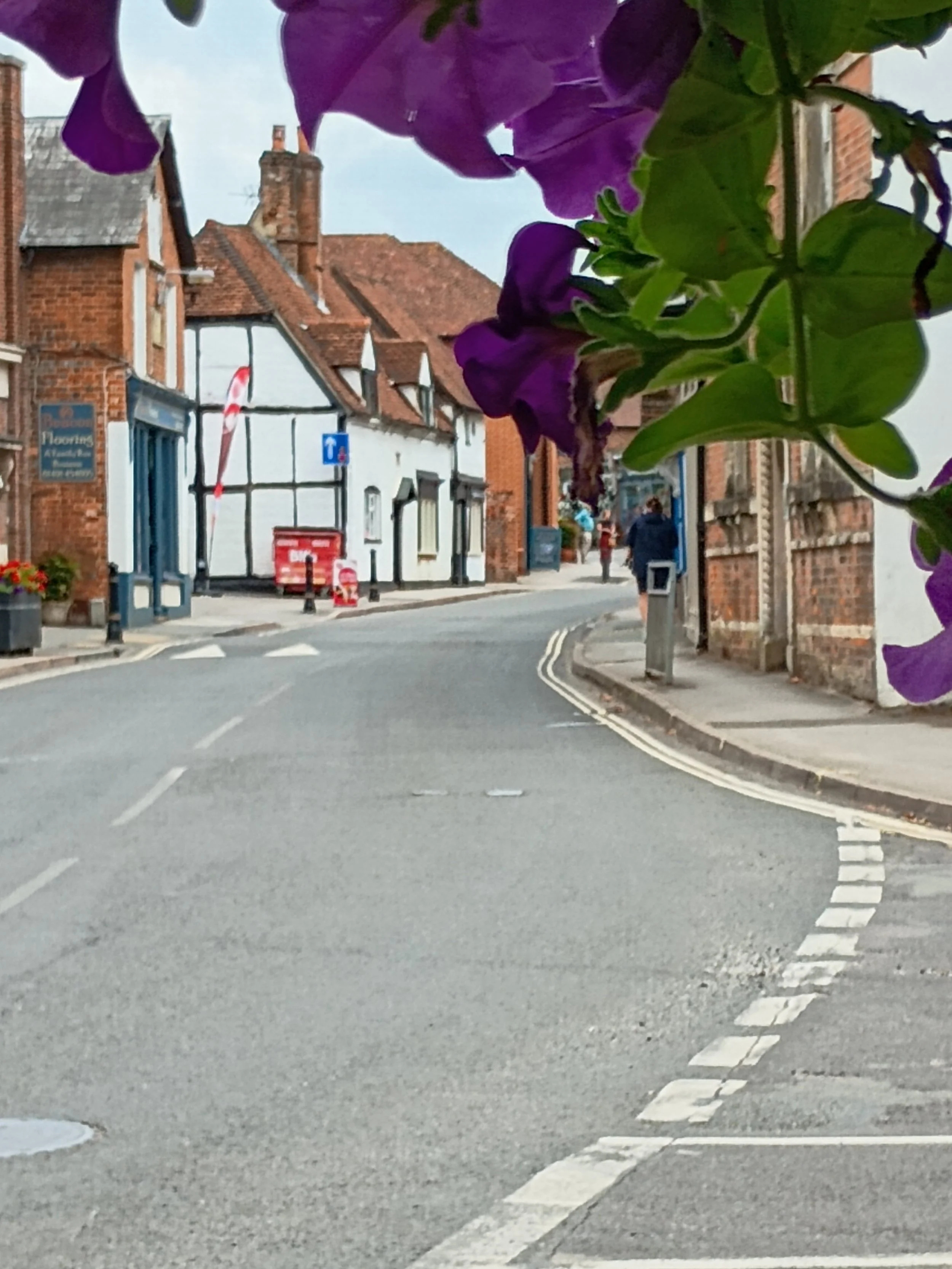
In less than three hours, we arrived in Wallingford and secured a mooring right in the town centre. Once settled, we set off to explore.

Like many towns along the Thames, Wallingford has a rich and fascinating history. Following William the Conqueror's victory in 1066, Wallingford Castle became one of the most important strongholds in England. The town flourished throughout the Middle Ages and later played an important role in ending the civil war, known as The Anarchy when the Treaty of Wallingford was signed there in 1153.

The centuries that followed were less kind. The Black Death reduced the population, and the town gradually fell from royal favour. However, Wallingford found itself at the centre of events once more during the English Civil War, becoming the last Royalist stronghold in Berkshire. After a sixteen-week siege, the town finally surrendered, and Oliver Cromwell ordered Wallingford Castle to be destroyed to prevent it being used in any future uprising.

Today, Wallingford is a thriving market town, full of independent shops, cafés and narrow side streets waiting to be explored (not by bicycle today). It also appears to have a remarkably busy Post Office. At least, that's what we thought until we discovered that most of the activity was centred around pints rather than parcels.

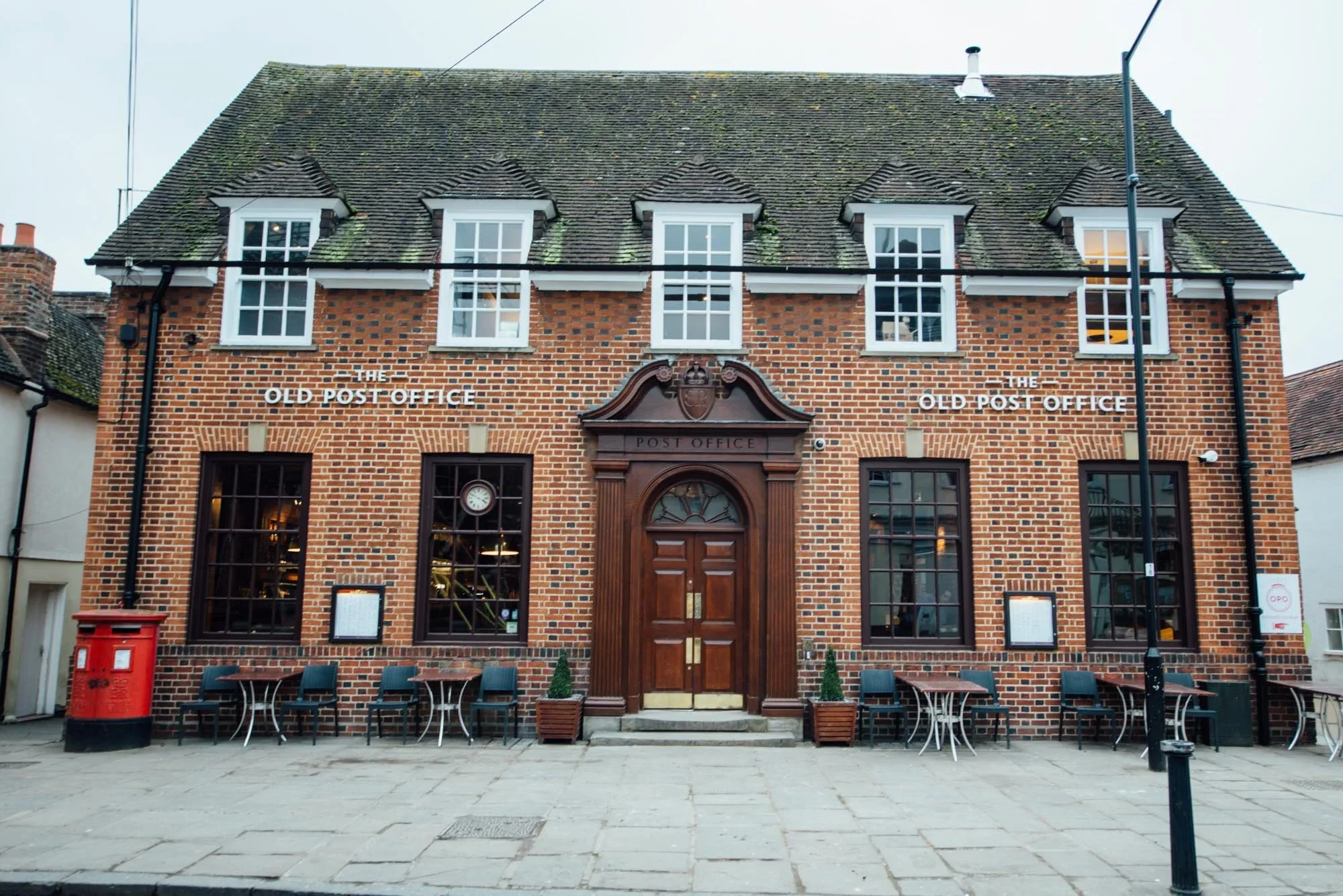
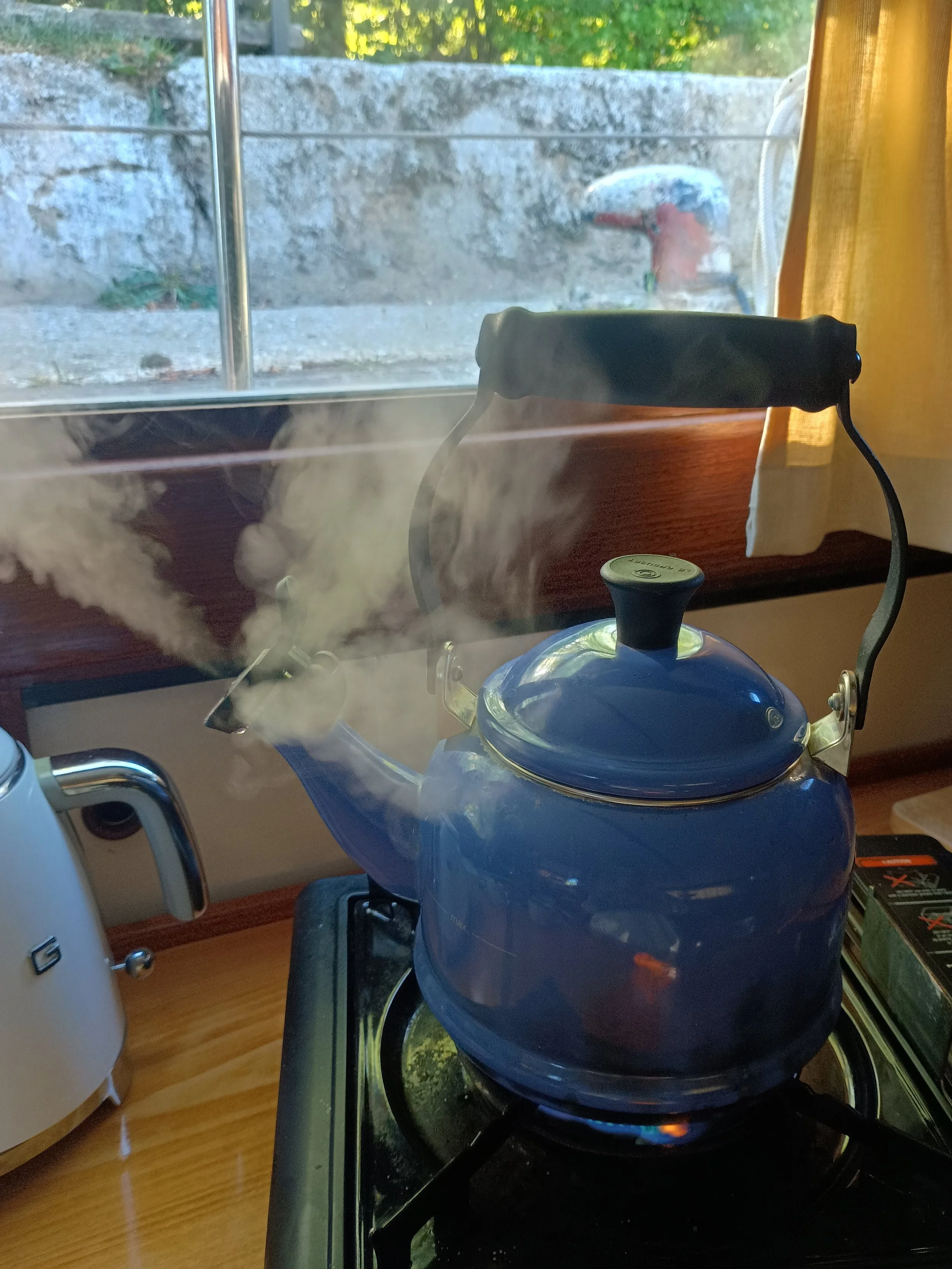
The Old Post Office, located just off the Market Square, occupies a Grade II listed building that once served as the town's main Crown Post Office. Following its closure in the late 1990s, it was transformed into a bar and restaurant. Many of the original features remain, including the Victorian counter, while a traditional red post box still stands proudly in the courtyard outside. Needless to say, it quickly earned a place on our Wallingford itinerary.

The evening passed pleasantly, catching up on family news, sharing stories and enjoying a delicious dinner and few drinks before retiring to Deux Poissons for the night.

Tomorrow, we turn downstream and begin our leisurely journey back towards Reading.

Through the Goring Gap

With a sunny and dry May Bank Holiday weekend forecast, we knew we had to make the most of it. Living in the UK has taught us that good weather is never to be taken for granted. To make the weekend even better, family were joining us for an overnight stay on Saturday, wherever we happened to end up. After a little discussion, we settled on Goring-on-Thames for Saturday night and Wallingford-on-Thames for Sunday, before returning to Reading on the Monday morning.

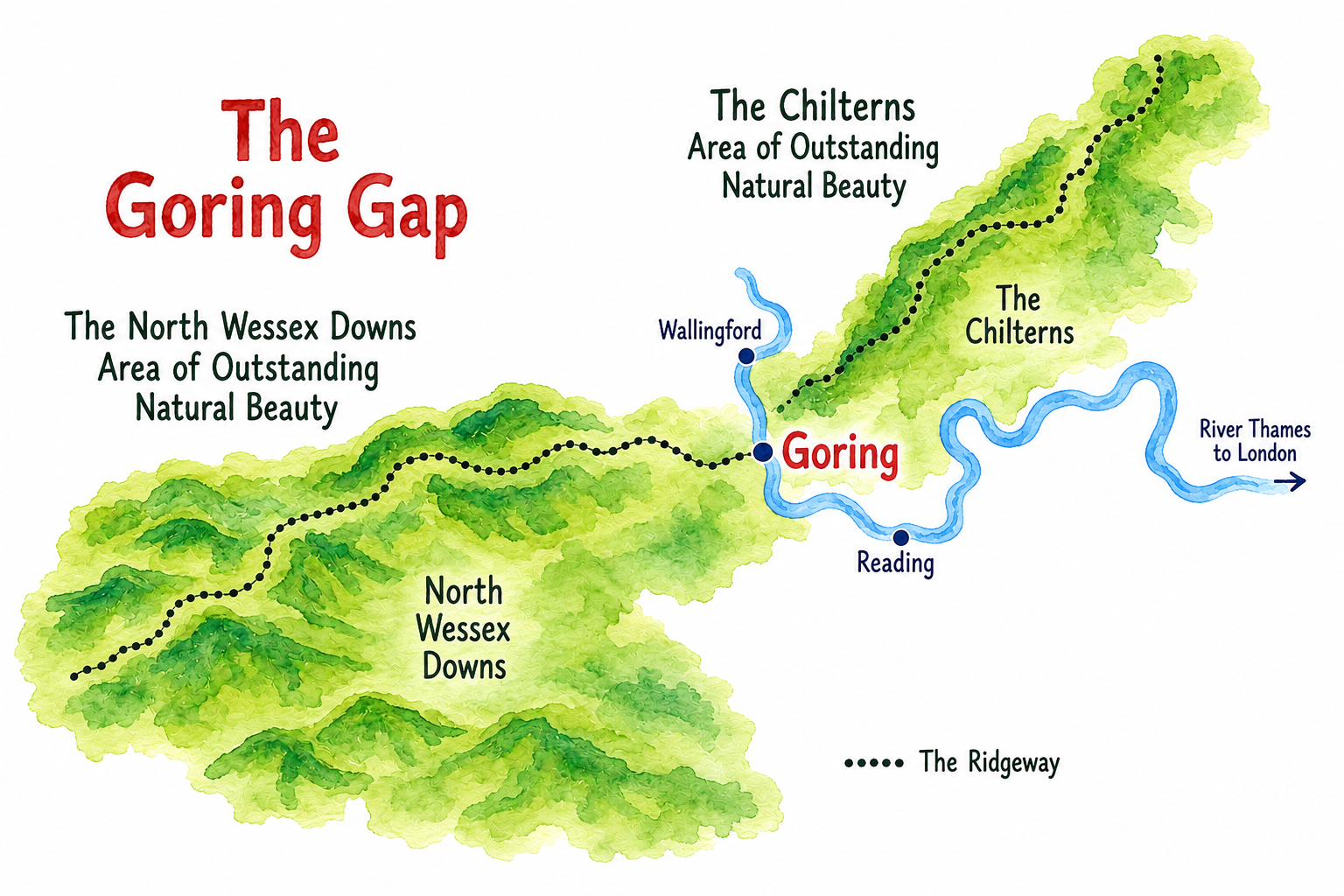
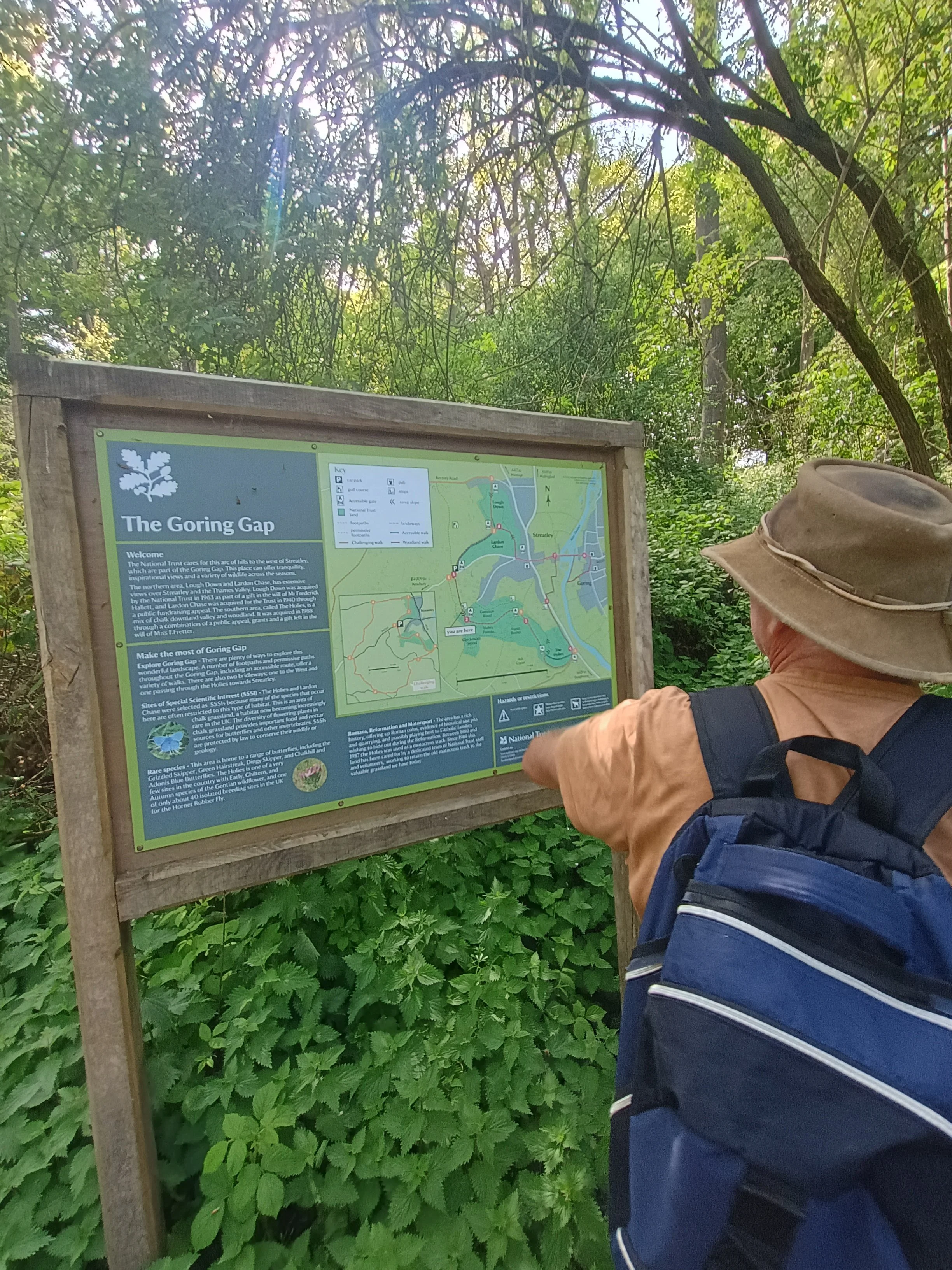
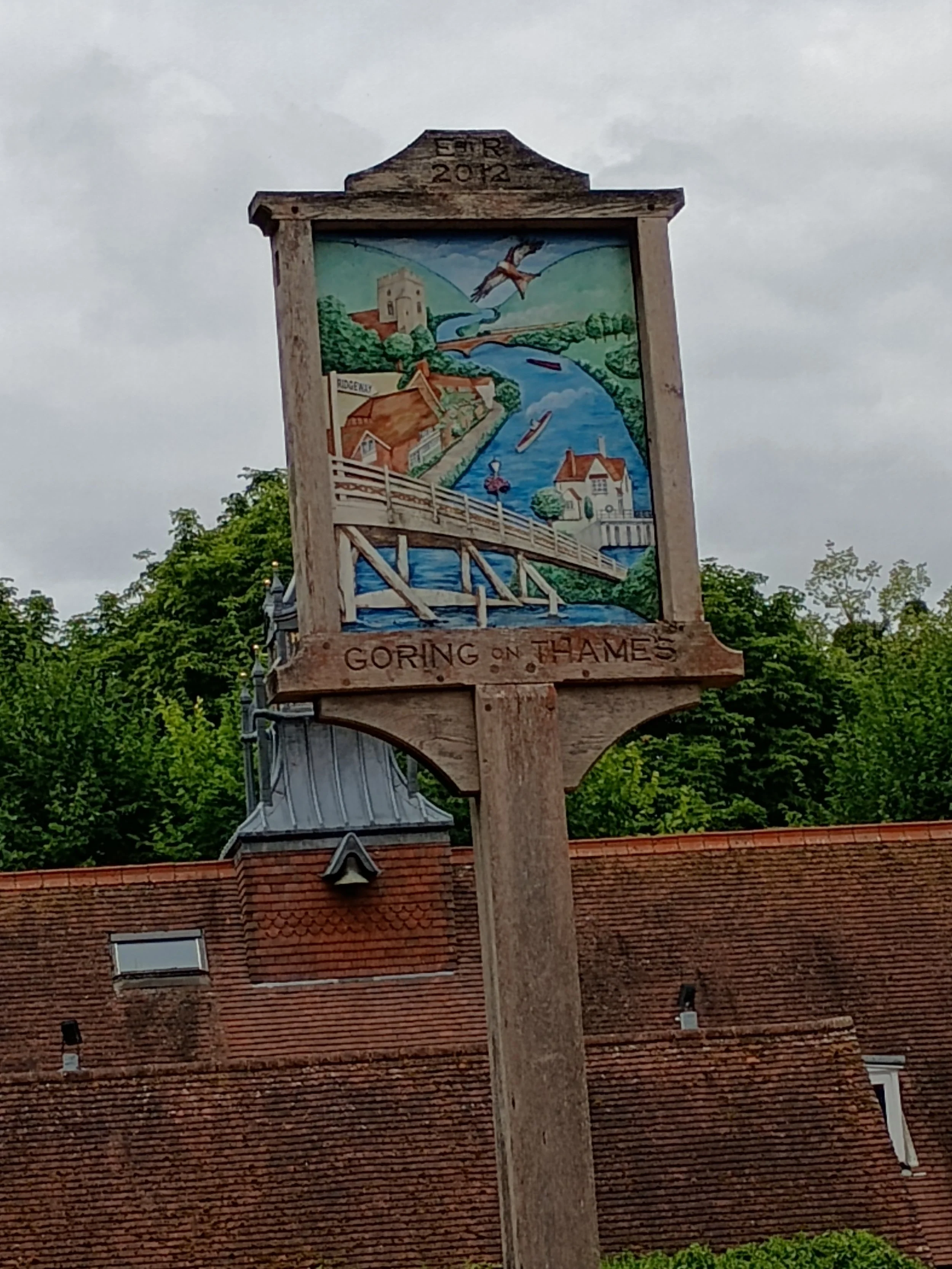
Goring is one of our favourite stretches of the Thames. Not only is it surrounded by beautiful countryside, but it is also steeped in history. Thousands of years ago, at the end of the last Ice Age, meltwater forced the River Thames through the chalk hills here, carving out what is now known as the Goring Gap. This dramatic landscape changed the course of the river, directing it through Berkshire and onwards towards London.

Today, the Berkshire Downs rise to the south while the Chiltern Hills stand to the north, creating a spectacular natural gateway through which the Thames flows. It is definitely an area of natural beauty and stunning to view from the deck of the boat when underway.

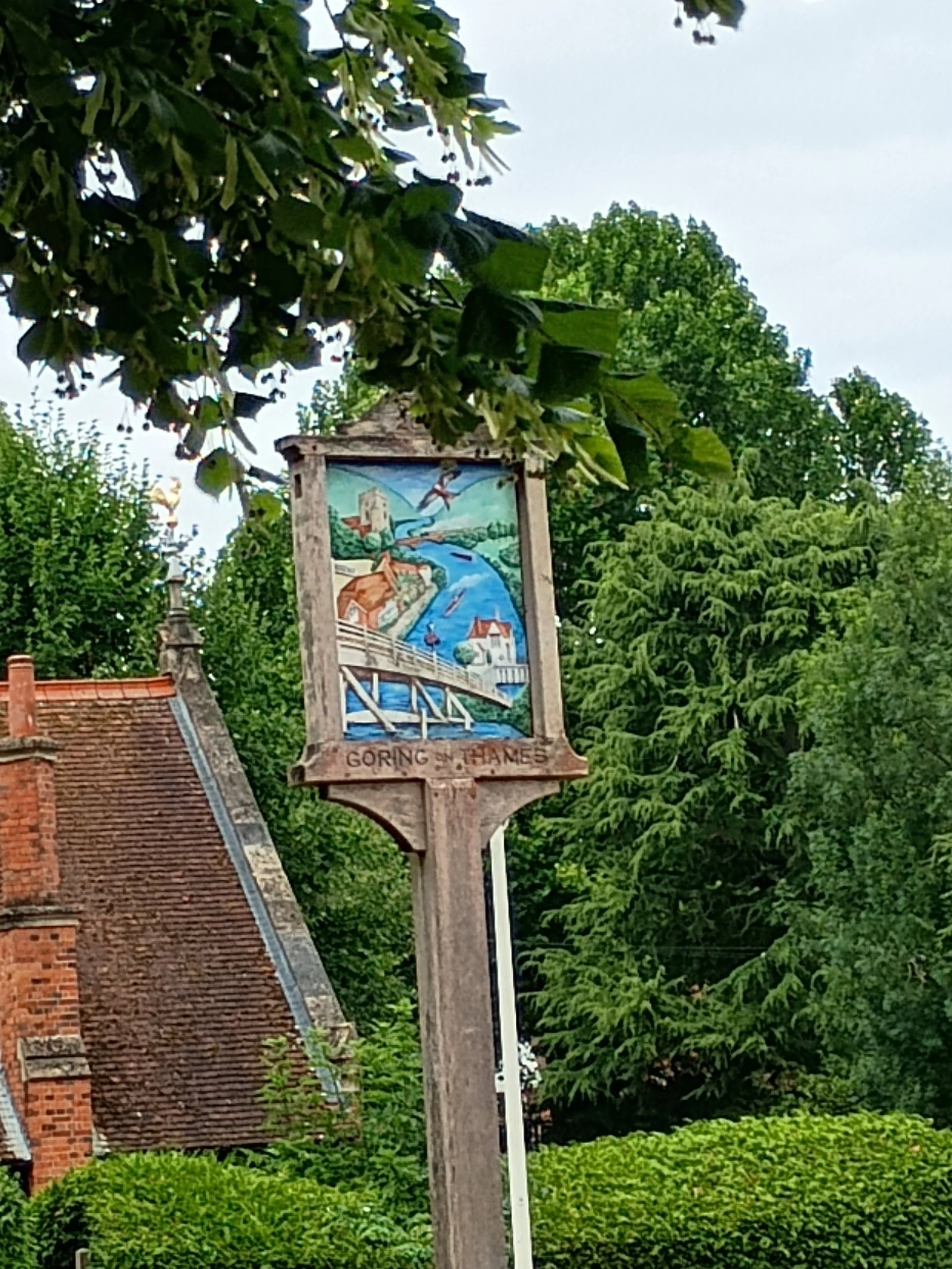
On either side of the river sit the twin villages of Goring and Streatley, linked by a bridge.

We always enjoy spending time here. There are quiet lanes to cycle, fascinating old houses to admire and beautiful churches tucked away. There are a few excellent pubs (four if I remember correctly) and these we appreciate even more after a day exploring on two wheels.

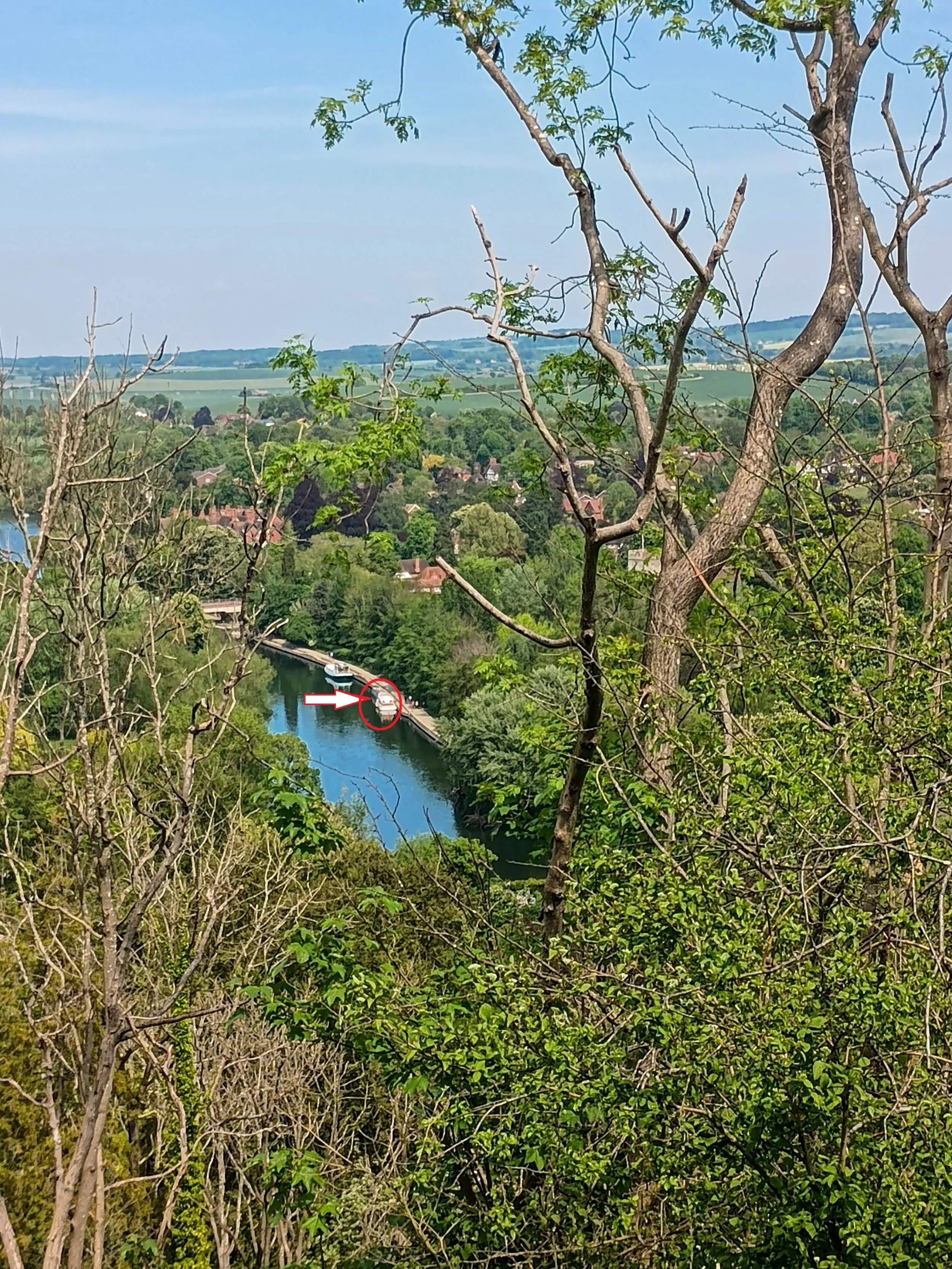
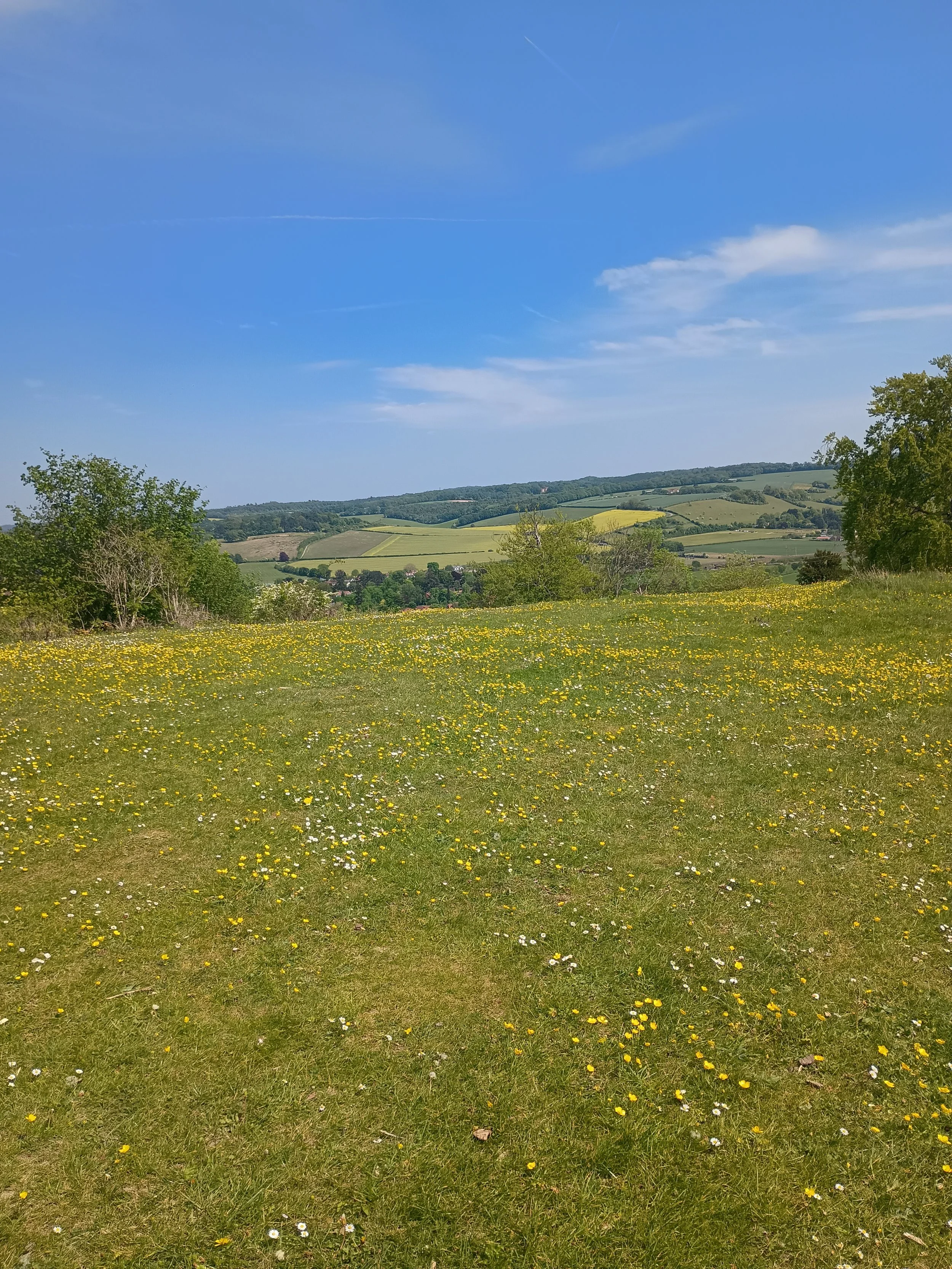
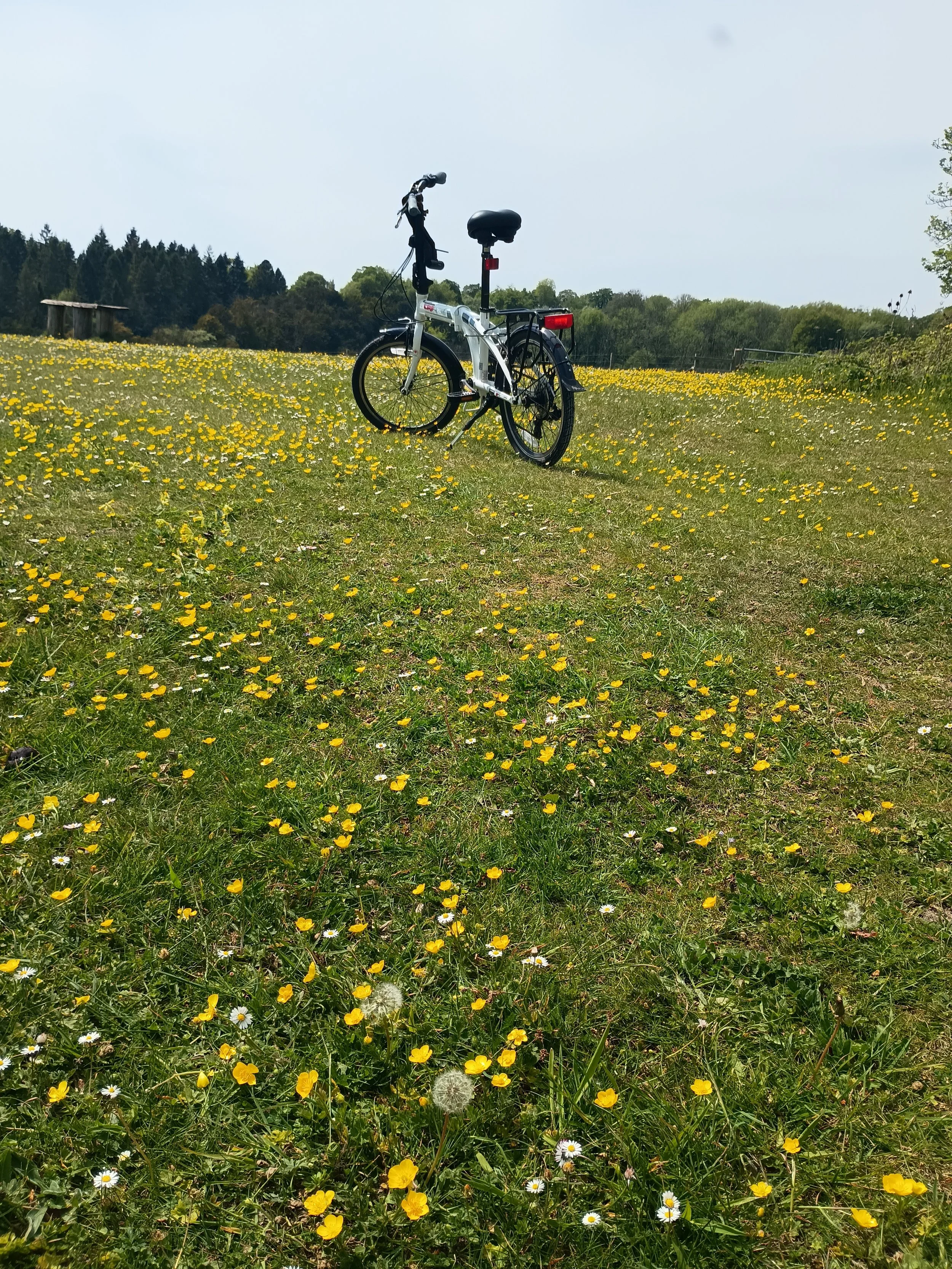
This weekend we decided to put our fitness to the test by cycling up the side of the Gap above Streatley. To be completely honest, "cycling" may be stretching the truth slightly. Much of it involved pushing our bikes up the steep chalk hillside while questioning our life choices. The climb was hard work, but as often happens, the reward was waiting at the top. The views across the Thames Valley, the Chilterns and the Berkshire Downs were simply breathtaking and more than justified the effort.

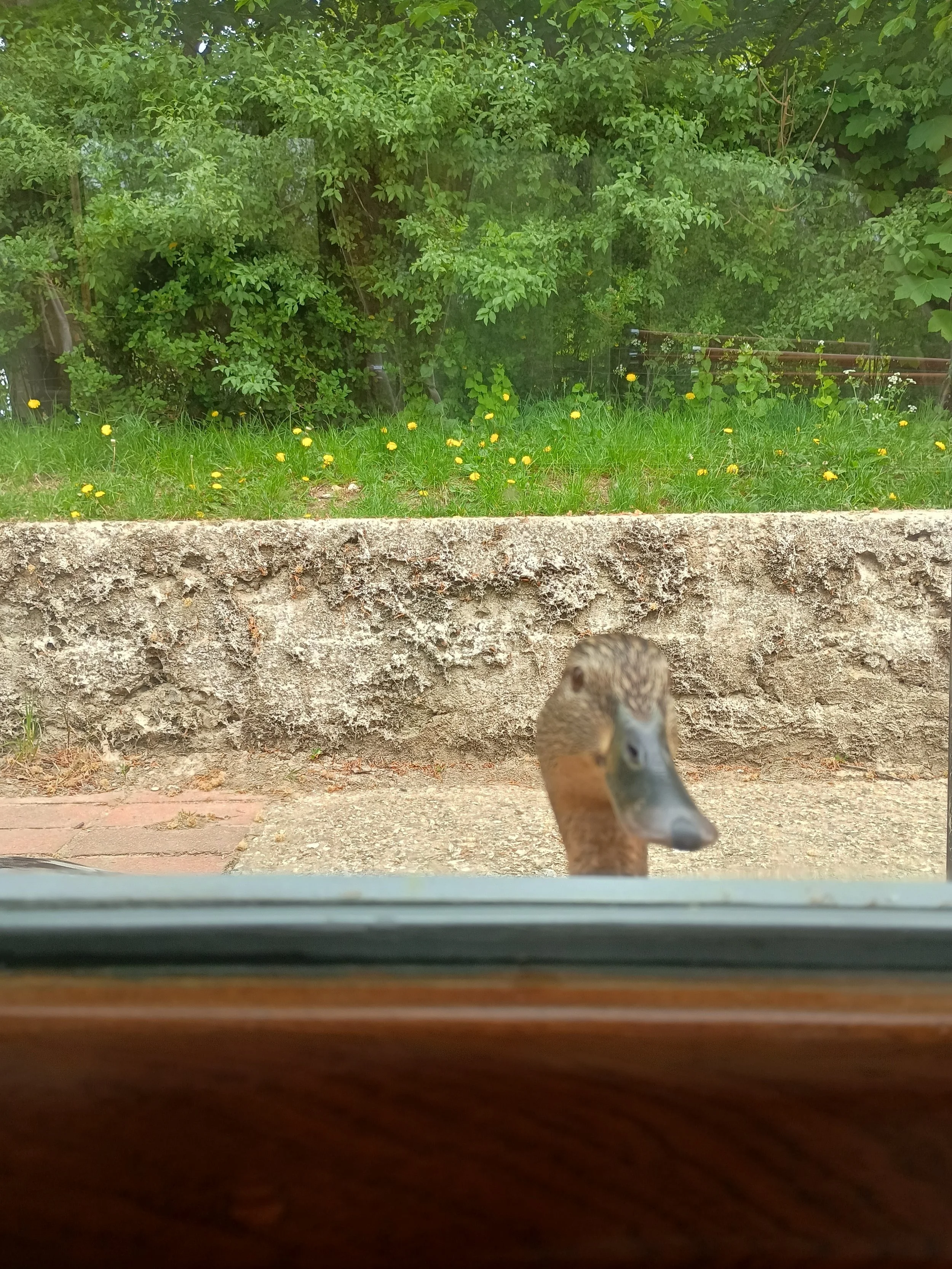
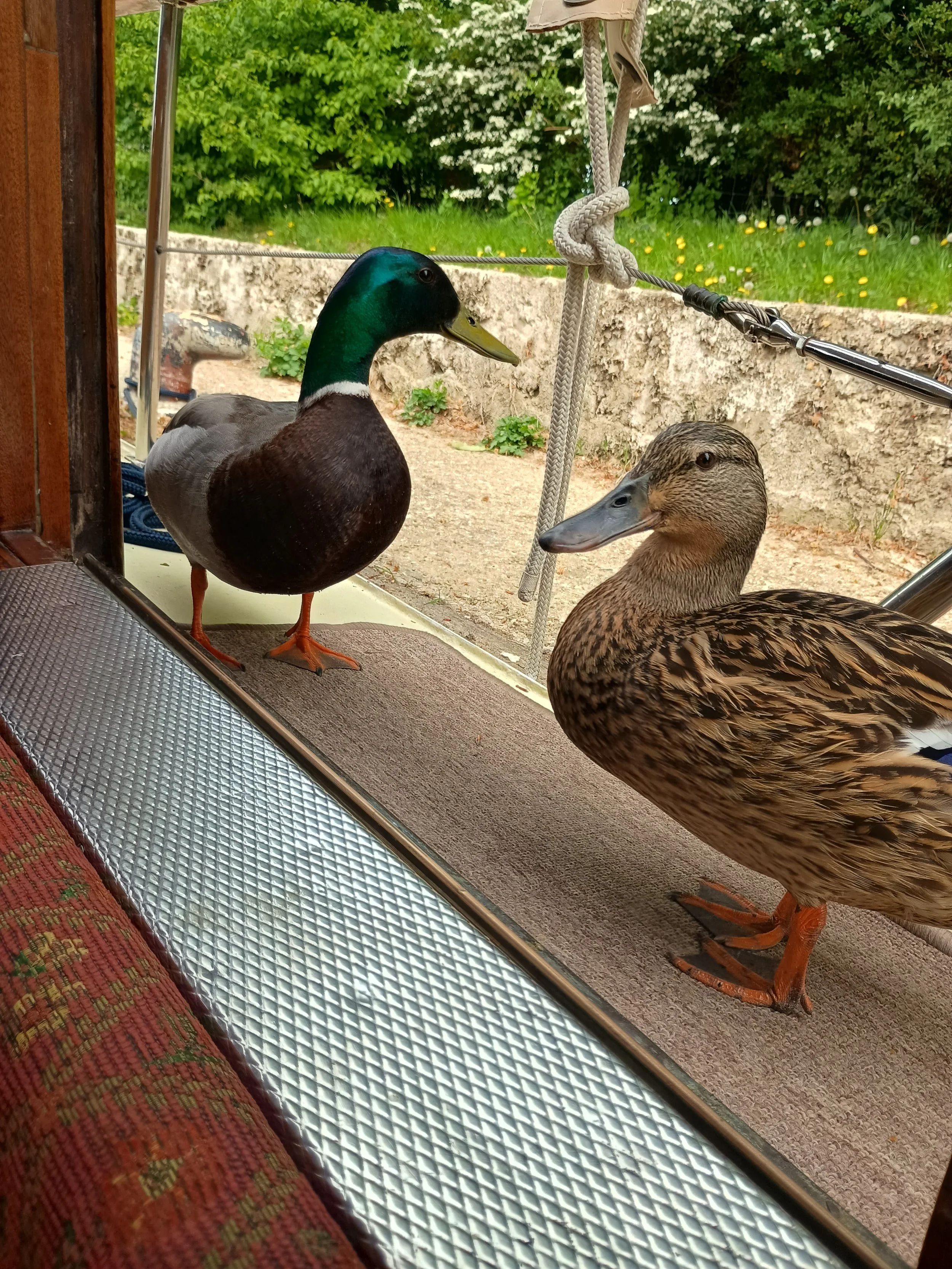
After a hair-rising speedy cycle back down the hillside, we returned to the boat and enjoying a well-earned shower and a short rest, dozing in the sunshine and reading. Word must have got around that we carry duck and swan food on board because before long we had two sweet little duck visitors venturing on to the deck of the boat. They became increasingly brave, getting ever closer in search of a snack.

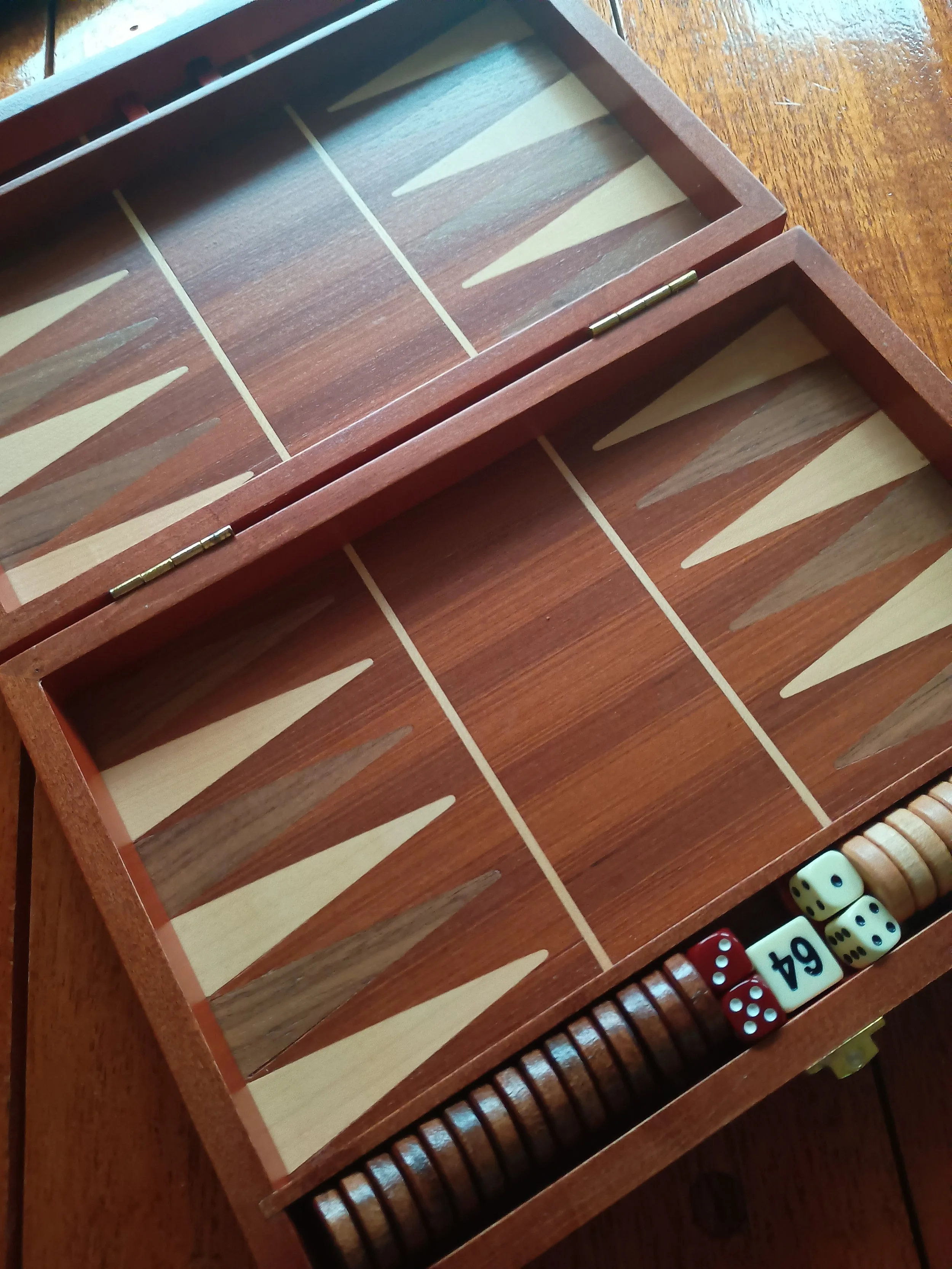
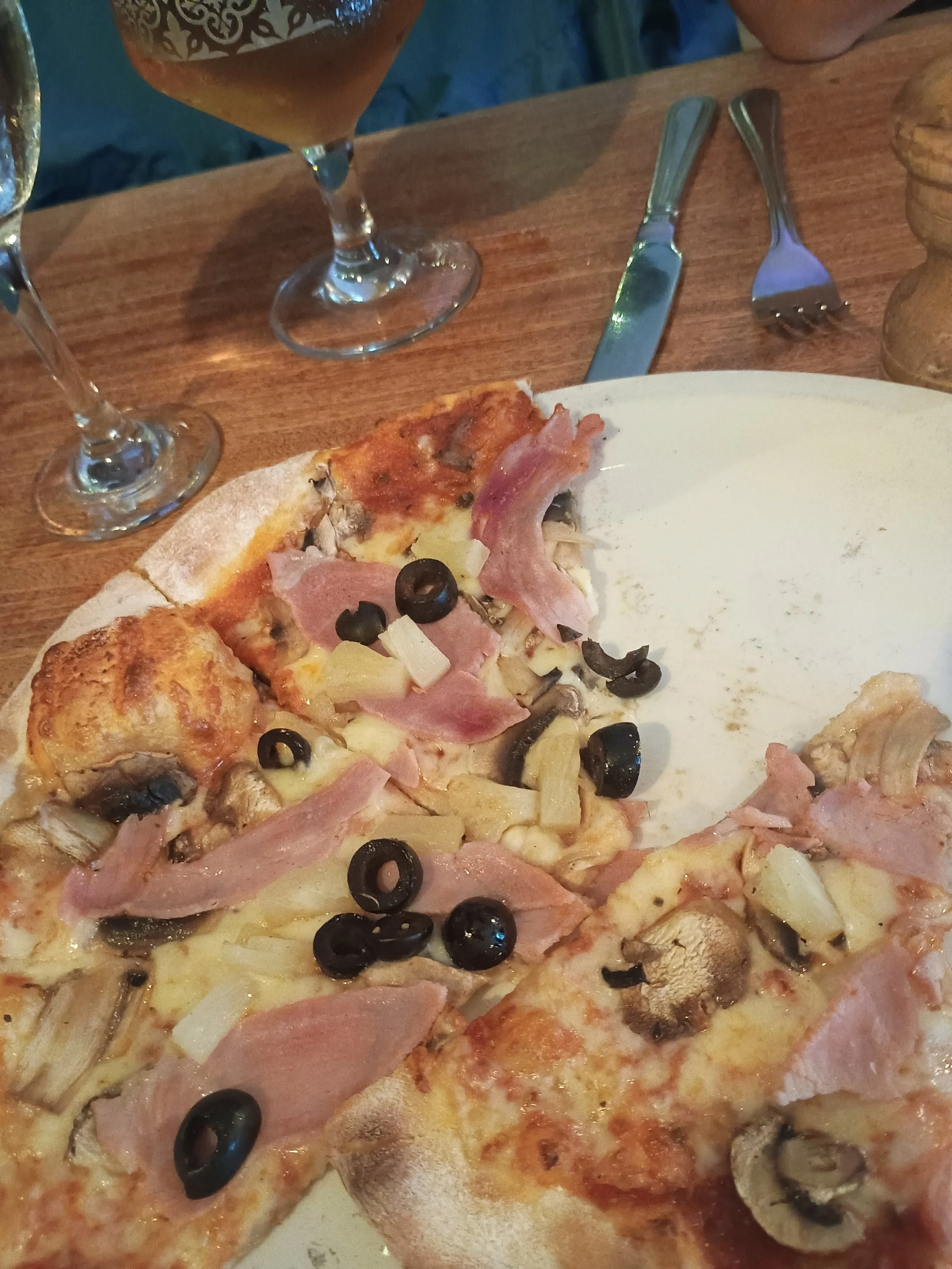
That evening, we cycled back into Goring and popped into one of our favourite pubs for a delicious pizza and a well-earned drink. Afterwards, it was back to our floating home for a quick backgammon challenge before turning in for a very early night.

Family will be joining us in the morning as we continue upstream, through the Goring Gap and onto Wallingford. We are looking forward to sharing one of our favourite stretches of the Thames and enjoying the journey through the eyes of others.

Tonight, however, the combination of sunshine, fresh air and a long day outdoors has caught up with me. My eyes are ready to close.

She survived the winter!

We’re back from our annual “winter escape” — six glorious months in South Africa. We know how lucky we are to swap the UK’s long, cold, soggy winter for Cape Town sunshine, beaches, Don Pedros (a popular South African alcoholic milkshake) and proper summer living. Even better, we still have family and long-time friends there, so it’s not just an escape — it’s a reset. And thanks to remote working, we can just about pretend this is all perfectly normal behaviour!!

Of course, leaving the boat behind for half a year in unpredictable British winter weather is never completely stress-free. Our strategy is simple: do absolutely everything we can… and then cross our fingers.

Preparing the boat for winter is not a quick job. It’s a full three-day operation. If it can be moved, it gets vacuum-packed. Curtains come down, cushion covers come off, mattress covers disappear, and every bit of linen and clothing gets washed and dried. Even the books aren’t spared — they go into vacuum bags too. Moisture traps are tucked into lockers everywhere, and we leave the dehumidifier ready to run once a week for a few hours. By the end of it, the boat looks like she’s preparing for a very organised expedition to the moon.

She’s stored safely on the hard under a full canvas cover, and for the past two years we’ve trusted Reading Marine Services to take care of her while we’re away. They lift her out, winterise everything properly (including treating the water tanks, checking batteries and running the dehumidifier), and then reverse the whole process before we return — putting her back in the water, replacing the drinking water, and making sure the engine and generator are ready to go. It’s a huge reassurance while we’re thousands of miles away enjoying sunshine.

So when we get back, our job is simply to unpack the vacuum bags, rediscover the many moisture traps I somehow miss every year (they continue appearing for weeks), and settle back into boat life again.

I always find the winterising process long and slightly tedious, and I’m often tempted to skip the trickier jobs — especially taking down the curtains. But every time we return and hear just how wet and damp the UK winter has been, I’m very glad we made the effort. Once again: no mould, dry wood, and a fresh-smelling boat waiting patiently for us.

Now we’re ready for summer on the river again — and we can’t wait …..

Just one more small job .....

Boat jobs are never done….

We cleaned up and locked the boat down for the 6 months of winter. We are all packed up and ready to leave for a 12 hour flight to Cape Town, South Africa. I turned my back for a few minutes. Patrick decided he had just ONE more small job ……
It’s going to be beautiful when it’s all done, but did it really have to happen as we were about to leave??

A reflection on our summer travelling the Thames

We spent the summer of 2025 exploring the River Thames, cruising slowly between historic towns and peaceful stretches of countryside. It was quieter than we expected, allowing us to moor in beautiful locations and spend our days exploring on foot or by bicycle.

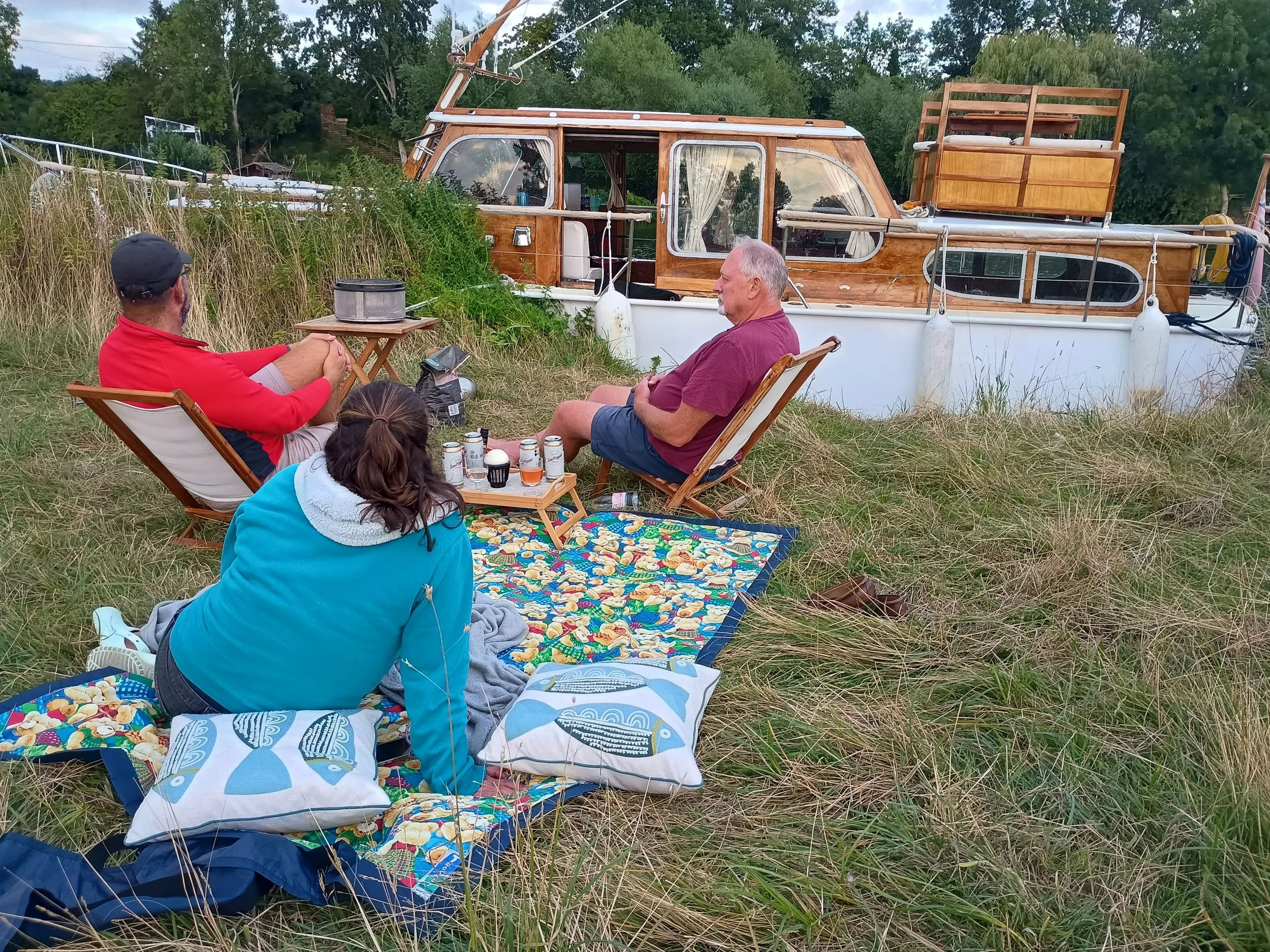
Evenings were often spent around the barbecue, enjoying good food, good company and more than a few sundowners as the sun dipped below the horizon. Friends joined us for parts of the journey, making an already special summer even more memorable.

It was a season of slow travel, simple pleasures and unforgettable moments aboard Deux Poissons. We cannot wait to do it all again.

Here are a few snapshots of our special time

Through Teddington and onto London

It was another early start today, and 10 or 11 locks. We plan to reach Teddington at about 14h00 and will stay overnight there. I was quite emotional about it.
For years we had discussed this trip; the UK leg and then onto France. It felt like it was never going to happen but we persevered and in August 2024 we said goodbye to Portsmouth, made our way round the bottom of England and up the Thames, through London, reaching the non-tidal part of the river Thames and Teddington, on Friday 30 August 2024.
Now as a complete co-incidence, 1 year later to the day, we are back in Teddington on our way down through London.
It has been a mixed year and I didn’t want to spend too much time unpacking it all, but needless to say it felt like we had been on the Thames River for much longer than 1 year!

The weather decided to co-operate and it turned quite sunny. The lock-keepers on the other hand all seemed to take the day off, so it was a full exercise day for me but its not too bad in the sunshine. We ate while underway and we got to Teddington with time to spare.

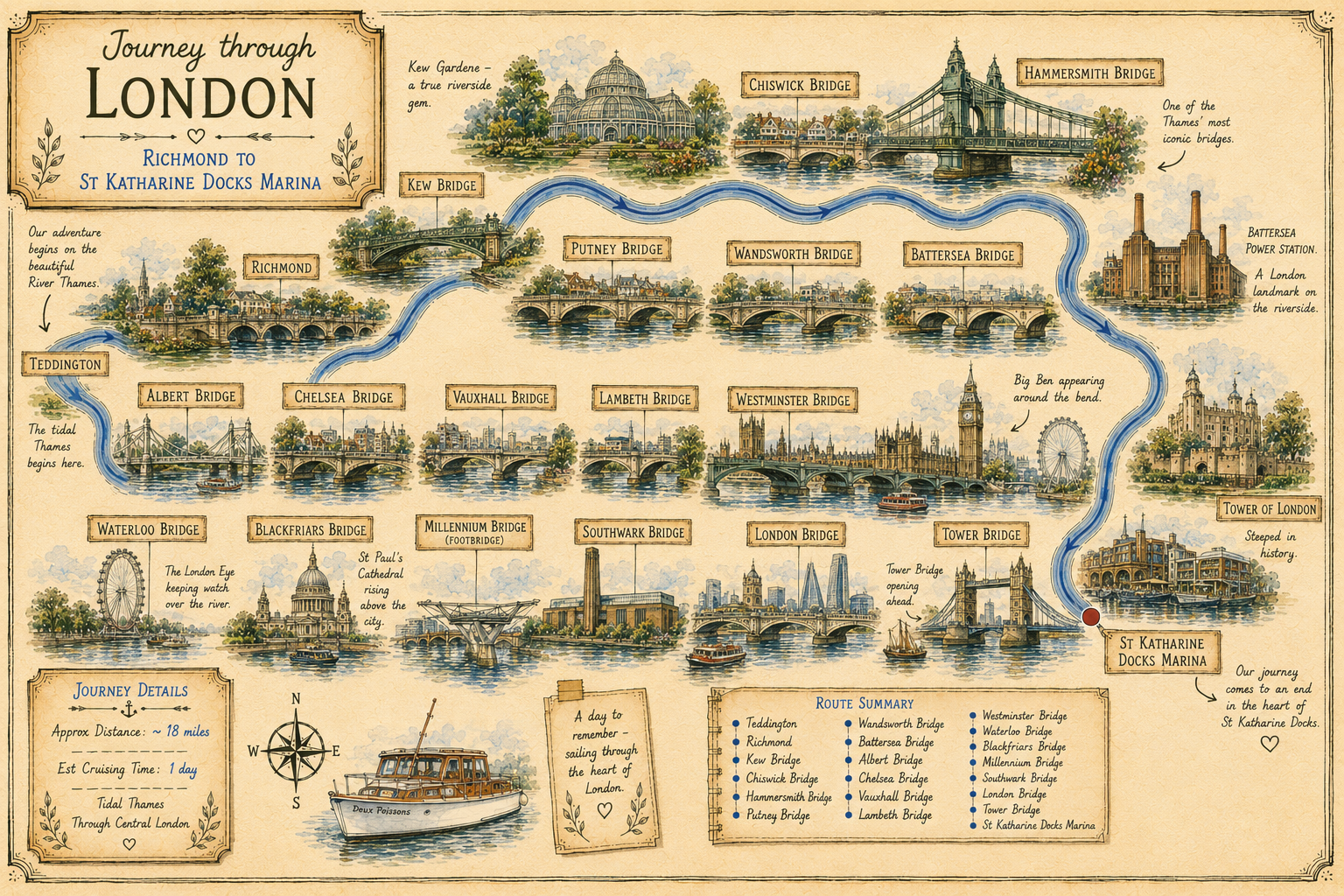
Patrick then asked “why are we waiting around?” He had a quick check on tides and times and suggested we keep going. We could get to Richmond lock for the tide (we can only go through that lock on high tide) and then it would be a few hours until we reached St Katherine’s dock. So we did just that. We had to hang around Richmond for about an hour for the tide and met up with a fellow boat festival traveller. He was heading to the show and so we travelled in tandem, which is always nice. We got to St Kat’s by about 19:00 and settled in. It was a lovely trip down, passing all the iconic buildings and parts of London that we only knew from “the land”. Seeing them from the water offered an entirely different perspective and was a fitting way to mark one year since our first arrival at Teddington.

Off to London Town and St Katherine's Dock

We were offered a space at the annual St Katharine Docks Classic Boat Festival this year. It is described as a yearly boating extravaganza with an expected 60 beautiful vintage and exquisitely preserved vessels. These include the war heroes, the Dunkirk Little Ships. This festival is something we have thought about doing for a few years now and we were keen to show Deux Poissons off in all her glory as well as have a close look at all those classic boats which have inspired us over the years.

It was going to be a 3 day trip to get to St Kat’s which is situated just below Tower Bridge and right in the centre of London (Oh and about 24 locks). Needless to say we were excited about this trip.

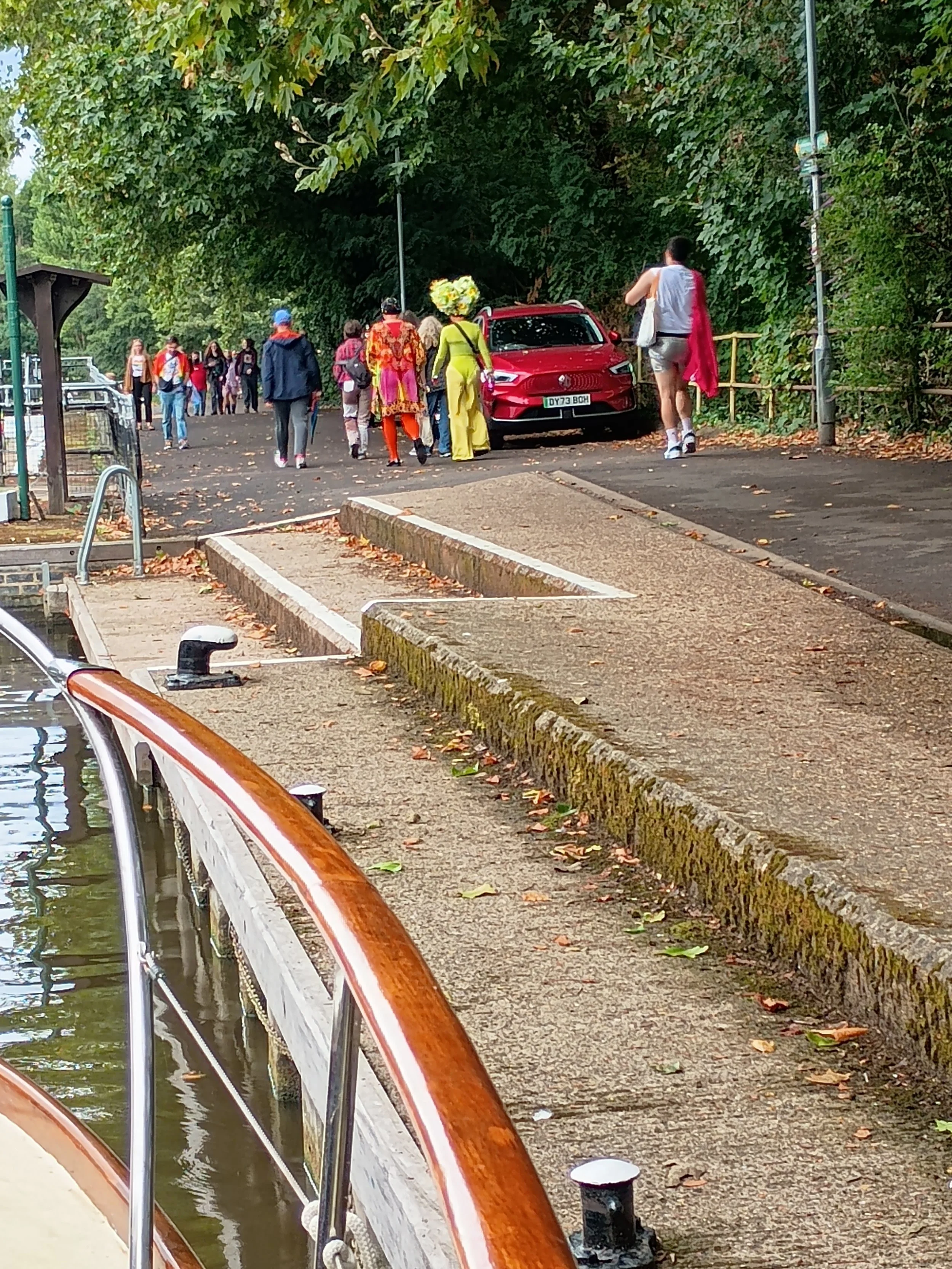
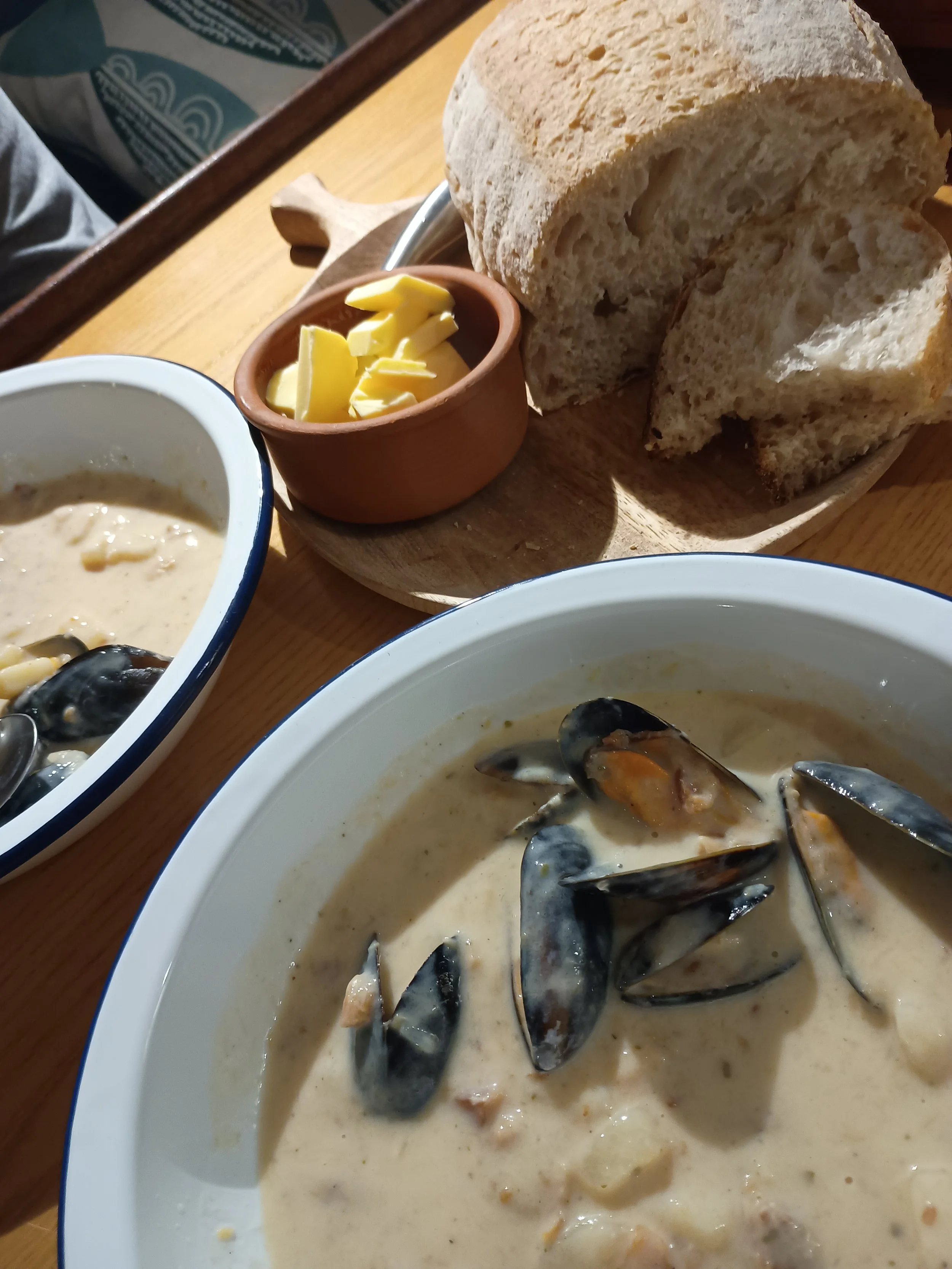
In true English style, day one was a grey miserable rainy day, only to be brightened up by a Pride Parade at one of the locks. It took about 12 hours to get from Reading to Maidenhead and through 11 locks, which fortunately were mostly operated by a lock-keeper. A seafood chowder was a welcome evening meal and an early night for the start of the next leg.

A birthday and a few days in Abingdon-on-Thames

We woke to a sunny quiet morning, perfect for a few minutes reflection on getting older and appreciating the fact that I could still step out onto the deck, with ease and enjoy my birthday morning. Not sure if I will be saying the same after celebrating my birthday later.
We set off for Abingdon-on-Thames and had a lovely run up the river. It took us about 4 hours to get there and only a few locks. The locks were mostly uneventful and were also manned by lock-keepers, so no need for me to be running back and forth opening and closing gates and sluices.
One lock we approached with that “joyous” feeling - “the gates are open, lock-keeper waited, its gonna be a quick and easy ride” until we got there. The lock was full of canoe boats. These rowers don’t tie onto the bollards. They kind of just cling to the (filthy) sides of the lock and to each other. And as the water pours in from the front, as the sluices are opened, it feels like a disaster is about to happen. Not sure what, but it could easily involve a canoeist being overturned, or driven back into our steel hull as we were right behind them. But none of that happened and the worst was waiting for the lot of them to row out of the lock. And also give us space to overtake them before the next lock. Which we did, apologising for the wake behind us as we got past them as quick as we could.
Once in Abingdon we found a spot on an open grassy bank, with only a few minutes walk into town and we got the boat all settled in. I am pleased to say that no irate canoeists ever arrived in Abingdon and I am not questioning as to why that was.

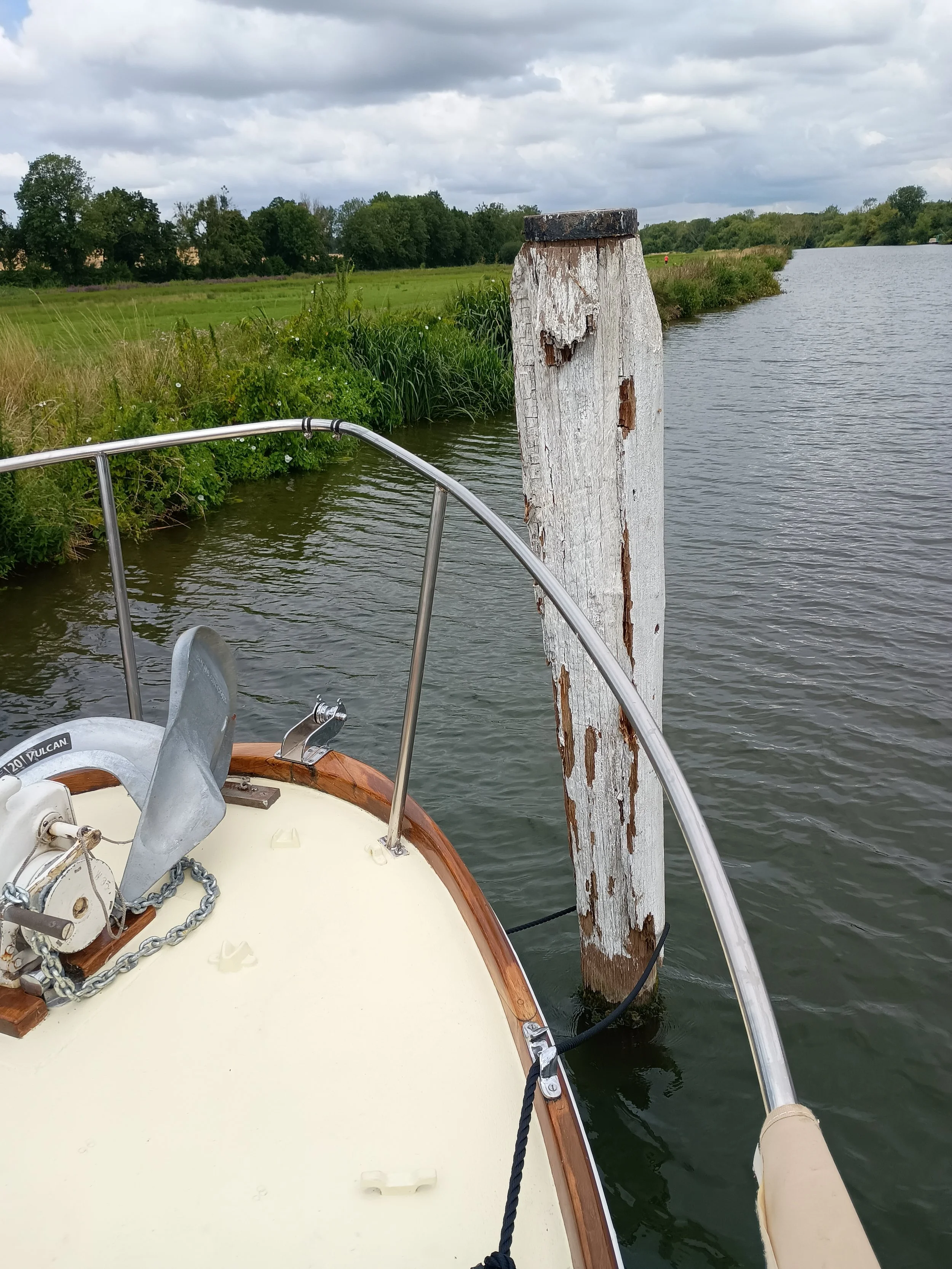
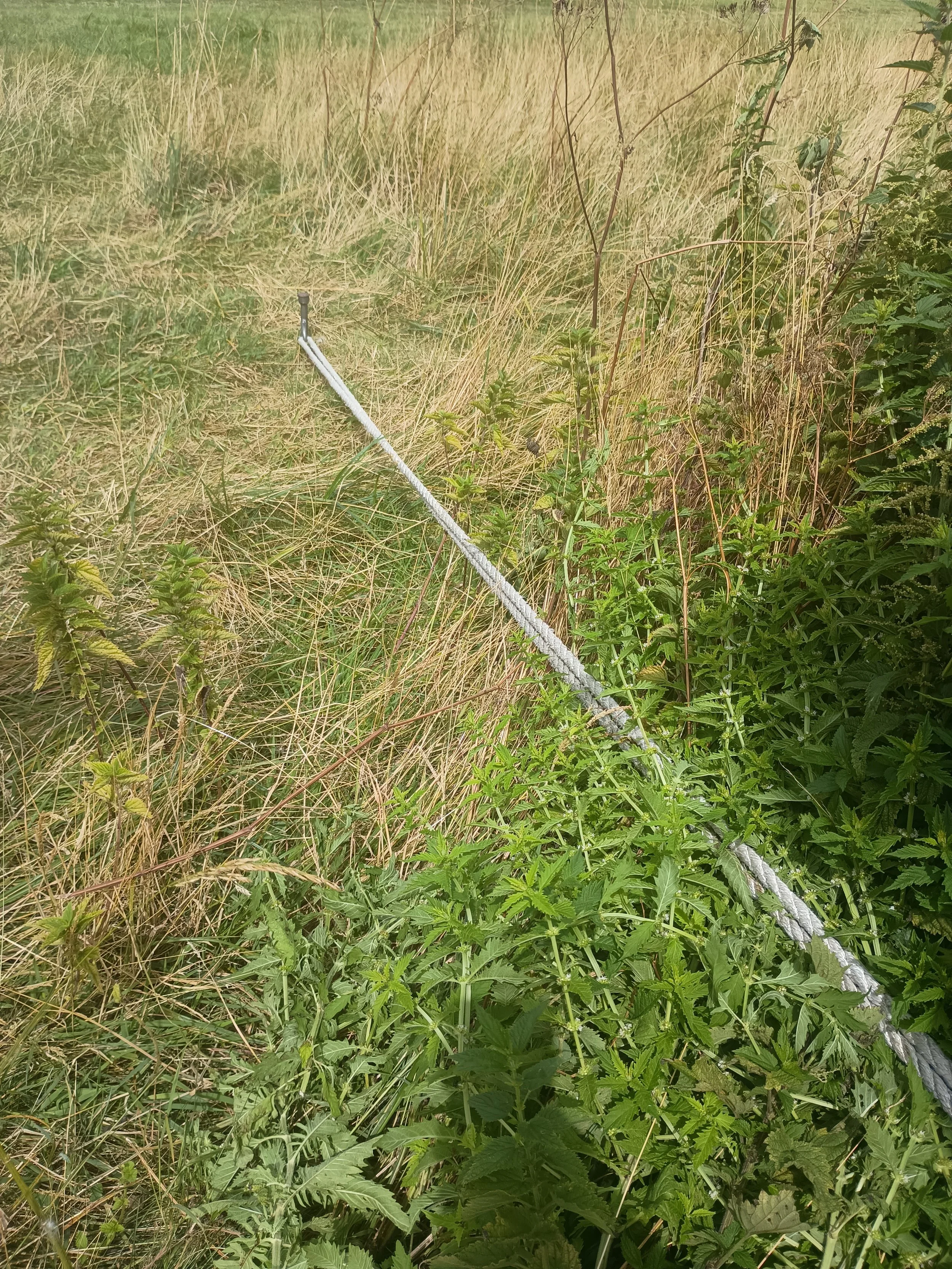
We had to use spikes hammered into the ground at this mooring and I love to do that. Makes it feel even more “off the grid”. A lot of moorings have secured rings or even bollards to use but there is something quite rural about hammering in spikes and tying up to those.

I had done some reading/research and was keen to do a little exploring. Abingdon is a historic market town and in the 13th and 14th centuries, was an agricultural centre with an extensive trade in wool, alongside weaving and the manufacture of clothing.
The area was occupied from the early to middle Iron Age and the remains of a late Iron Age and Roman defensive enclosure can be found near the town centre. Abingdon Abbey was founded around 676, giving its name to the town.

Other history of note (for us, anyway) is Old Speckled Hen ale was originally brewed by Morland's of Abingdon in 1979 to commemorate the 50th anniversary of the MG factory in the town. Old Speckled Hen took its name from an experimental car called the MG Featherlight Saloon. The car's body was made of a wooden frame covered with gold-speckled black cellulosed fabric. It was used as a runaround for workers in the MG factory in Abingdon and was nicknamed the "owd speck'ld un". In 1979, the MG Factory celebrated the 50th anniversary of the MG Car Company's move from Oxford to Abingdon. They asked Abingdon brewers Morland & Co to create a special commemorative beer for the occasion, for which they would suggest the name and would also design the octagonal label. While I appreciate all the history of Abbeys and Iron Age, I loved this bit of history. Everyday is a school day!
I also enjoyed the history of the Abingdon prison, built by prisoners of the Napoleonic Wars in 1811. The prison no longer exists - in 1970 it was converted into a leisure centre and flats/townhouses. According to local legend, prior to its conversion in the 1970s, the prison was haunted by the ghost of an eight-year-old boy who, after being convicted for arson in the mid-19th century, became the youngest person in the UK to be executed by hanging…… I wonder if the estate agents disclose this bit of info in the sales pitch?
And last but not least Abingdon still continues the tradition of bun throwing ! Bun-throwing is an Abingdon tradition that began with the 1761 Coronation of King George III.  This longstanding tradition of the town has local dignitaries throwing buns (as many as 5,000 buns in 2018) from the roof of the Abingdon County Hall Museum into crowds assembled in the market square below, on specific days of celebration (such as royal marriages, coronations and jubilees). The museum has a collection of the buns, dried and varnished, dating back to bun-throwings of the 19th century. To date there have been 35 bun-throwing events.

It being my birthday, I wondered if today would be the 36th bun-throwing event??

Oh and Abingdon has contributed to UK music history. The band Radiohead formed as students at Abingdon School. I did enjoy that there might be a connection between the ghost of the Abingdon prison and the lyrics of “Creep” by Radiohead.

We spent two days exploring all of this and more. The weather was glorious so we cycled all around Abingdon. I never got to try Speckled Hen Ale, which I am sorry I didn’t do, but it is no longer brewed by Morelands and the MG factory is no longer there, so things have moved on. We had a delicious meal in one of the old pubs and on the second night had a barbeque on the boat. We might not have had Old Speckled Hen Ale, but we did have a delicious bottle of red wine and we took a few minutes to appreciate the history of towns and villages like Abingdon. It was a relaxing slow two days and exactly what we love about travelling on the boat. And, following a small birthday celebration, I was still able to step up onto the deck and back down, unassisted. So perhaps we should have grabbed a couple of the Old Speckled Hen ales, invited the child-ghost on board and turned up the sound of Radiohead.

A little romantic weekend away aka engine test run

We left Reading today with our new engine, all happily fitted into her new home. The engineers have asked us to do an engine run and put 20 hours on the engine. They will then do a filter, oil change and an engine check. All I heard was …. go travel for a few days, enjoy the good weather, have a few BBQs and sip on plenty of chilled wine. Not one to argue, we complied.
Our plan is;
* Goring for an overnight
* Abingdon by Friday mid-day
* 2 days in Abingdon
* Back down to Wallingford for overnight
* Back to Reading for engine check and oil change.
5 locks to get there and then back. The weather is forecast to be good and we are looking forward to a little trip and taking time to explore these towns and villages.
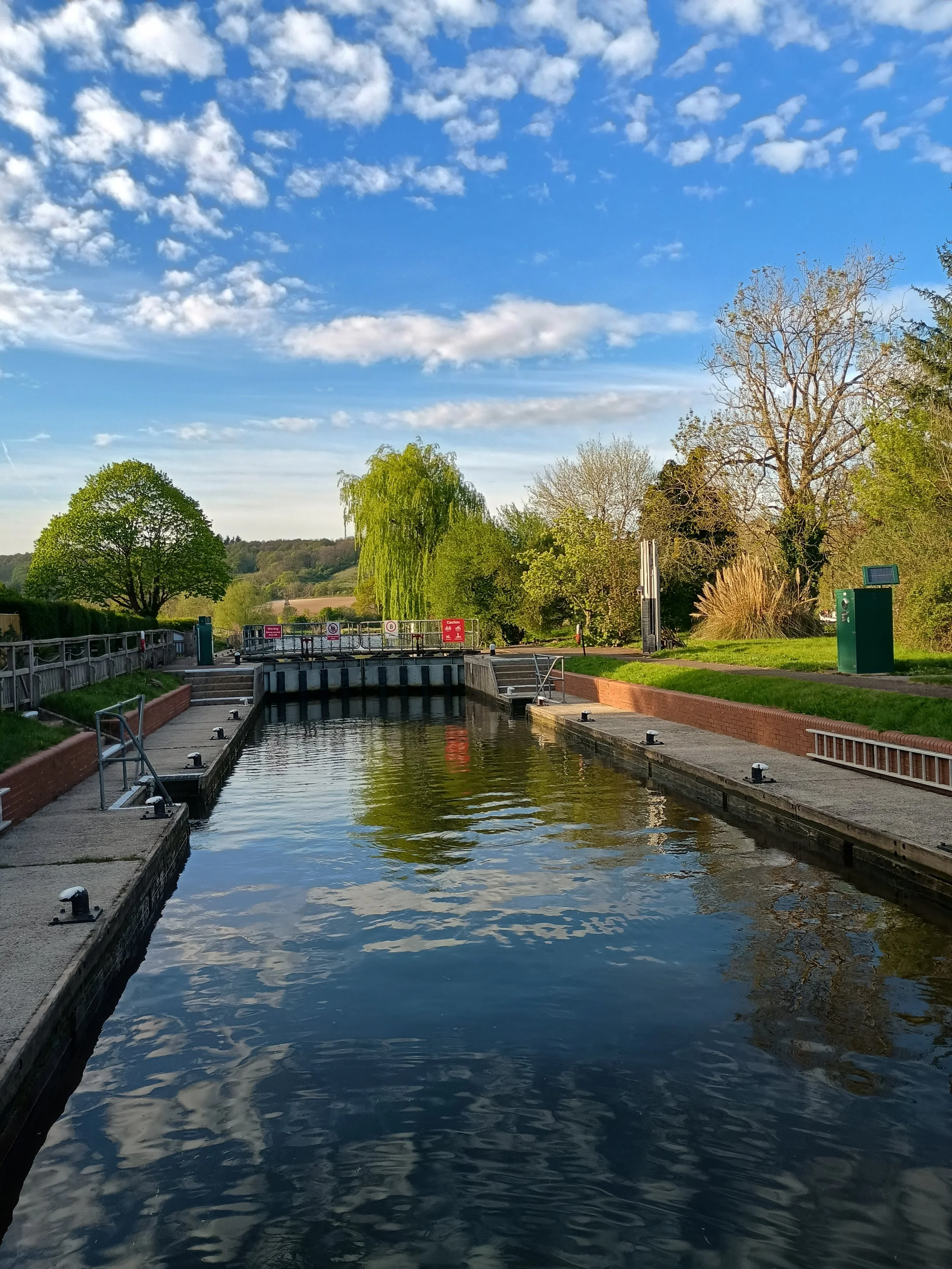
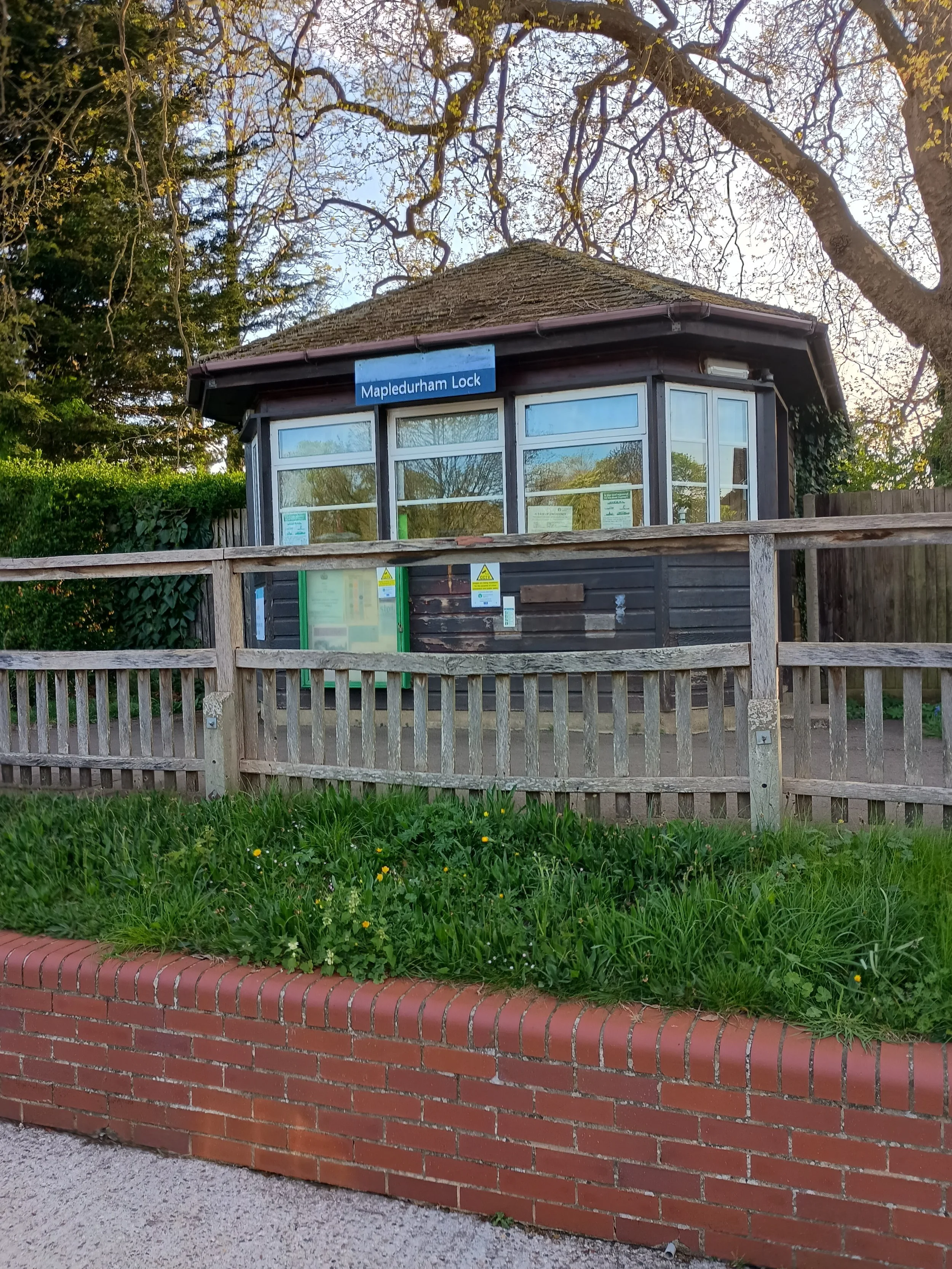
We grabbed some provisions (including that wine) and set off about mid-day. The first lock, Mapledurham, was “crowded”. Well there were only 3 of us in the lock but most of our experience on the river this year is that we are the only ones in a lock, so it felt like a crowd. Perhaps we were not the only ones out to enjoy the good weather.
Half an hour later, we approached the next lock; Whitechurch, Pangbourne. The two boats that were in the Mapledurham lock with us, were tied up waiting to go into Whitechurch lock, along with four other boats! So we had to join the queue.
We had heard from lock-keepers that “in the old days” locks were crowded and people queued to get through, but this was new to us. We squeezed in behind a hire boat on the waiting pontoon and were brought up to speed on what the hold up was. The gates into the lock from upstream were jambed by debris – and more specifically a large submerged log. There was no way to get the gates open and even if they did, it would mean that the log would be floating in the lock. (No one wants to come up against a floating log!).
The lock-keeper had notified the people he should notify in a case like this and they had called on some divers, who were on their way. Estimated wait time – 3 hours. Patrick looked at the clock and me and before he could even open his mouth, I emphatically said NO, we are not turning back to Reading. We will wait until it’s cleared and enjoy our trip. Enough with the false starts…
So we waited, read our books and even had a quick nap, to be woken by the sound of boat engines starting. More than that the boat going past our windows was not a waiting boat turning around to head back, but a large boat coming through the lock. YAYYYYY.
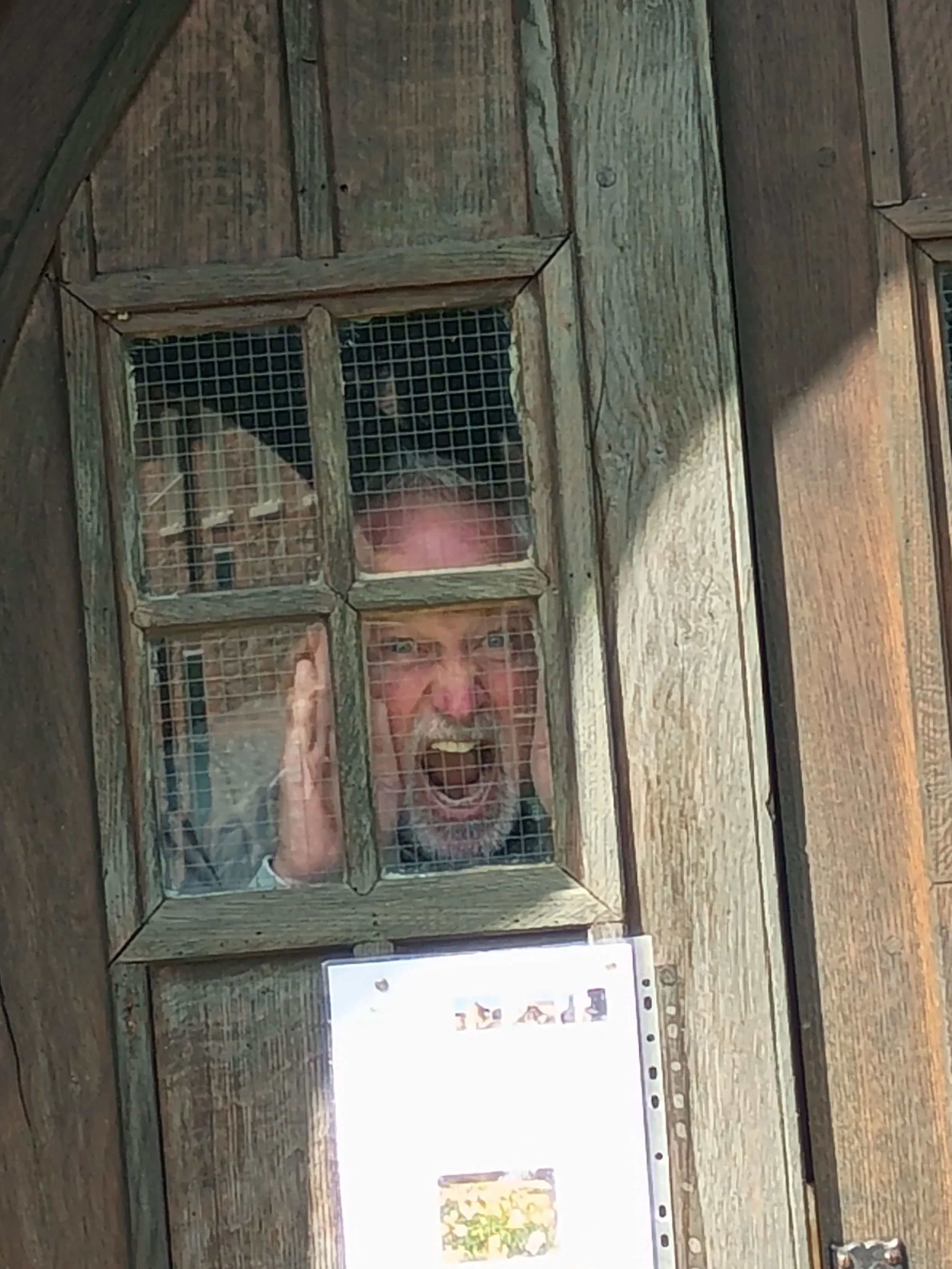
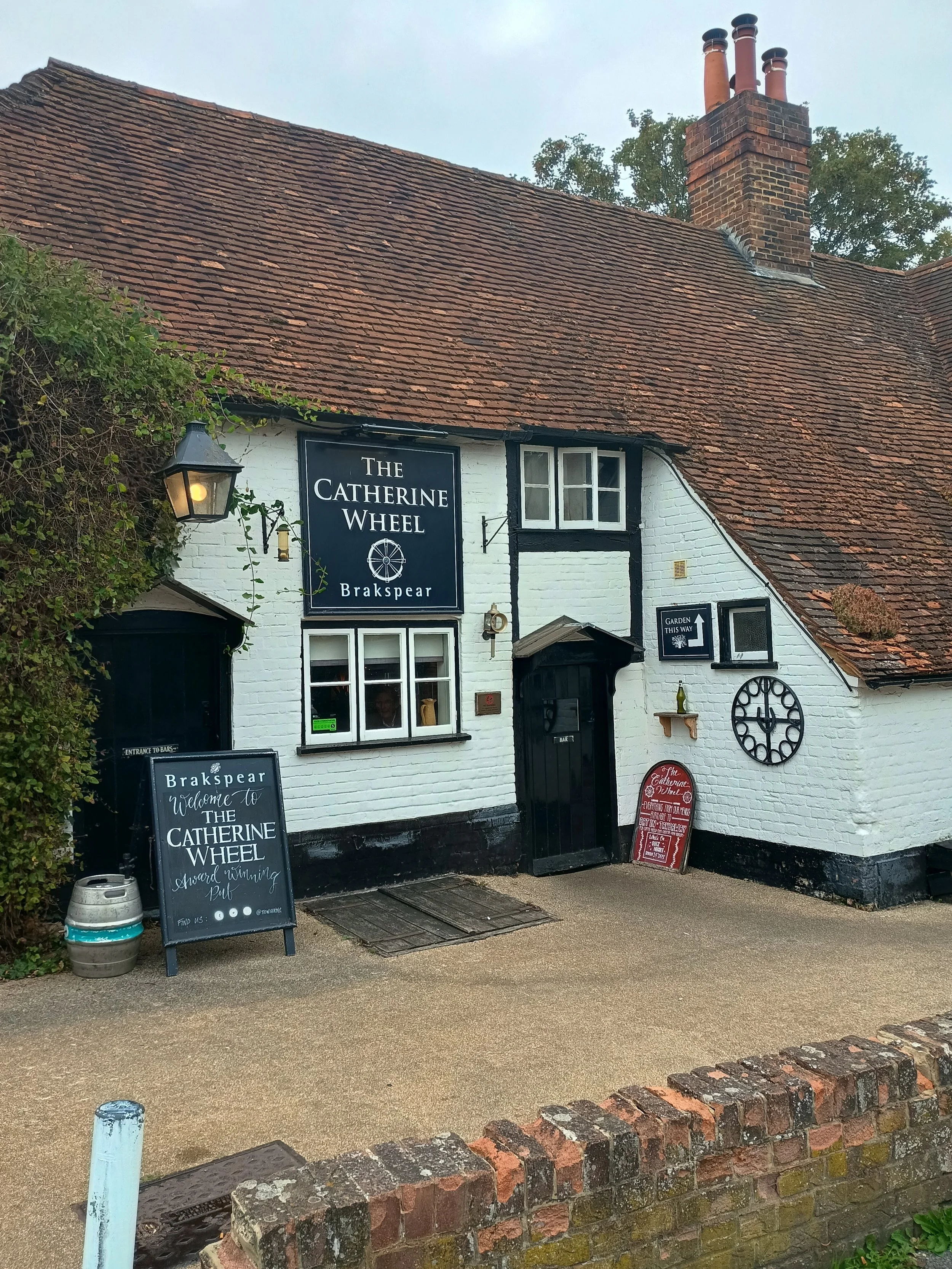
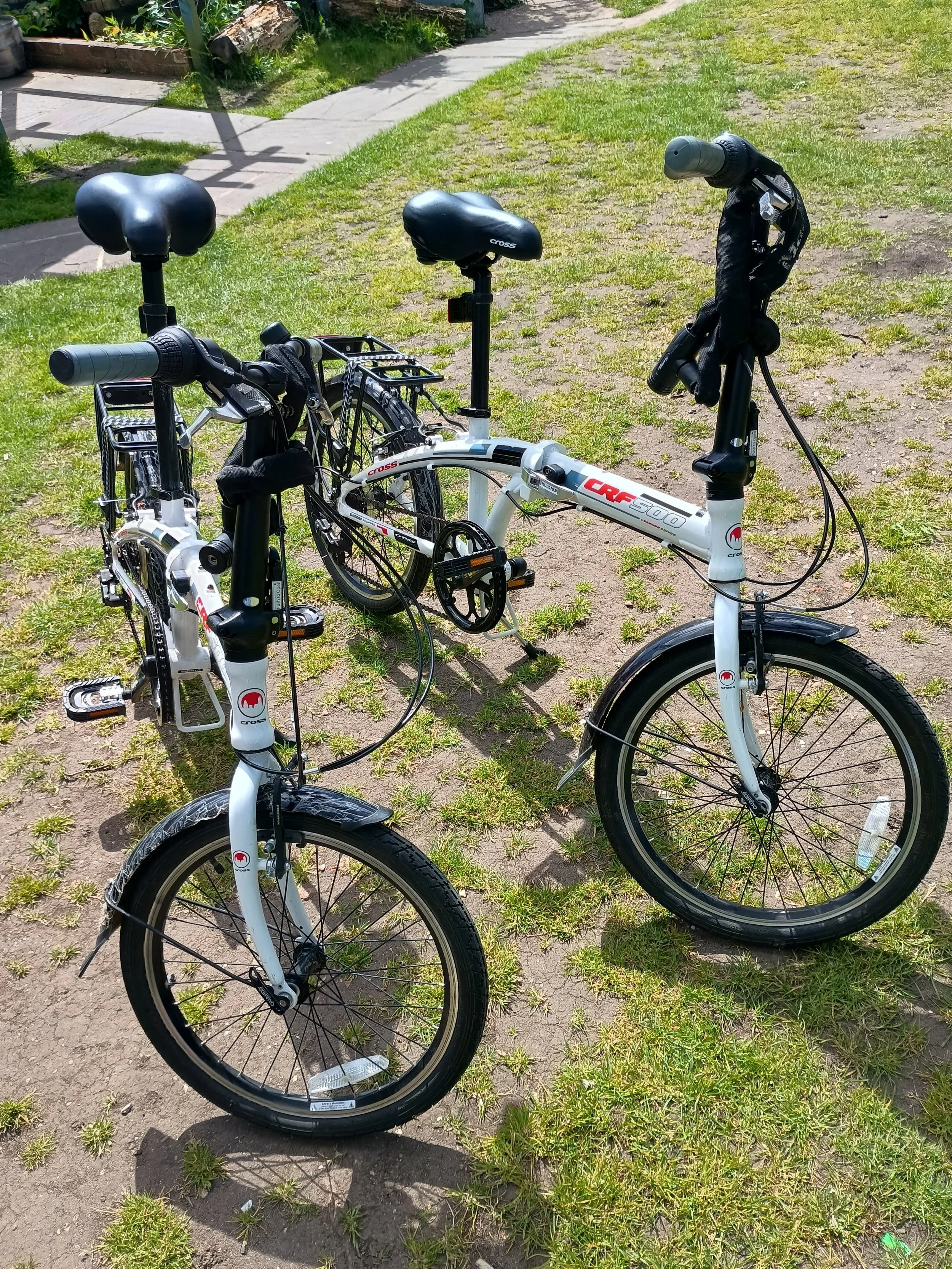
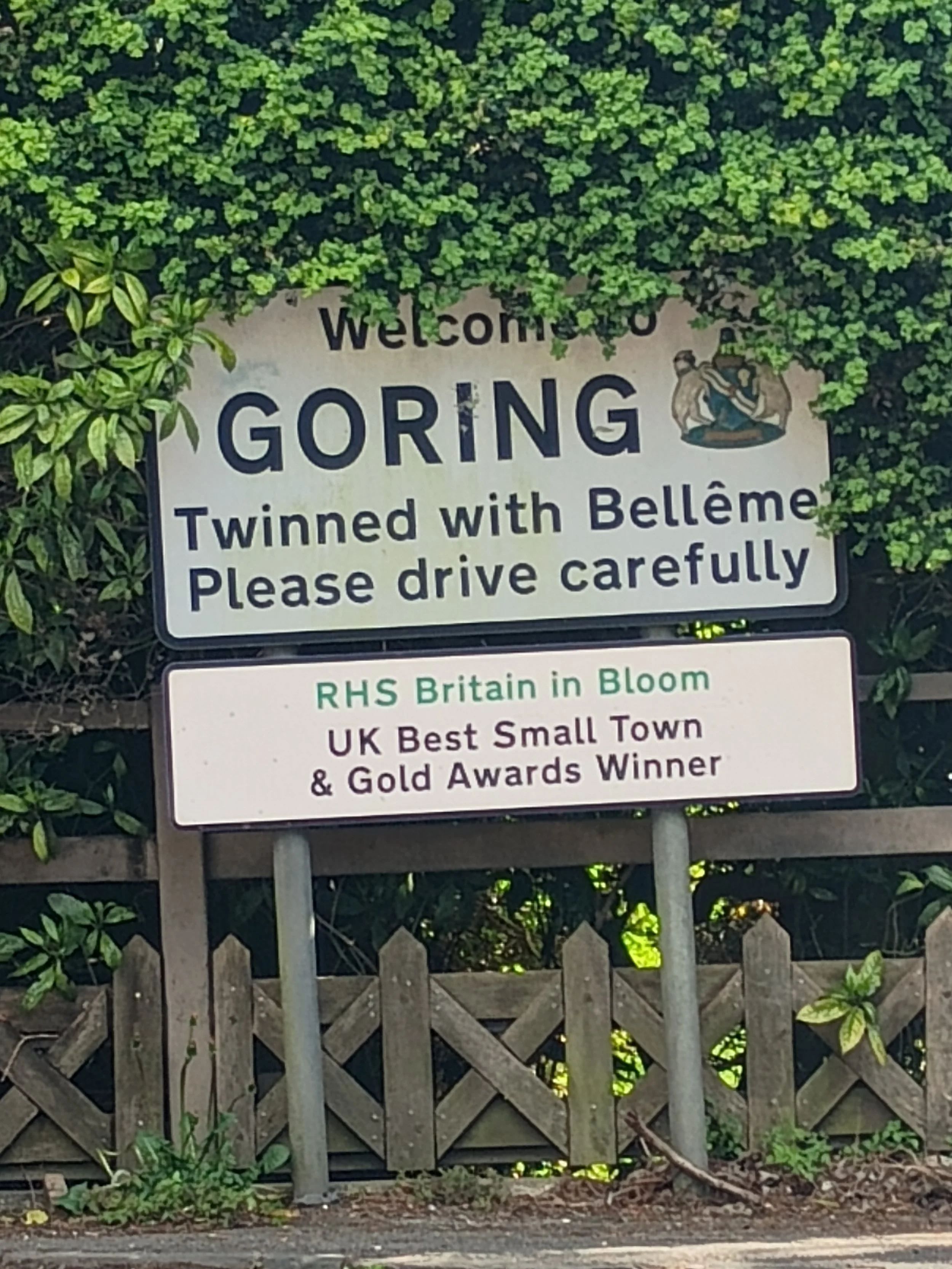
We had to wait a little while longer as there was also a queue of boats on the other side but eventually we got in AND got out of the lock. The rest of the trip to Goring was uneventful, peaceful and calm – just like I like it. We got to Goring after 15:30 and secured a mooring on the side of the lock, with the weir not too far. I really love the sound of the water running over the steps of that weir, so I was happy to be there. And the view is really beautiful. After a few hours on board we were ready to a bit of exercise. (Only a bit). We got the bikes off the back of the boat, packed a few waterproof tops as it was looking gloomy now and headed off to explore a bit more of Goring and Streatley. It ended up being a full pub crawl through the two villages as we stopped 4 times on our route, at ALL 4 of the pubs in the villages. We were starving once we reached the last pub, The Catherine Wheel, and settled in for a pizza and another drink. It wasn’t a late night and we were back on the boat, happy and full of delicious pizza. We didn’t make it to midnight, so there were no birthday celebrations, but that could wait for tomorrow.

Decision made: Out with the old, in with the new

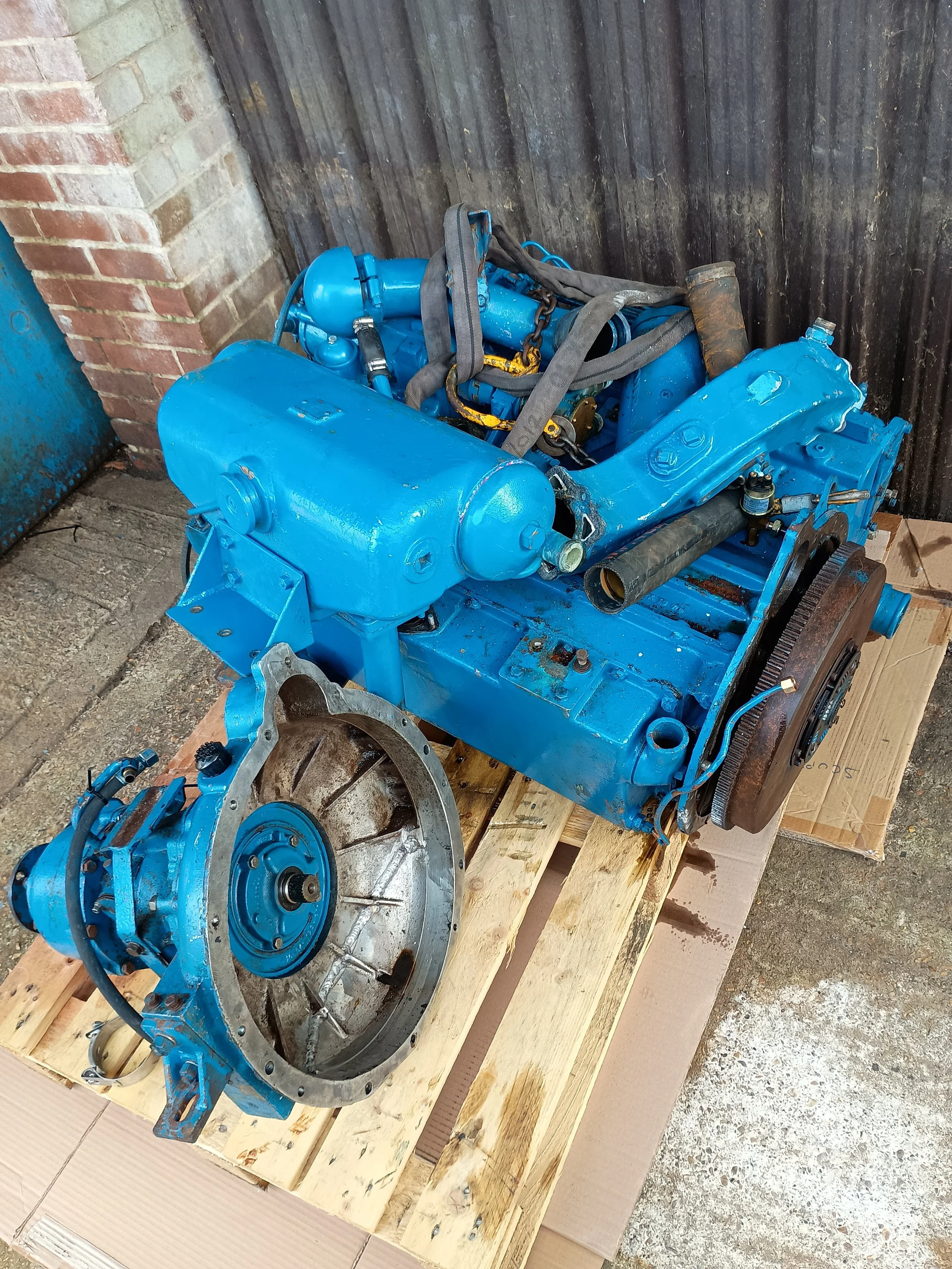
Engine problems…..After a lot of thinking, discussions, backwards and forwards on what to do next, we came to a conclusion – out with the old and in with the new. We just wanted peace of mind and be able to turn the key and the engine starts. Every time! And that meant out with the old engine (again) and in with a new one. Our existing engine is a Perkins 3654H and we believe she was fitted into the boat in 1971. This is not the upright, model and the engine lies on the side with access to most serviceable parts, but not all. The engine was rebuilt in 2019 and even then the engineers struggled to find spare parts for her. In fact, the rebuild involved a repair to two major corroded engine parts (sump and bell housing) as we could not find replacements parts. We were also warned that the oil scavenge pump for the engine was no longer available. There was also a persistent oil leak and we had resigned ourselves to the fact that this was going to be a weekly mop-up job...not ideal. Despite this, we felt (fairly) confident that we would be OK with this engine. Yes, we would be travelling with almost no access to spare parts should there be a problem and we had an oil leak. But it was a risk we were prepared to take as it felt we didn’t have a choice and this was effectively a new engine following a full rebuild.
But now we have a new problem and it involved a lot of white smoke from out of the exhaust and our confidence in the engine shifted. Patrick and the engineers could stab a guess at what it might be but it would take hours and possibly a lot of money to accurately diagnose and fix the problem and this is without addressing the oil leak. A diagnosis was going to involve taking the engine out and possibly sent away (somewhere?) to be diagnosed. The engineers said they could start having a look to get a view of what might be wrong, but it probably beyond their remit. They also repeated their concern/warning about not being able to find spare parts to do any work or parts for us to keep onboard as spares. So they gave us some time to decide what to do next.
What we really wanted was peace of mind. We wanted to be able to turn the key, knowing that she was going to start and we could move on and travel. Particularly in a foreign country. We decided that travelling with an old risky engine with no part numbers and reduced access to spare/replacement parts is not a game we wish to play.
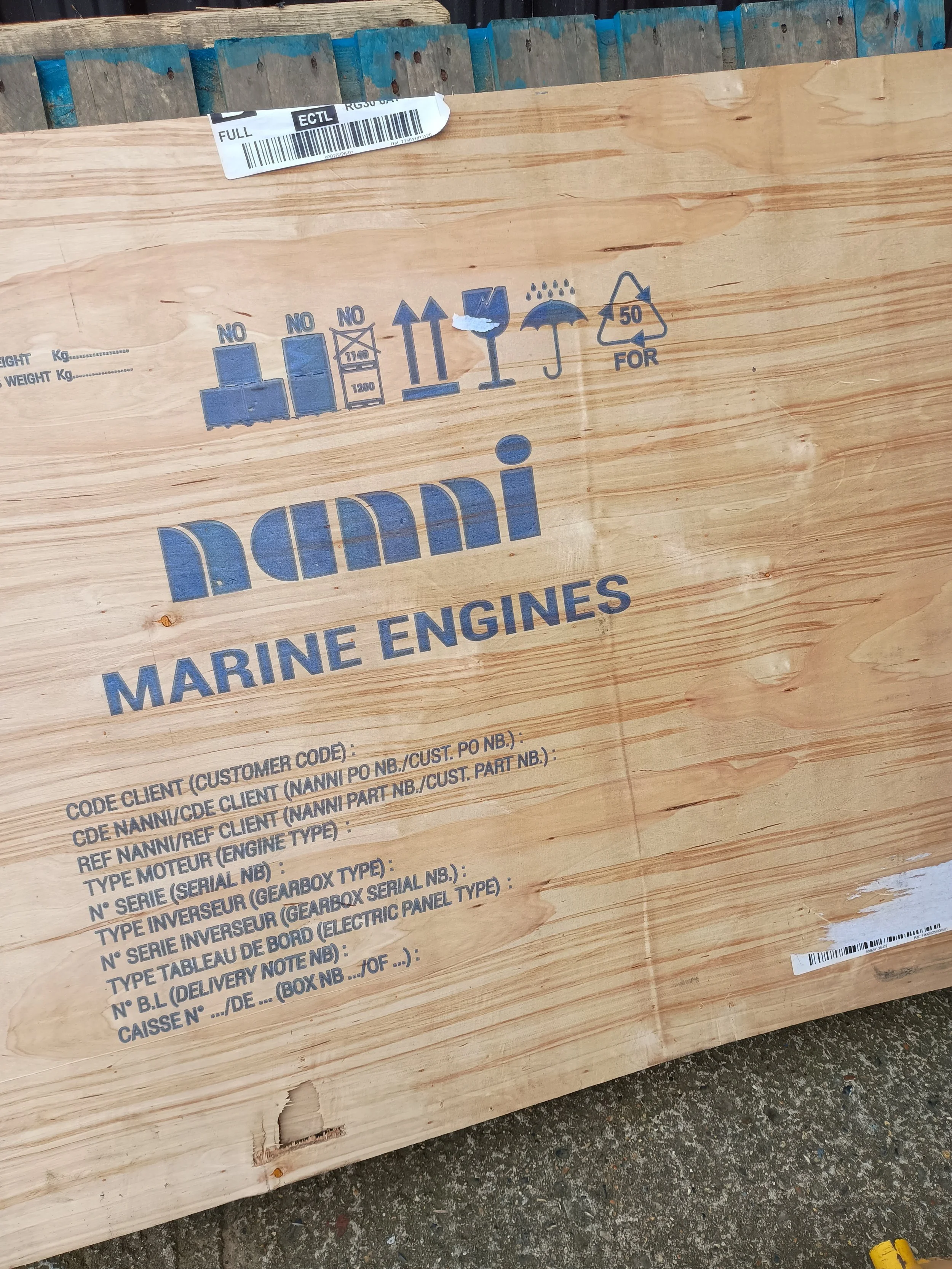
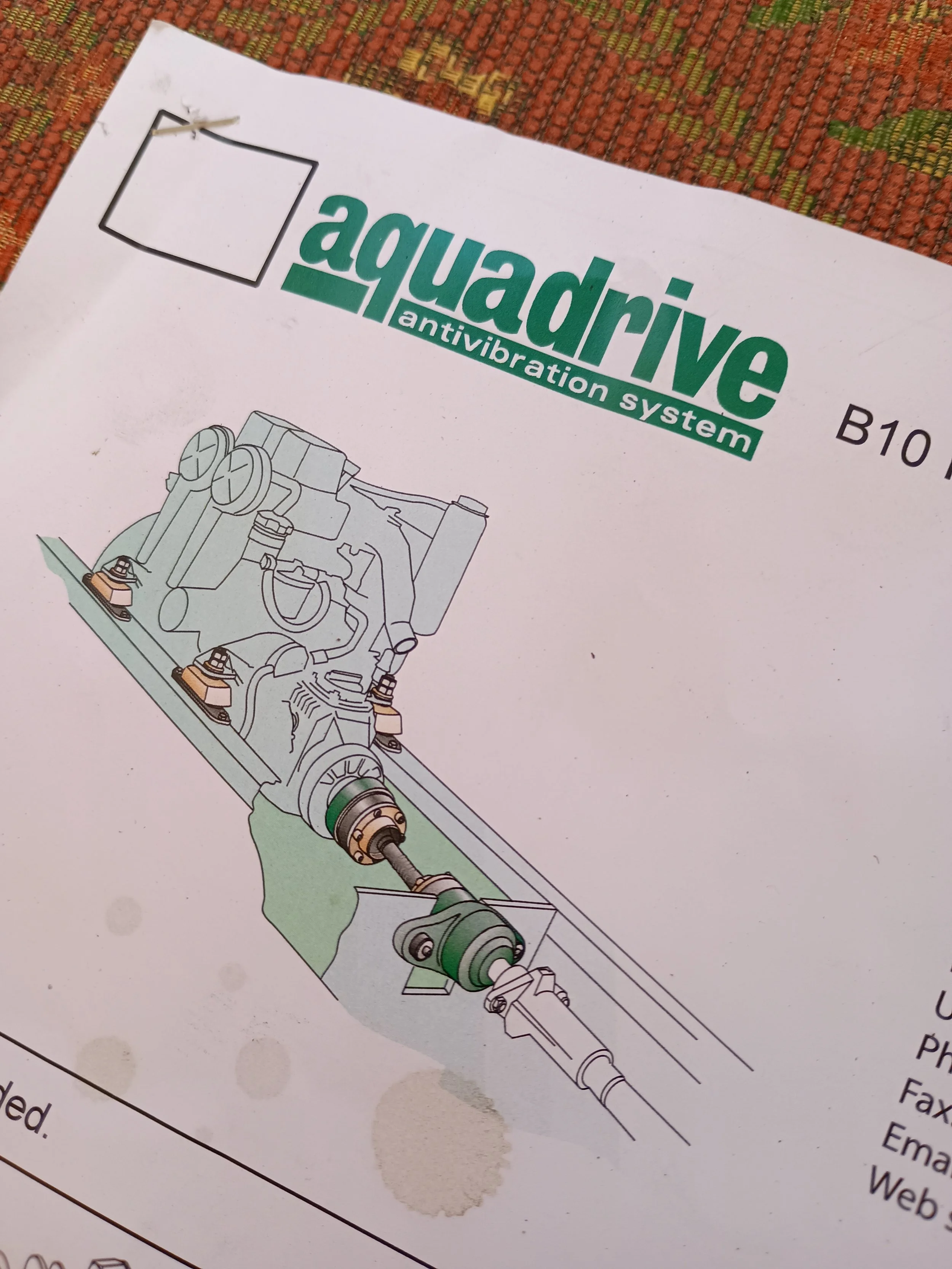
So we dug deep and then deeper into our pockets and we decided to proceed with a new engine. Patrick and the engineers discussed options, considering the space and height restrictions of the engine bay and also what our requirements were. The decision was a Nanni 115, a 4 cyclinder turbo engine. Nanni was an engine Patrick had always had in mind should we have come to this very point. The beauty of this engine, besides being new and fitting in the engine bay, is there are no electronics, its just a simple diesel engine. It was also agreed to fit a thrust bearing, so the new engine will run smoother.
Once we got over the initial shock of the cost of this, we were excited to be moving in this direction. So we “pushed the button” and a new engine and all the extra bits were ordered.
The engineers got ready and they lifted out our very broken engine, which was a sad moment for us as we had tried so hard to keep her going and she had given us some fun adventures.
Once the engine was out we were made aware of two more issues that would have put halt to our trip, and again, before we even really got started. The engineers also showed us how corroded the exhaust manifold heat exchanger was and they estimated we only had a few hours of motoring left on this manifold.
Also, the engine was actually touching the bottom of the hull. We always knew it was a tight fit in the engine bay and Patrick had never been able to even slide oil-absorbing sheets between the engine and the hull. What we were not aware of was that the engine was rubbing away at the hull when running!
Looking back, I suspect our initial response to all of this must have been disbelief, but also a sense of relief and further commitment to a new engine.
So the planning and initial work for the fit of the Nanni began. Patrick spent a few days cleaning up the bilges and getting ready for a brand new engine. The existing bearers for the Perkins were too wide for the narrower Nanni. So new steel bearers were made, painted and fitted to the existing bearers. The fire extinguisher was removed and we are going to have to find a new space for it. It is attached to the front bulkhead and is wide and in the way. The Perkins had the exhaust on the starboard side, it ran up and over the starboard fuel tank and down the starboard side of the boat. The Nanni has the exhaust on the port side. So they are going to have to run the exhaust pipe round the back of the engine to join up with the existing exhaust.
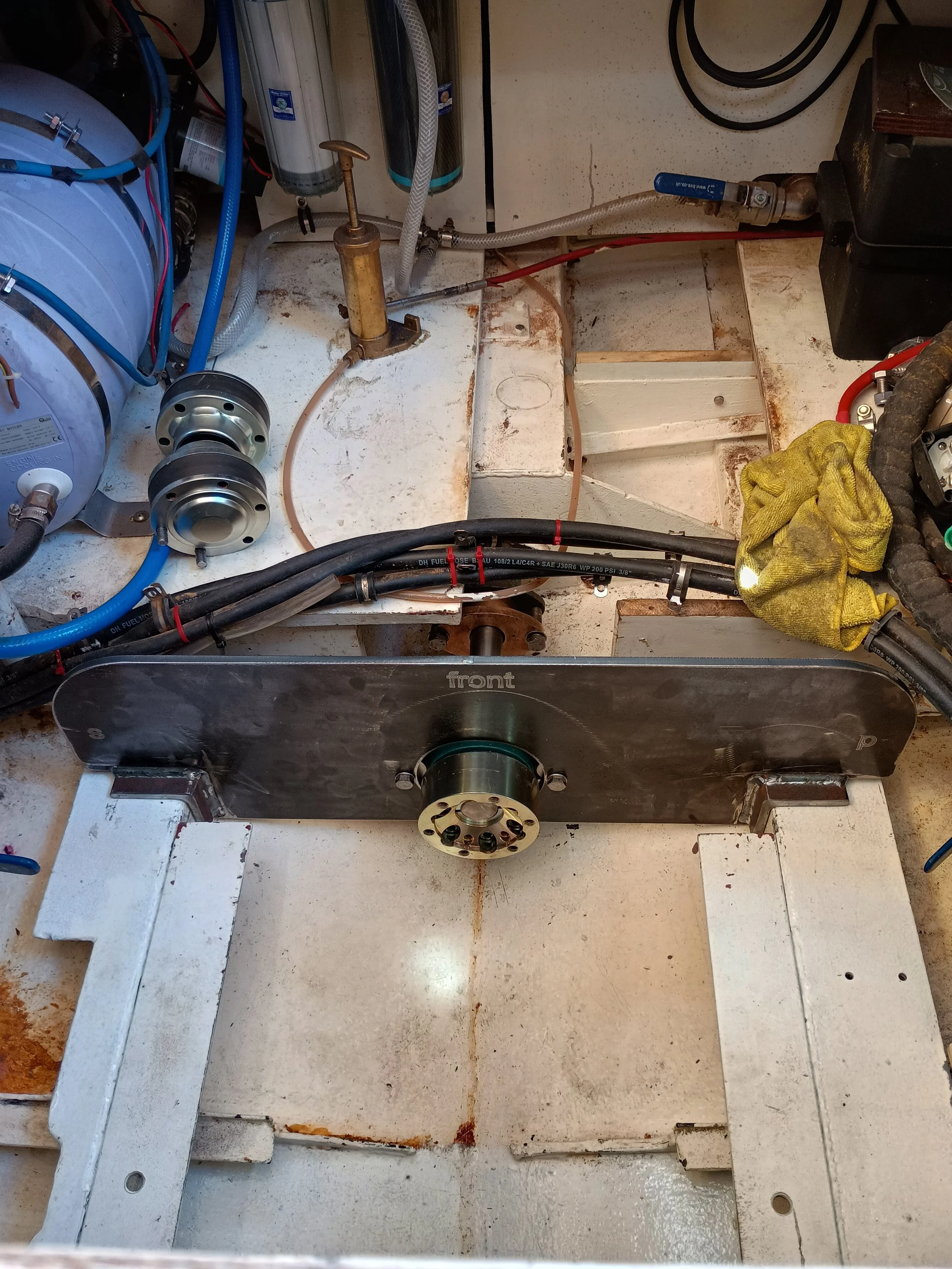
A steel plate was needed for the thrust bearing, so that was measured up and the template sent away to be completed.
Fortunately the generator did not have to be moved, only taken out for the engine fitting but it could go back in the same spot. That would have been another huge job if it needed to be moved elsewhere. We will have to find a new spot for the generator battery though.
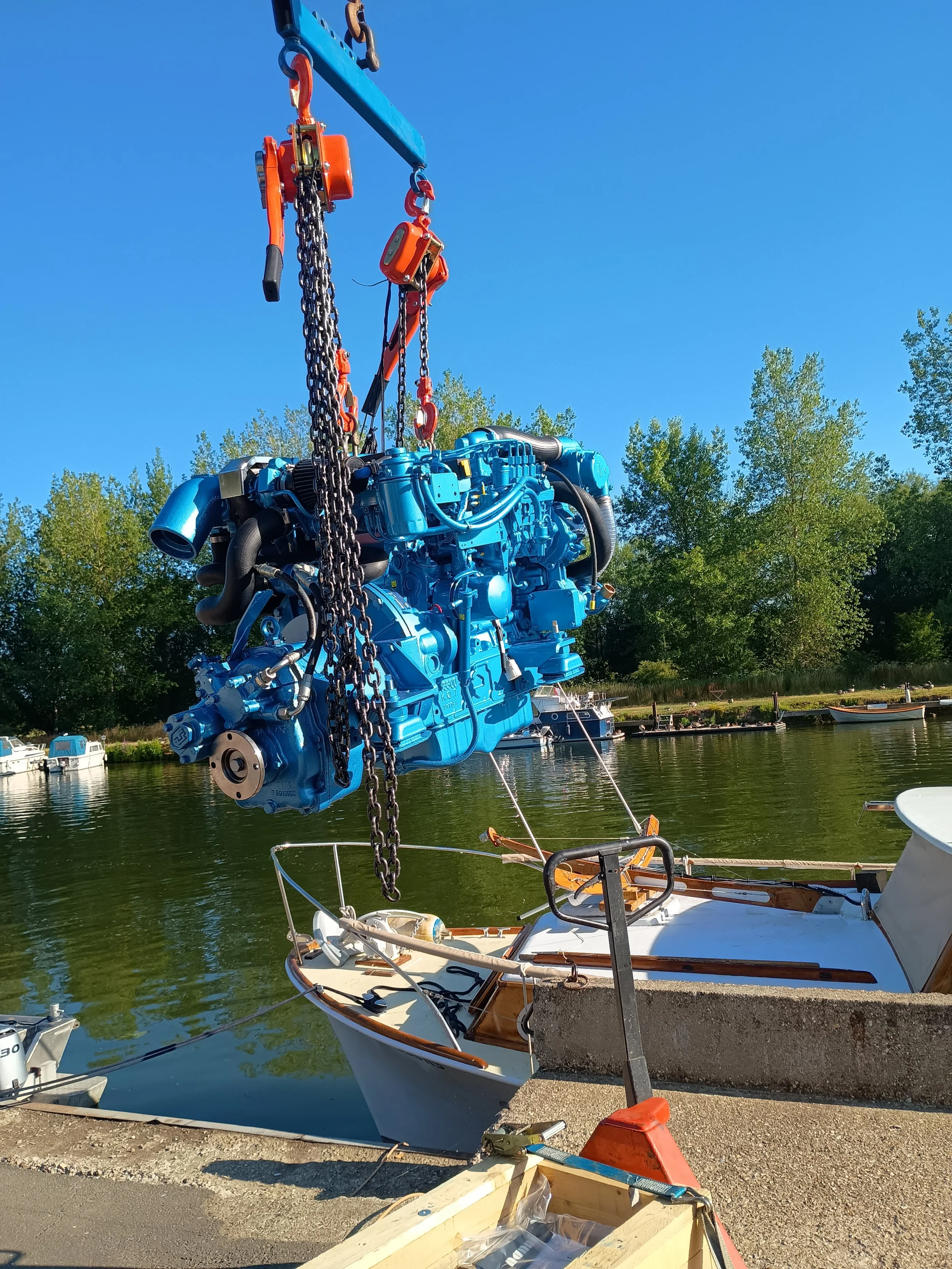
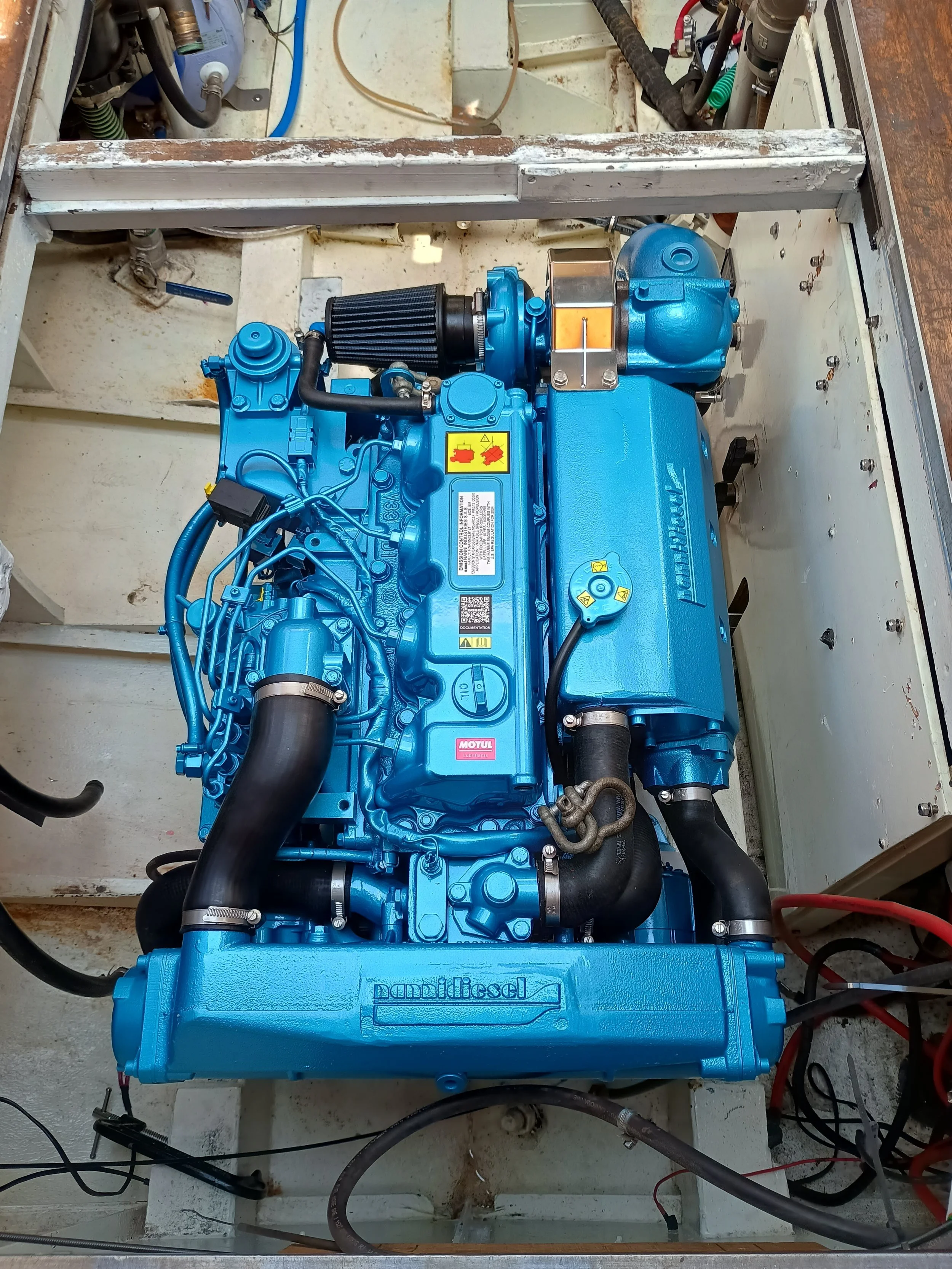
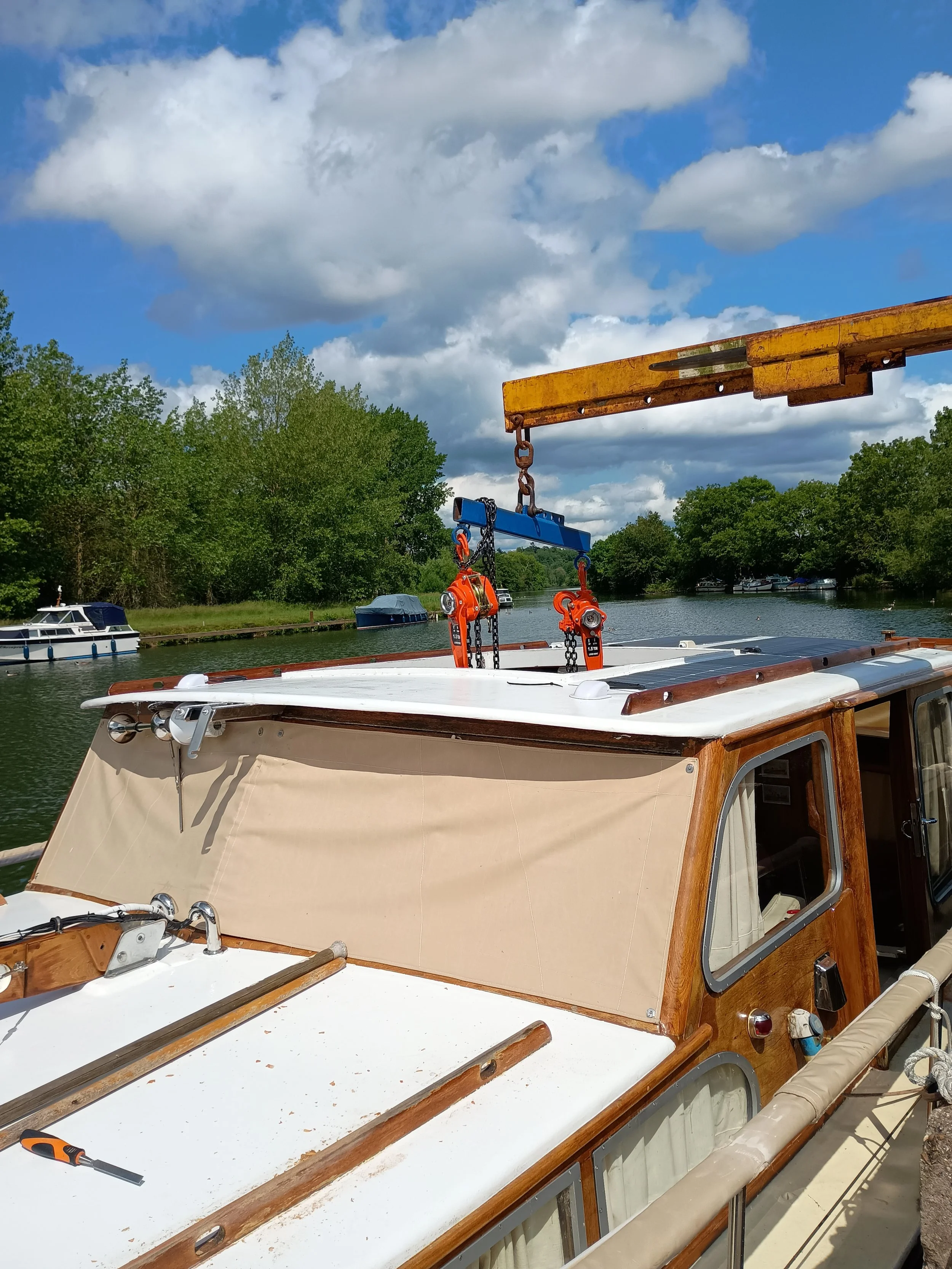
Once the new bearers were in, the Nanni was dropped through the roof to check that everything was dimensionally correct. Although the engine wasn't in the boat for long, it was exciting to see it in there, all shiny, new and blue.
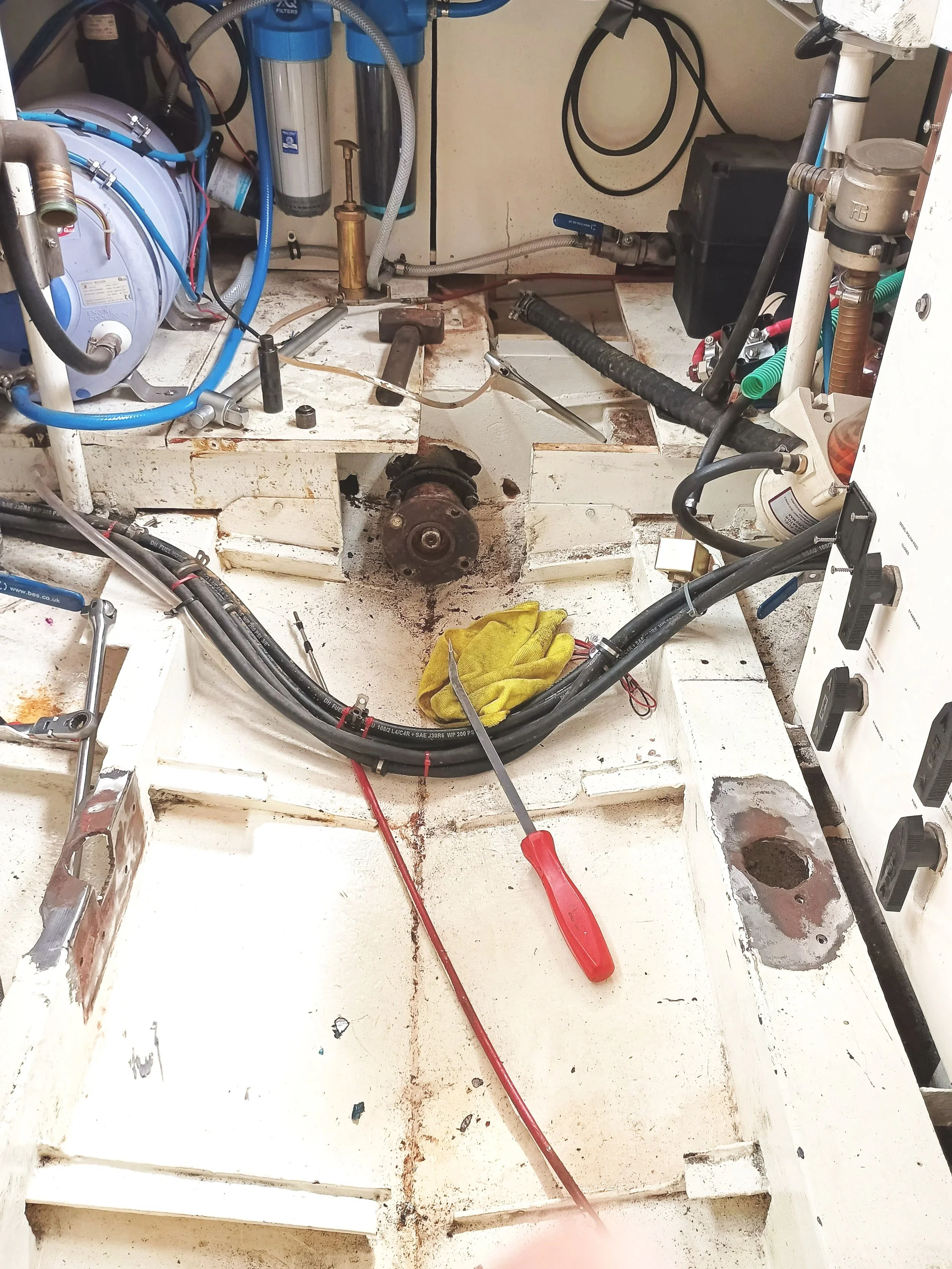
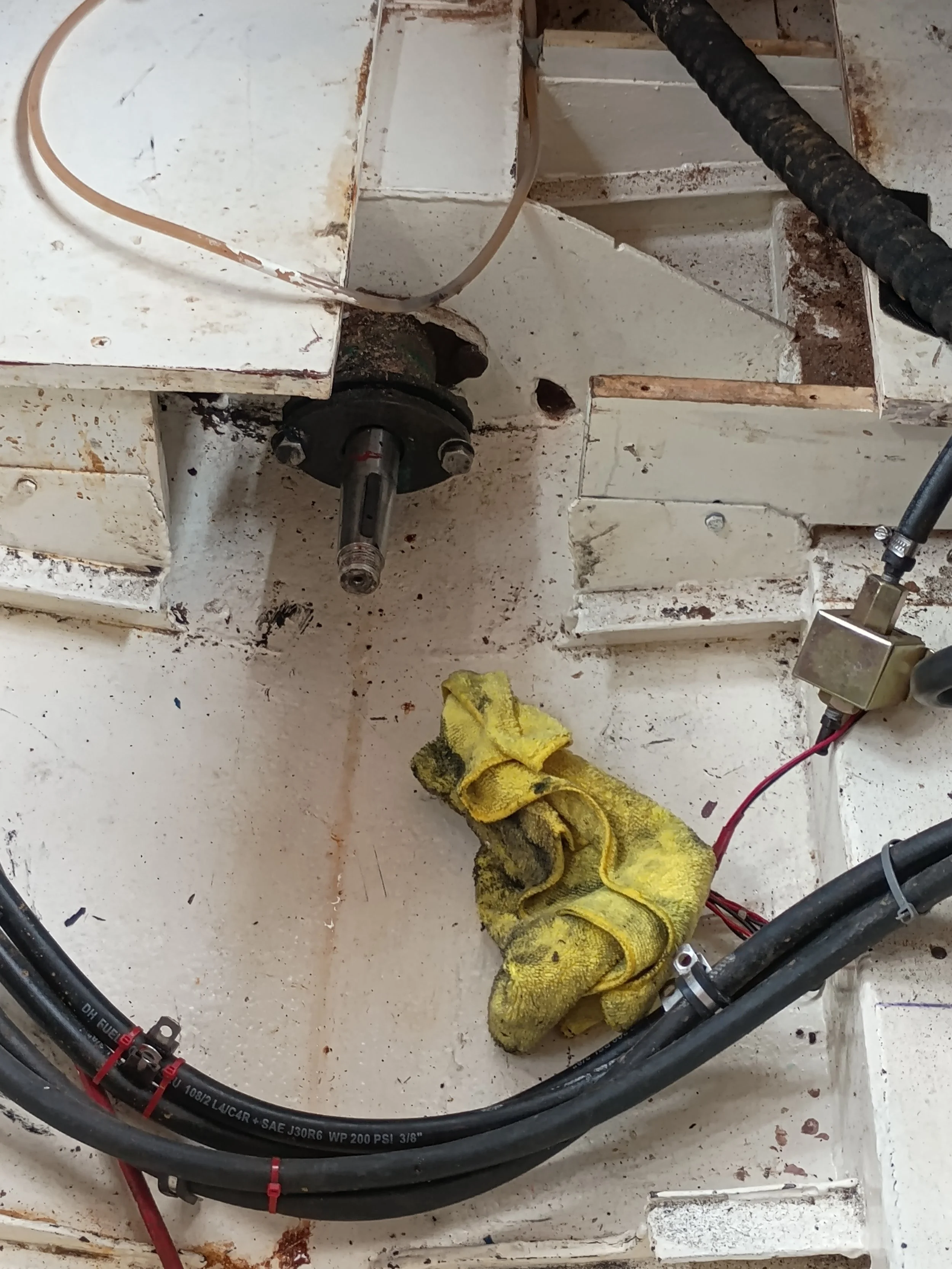
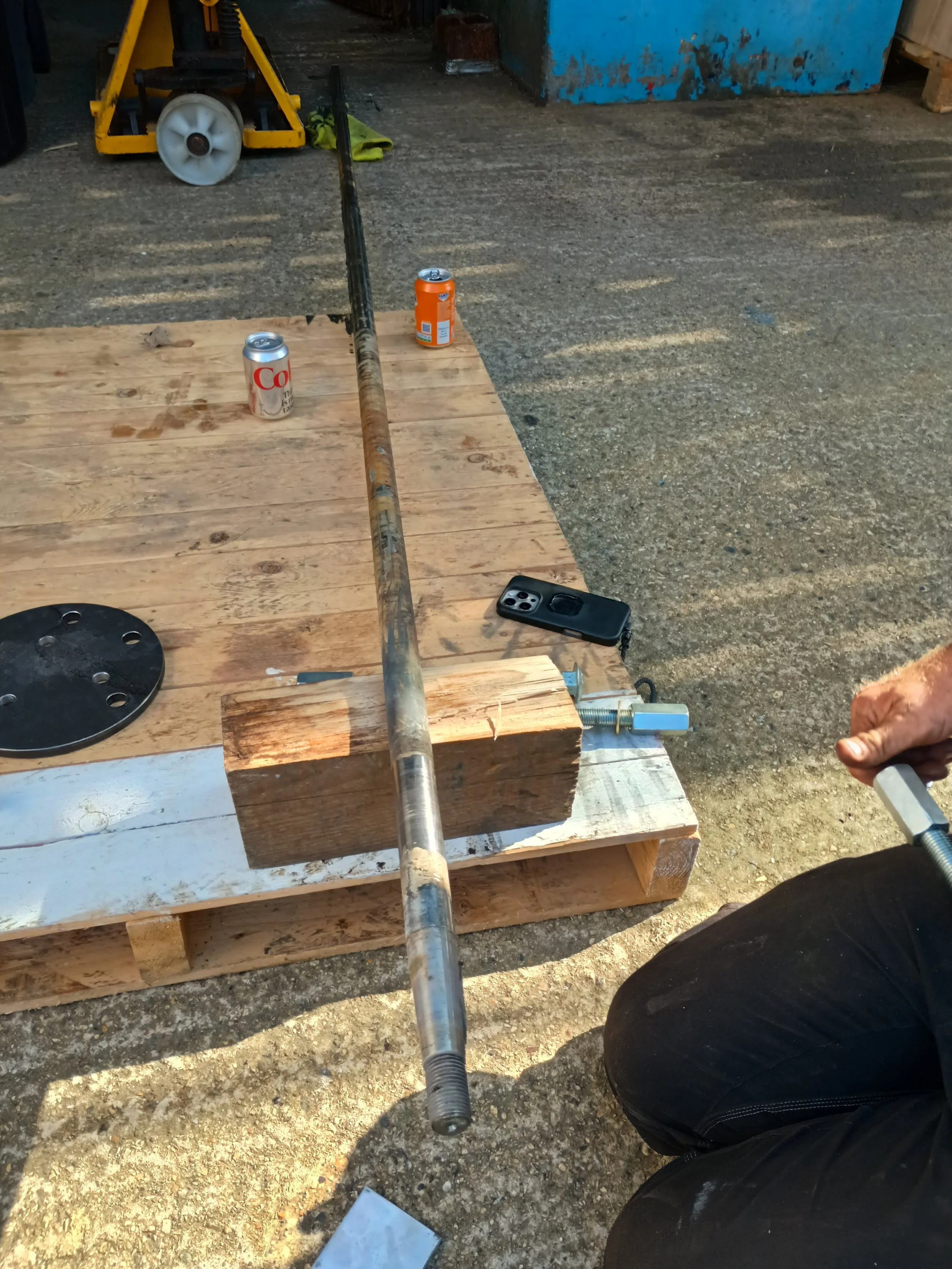
Then she was lifted back out and the engineers got into the engine bay to start the proper fitting work. They first had to remove the shaft coupling that was there from the Perkins, in order to fit the thrust bearing. (At this point we should have KNOWN that we were in the quiet before the storm). Removing the old prop shaft coupling was proving to be almost impossible. After a long long struggle, the engineers finally got it off. It took hours of pulling, using gas heat, pulley plate and eventually an angle grinder. Then the problem exposed itself. The shaft was tapered. This problem was explained to me. The new thrust bearing had to be fitted on a square end of a shaft. It was not designed to clamp onto a tapered shaft. To be fair the engineers did explore a few options to overcome this problem… can the tapered end be cut off, creating a square? Not enough shaft left to reach the engine. Do the manufacturers have an “adaptor” for situations like this? No.
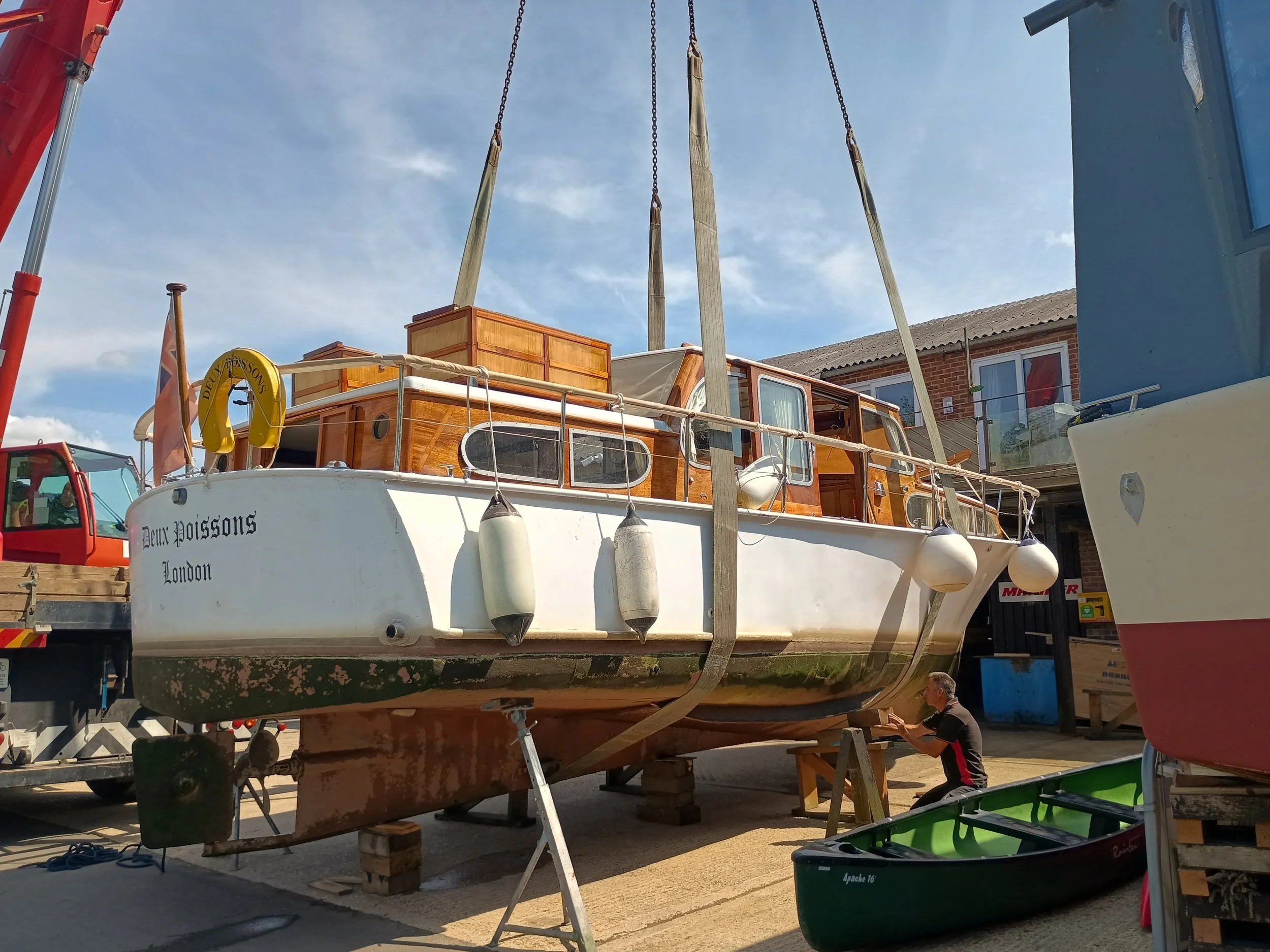
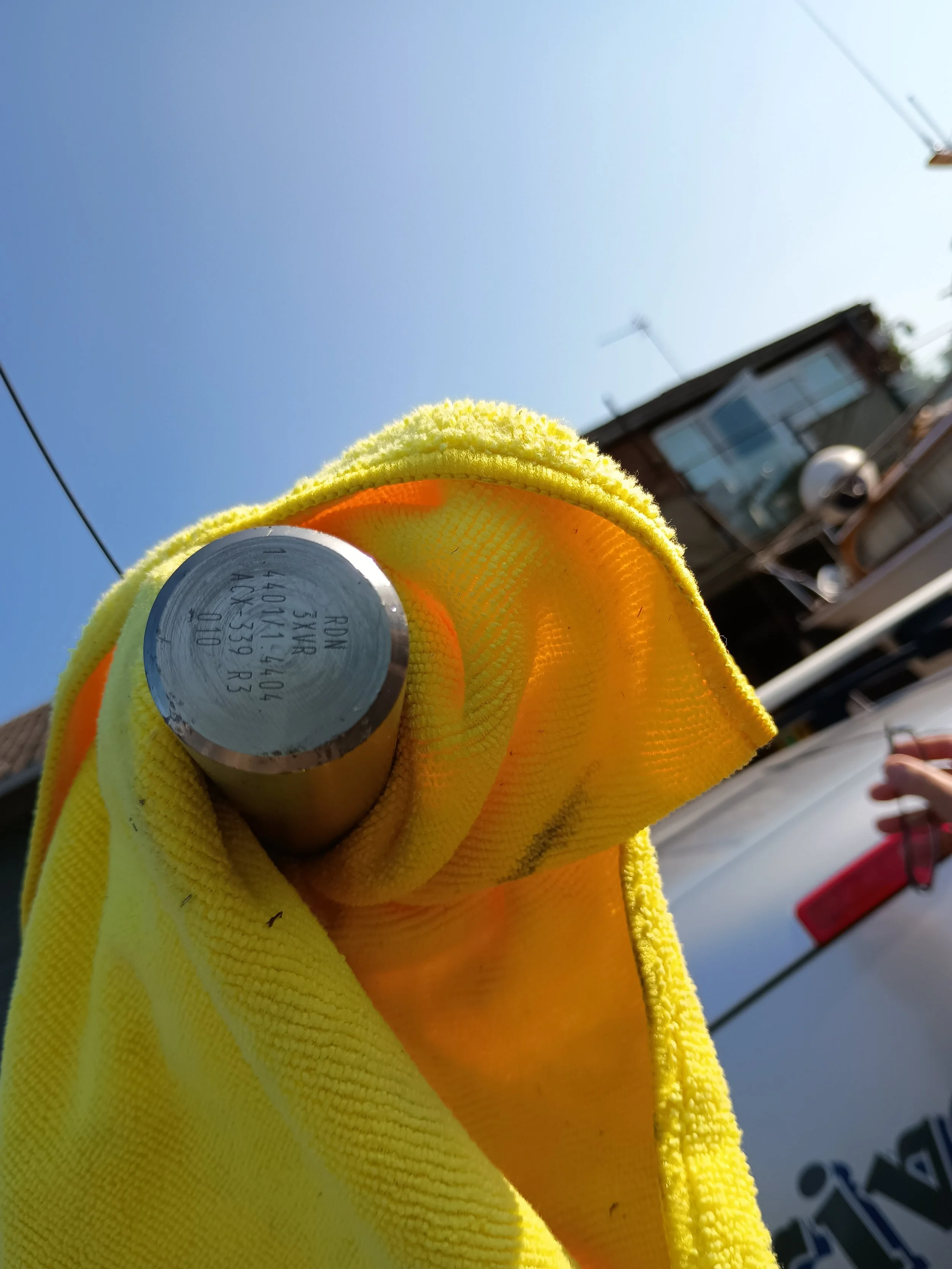
The outcome? A new shaft was to be fitted. This is going to involve lifting the boat out of the water with a crane, removing the old shaft and fitting a new one. They estimated a couple of hours and even discussed doing this shaft replacement while the boat was still in the slings of the crane!! That made sense to me because the boat could go straight back in to the water and they continue with the engine fit. Easypeazy!!
Enquiries were made as to how long for a new shaft to be delivered and also when would a crane be available for the lift. A little over a week!! Just as UK prepared itself for a heat wave and summer was starting to be a real summer. A summer where travelling on the river would be amazing, long warm days, BBQs, walks. I wanted to cry but also knew this was going to be worth it.
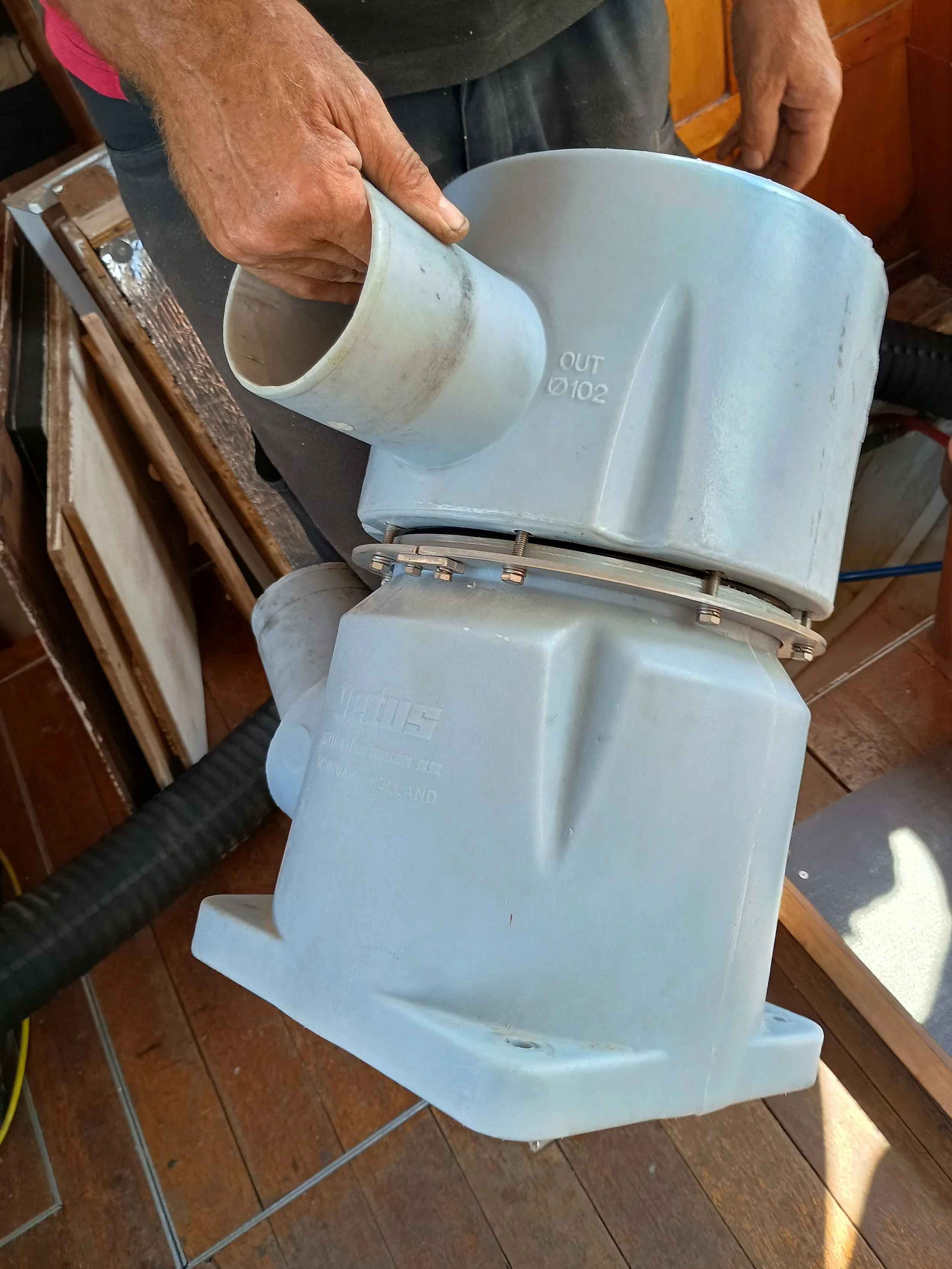
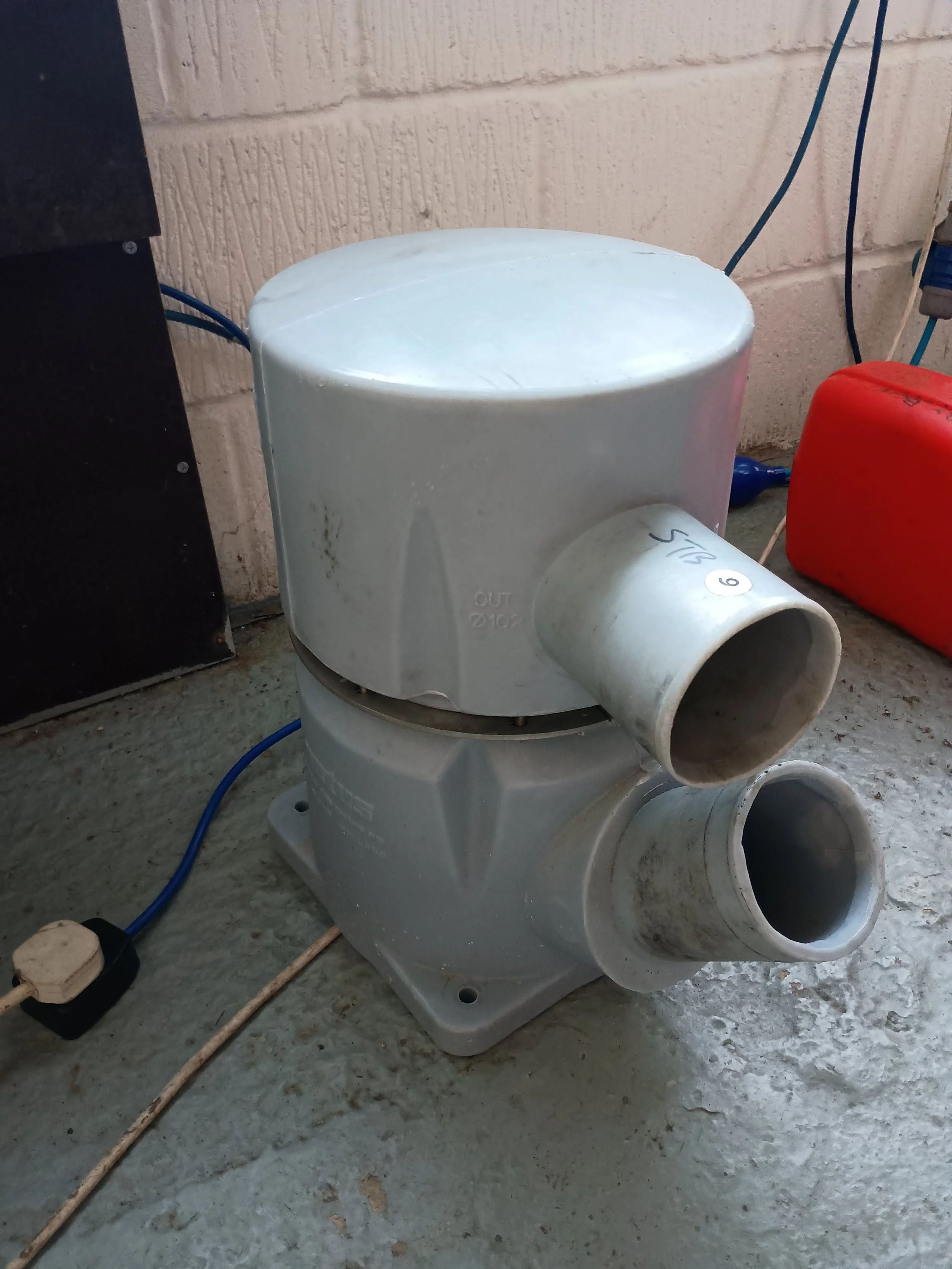
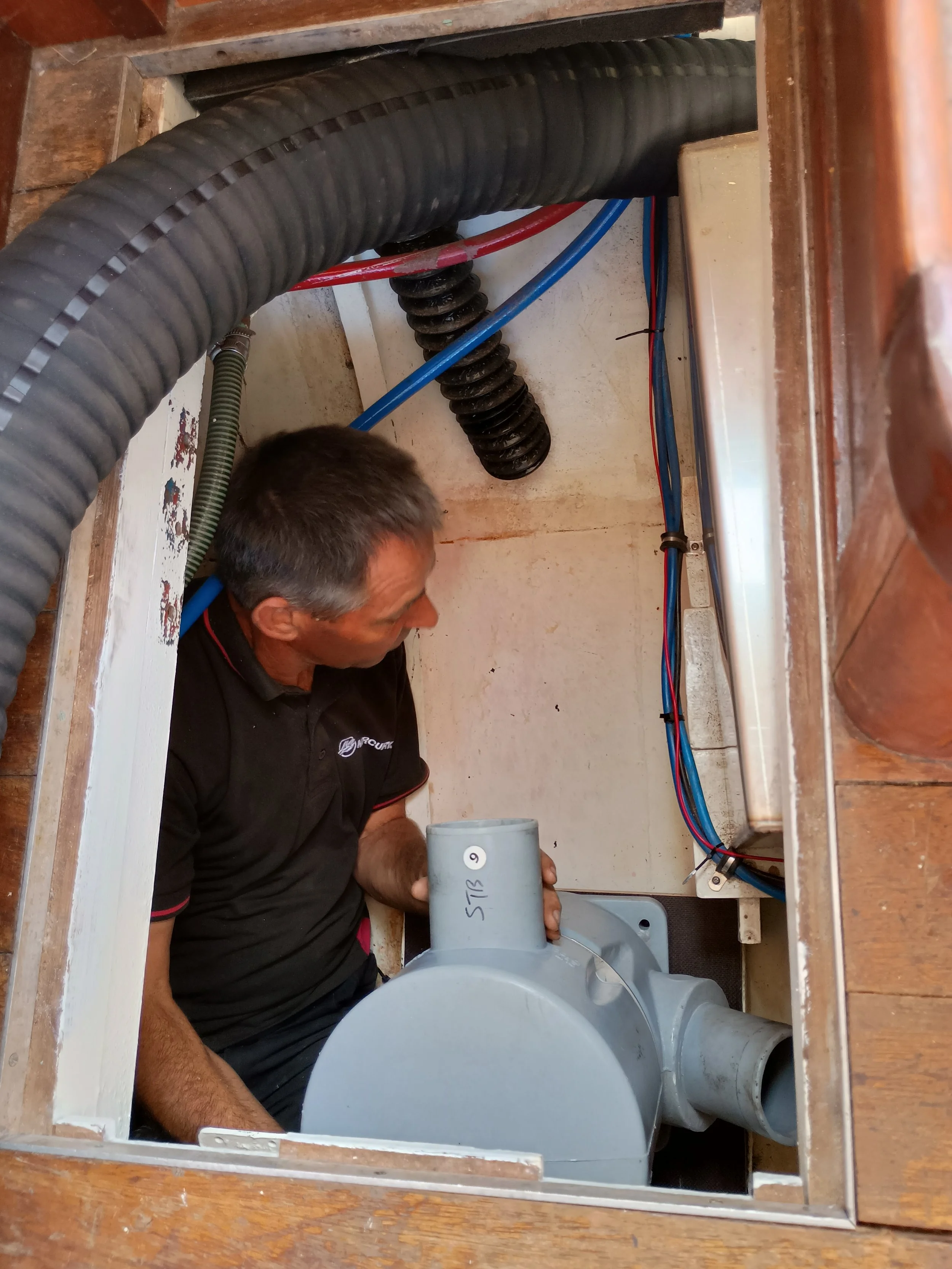
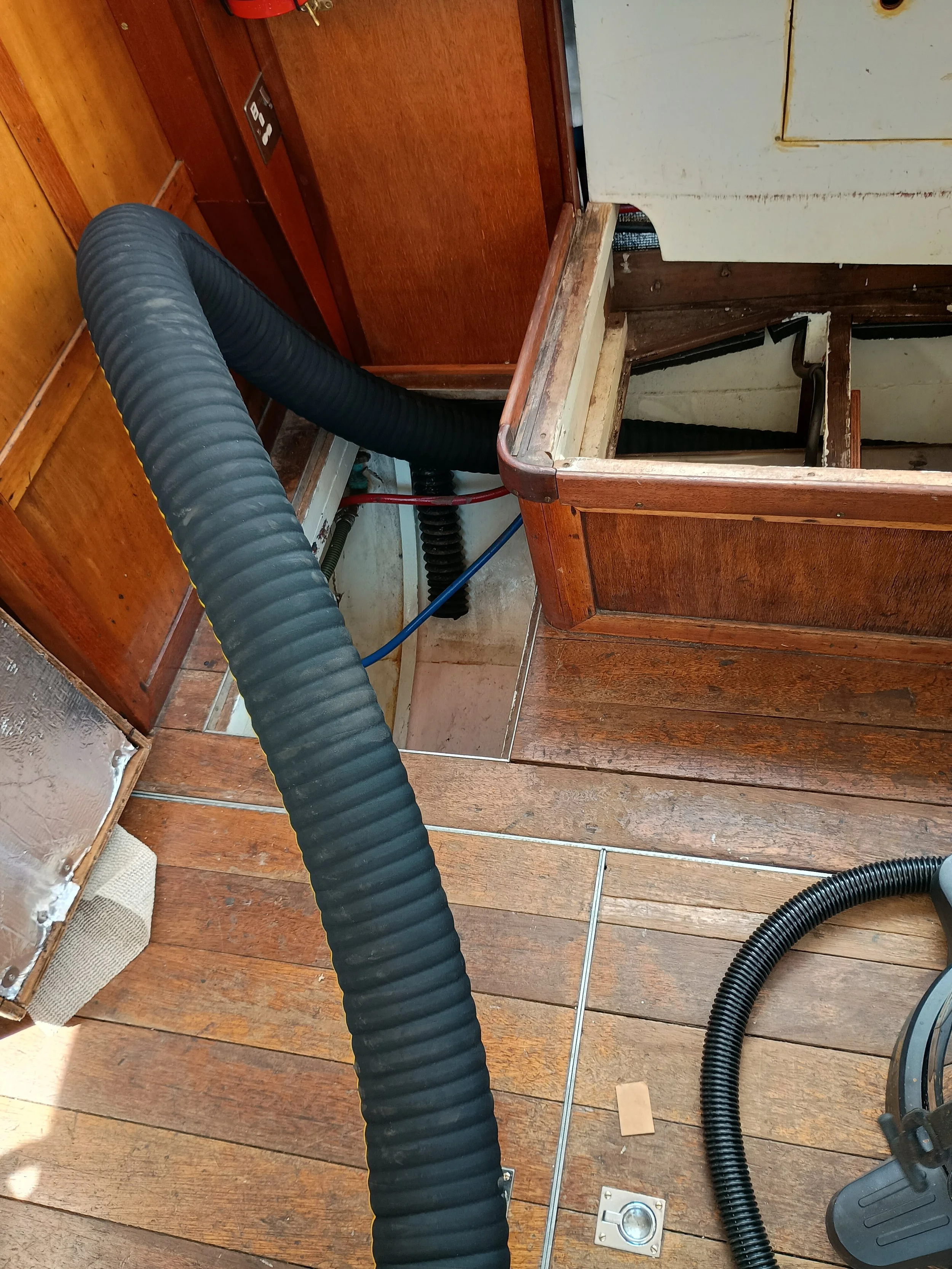
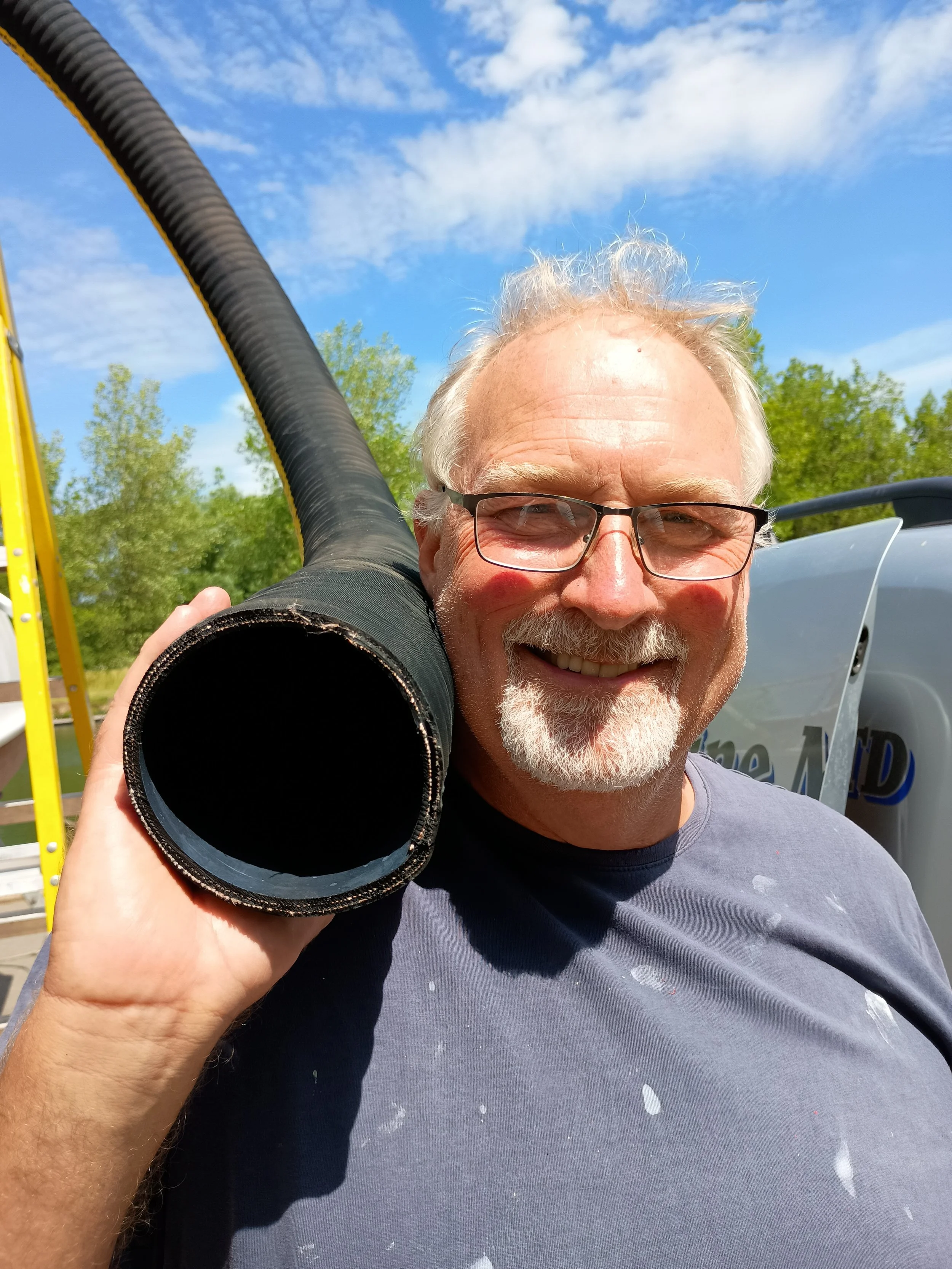
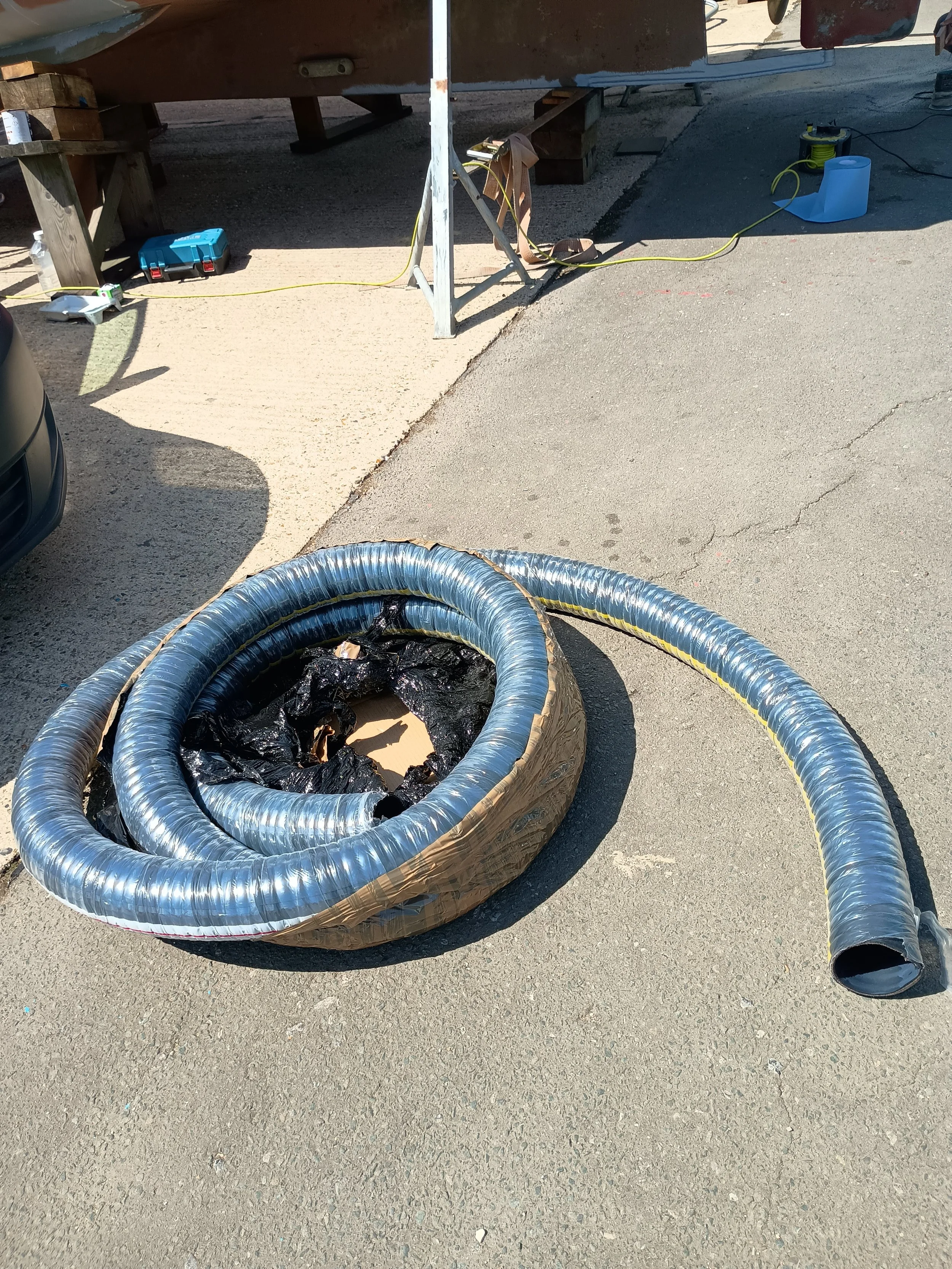
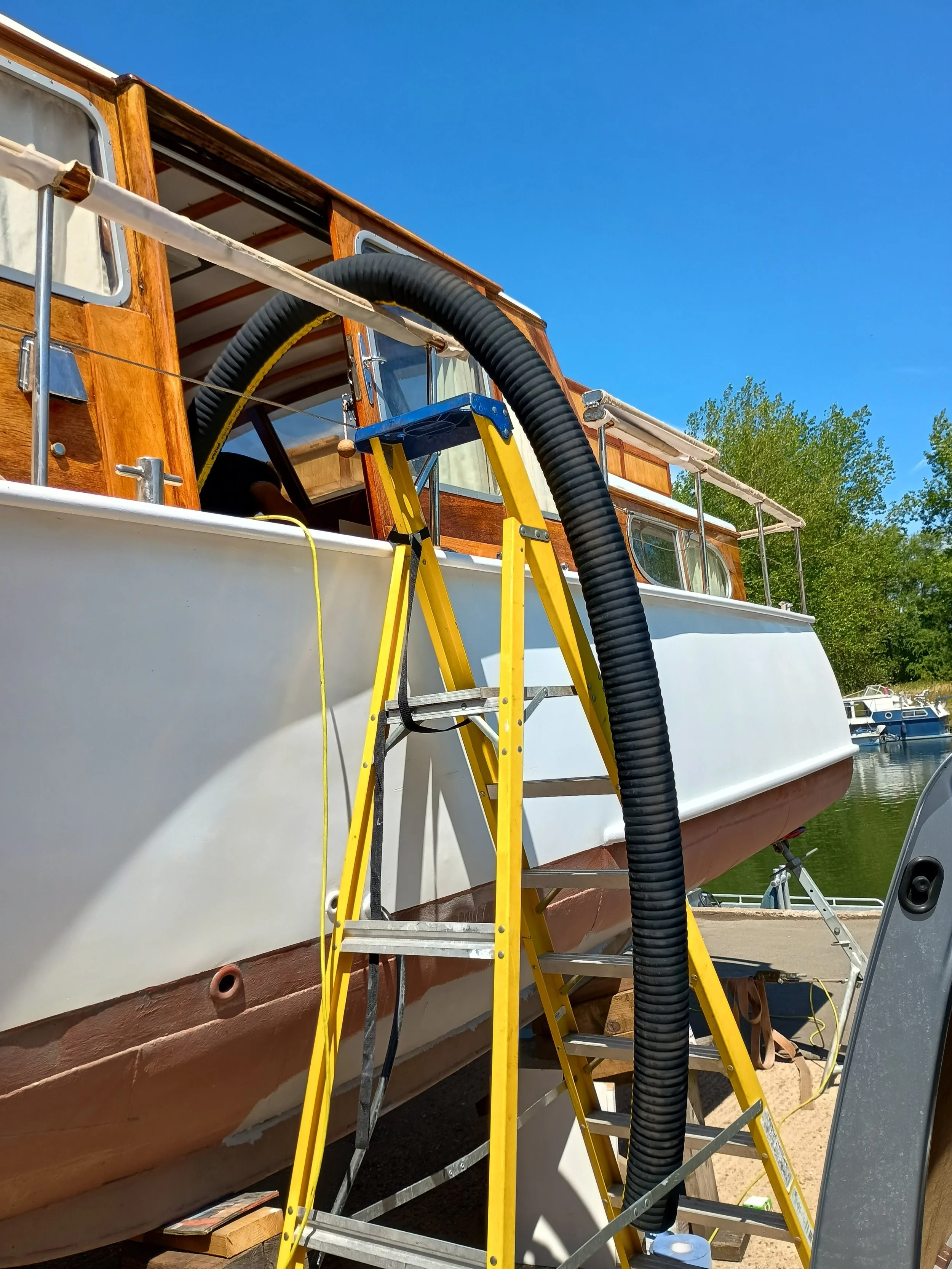
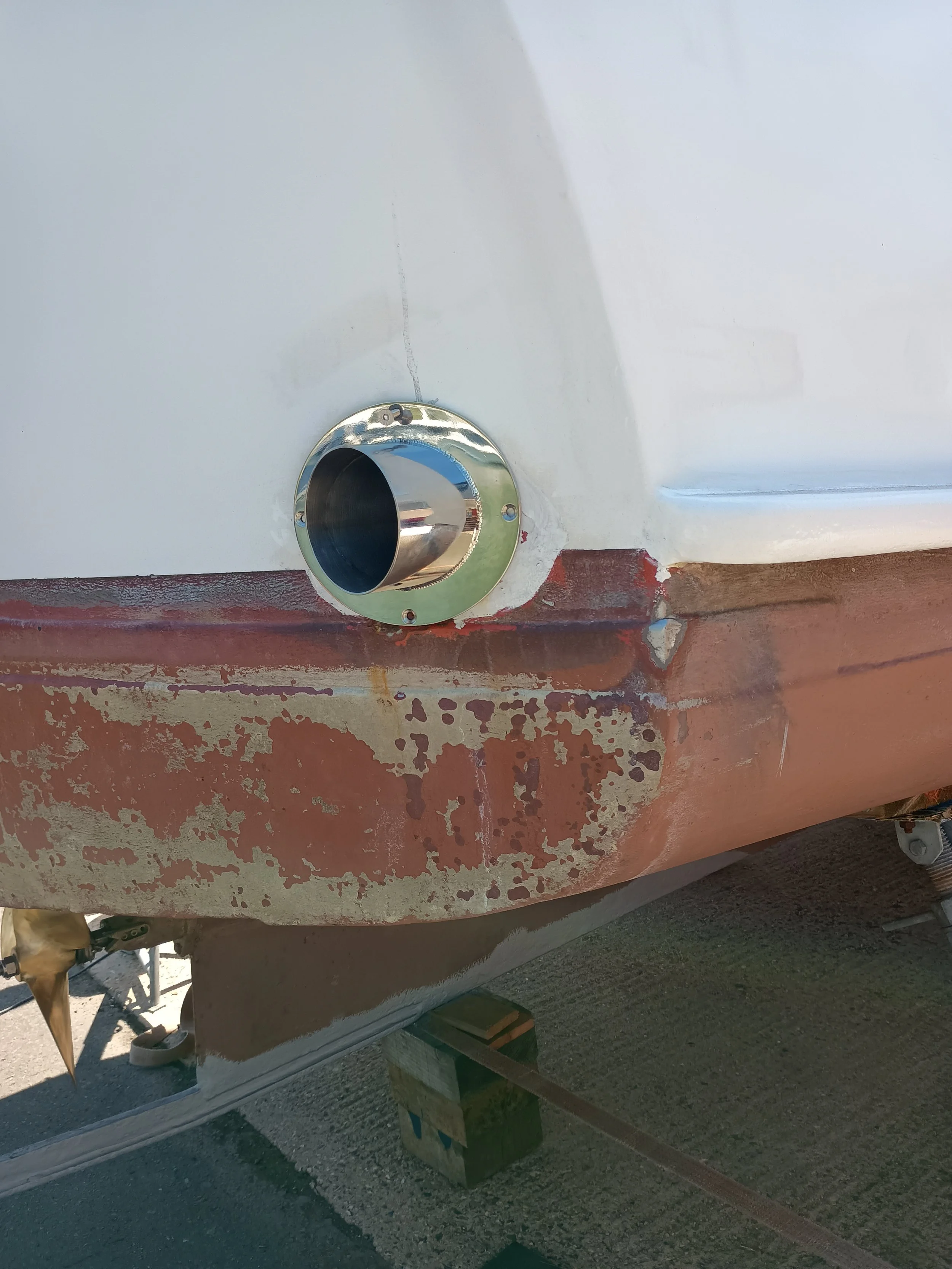
Into day 3 of waiting for a lift out, the engineers stopped by to talk about the exhaust. They had a conversation with the manufacturers of Nanni engines, the engine required a new exhaust. The current exhaust wasn’t fit for purpose. Besides being old, the new engine needed a bigger exhaust. (The old exhaust was a 75mm and Nanni needed 104mm). There would also need to be a water lock installed. This device collects cooling water when the engine is stopped, preventing it from flowing back into the engine and causing damage. It also acts as a muffler to reduce exhaust noise. To fit this larger exhaust pipe we were going to have to give access behind lockers, fridge, dishwasher and some of the cupboards, both in the saloon and galley. The exhaust runs behind all of these, down starboard side under the deck.
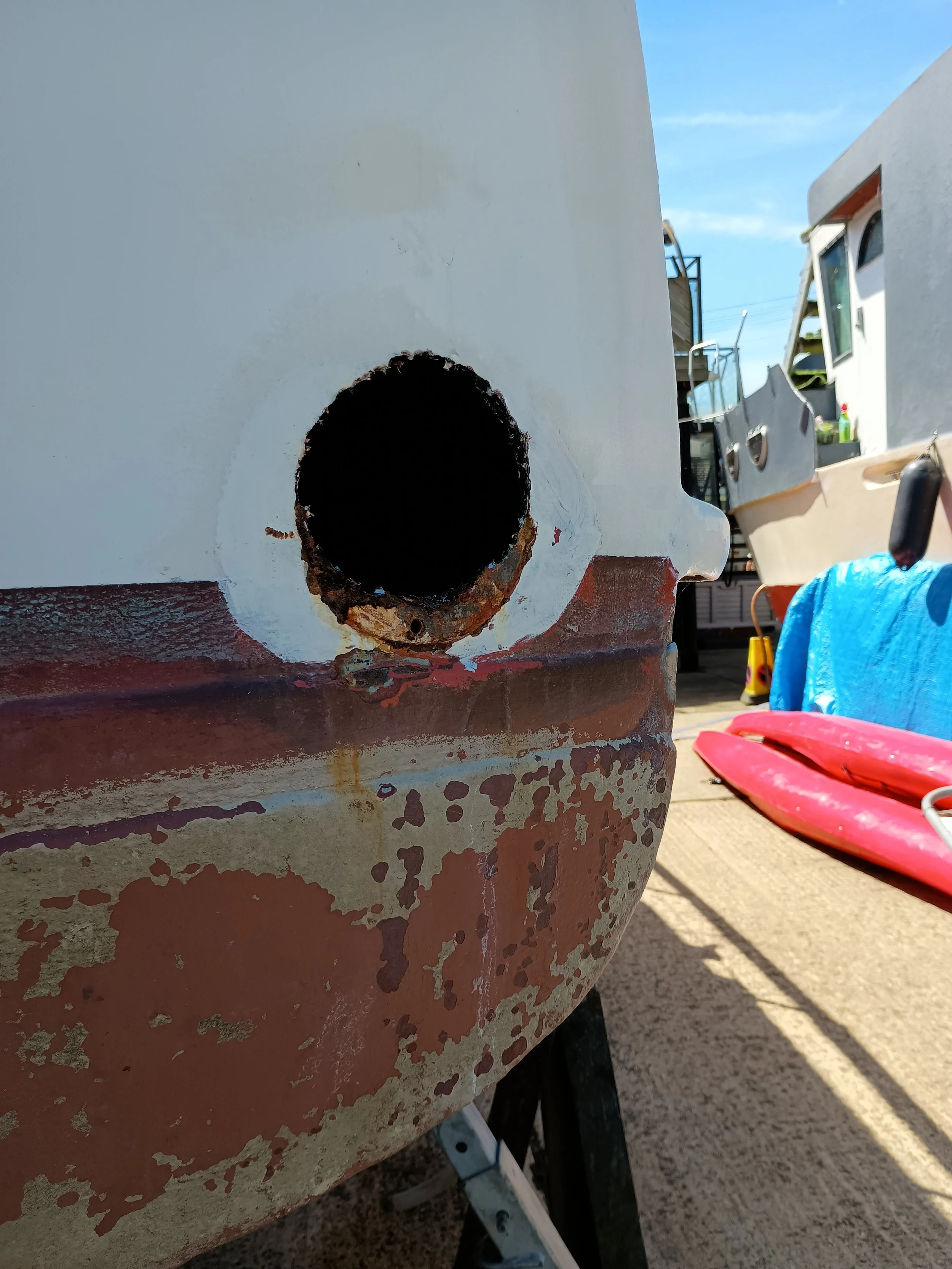
So the exhaust pipe and water lock were ordered and the beautiful new engine stayed safe in the workshop. Then we received a call to say we needed a new, larger exhaust tailpipe. As the back of the boat is shaped at a curve, we would not be able to buy one off the shelf, so the new one would need to be made to spec. All of this meant that Deux was going to have to be lifted out and placed on supports in the yard and the work would take longer than a few hours in the slings. Possibly a week of work (two to be cautious).
At this point I was ready to say goodbye to summer. I would watch it go by from the back of the boat, 3 meters high, in the boat yard.
And then it finally happened…. The crane arrived, the exhaust pipe, water lock, tailpipe and a lot of other bits all arrived. As well as the heatwave!!
The boat was lifted out and placed on supports in the yard. The engineers fitted pipes to our water outlets, so while we were on the boat, we could use the shower, hand basin and sink as well as the dishwasher. The toilets in the yard were only a quick ladder climb away, so we didn’t have to use the onboard toilet and fill the holding tank. We had access to electric and water so we were not completely hard done by. And the sunsets were really pretty from so high up. I also got really fit with every day climbing up and down the ladder – the hotter it got, the more beer was needed, the more toilet trips were required, the hotter I got = it was easy to see the cycle!
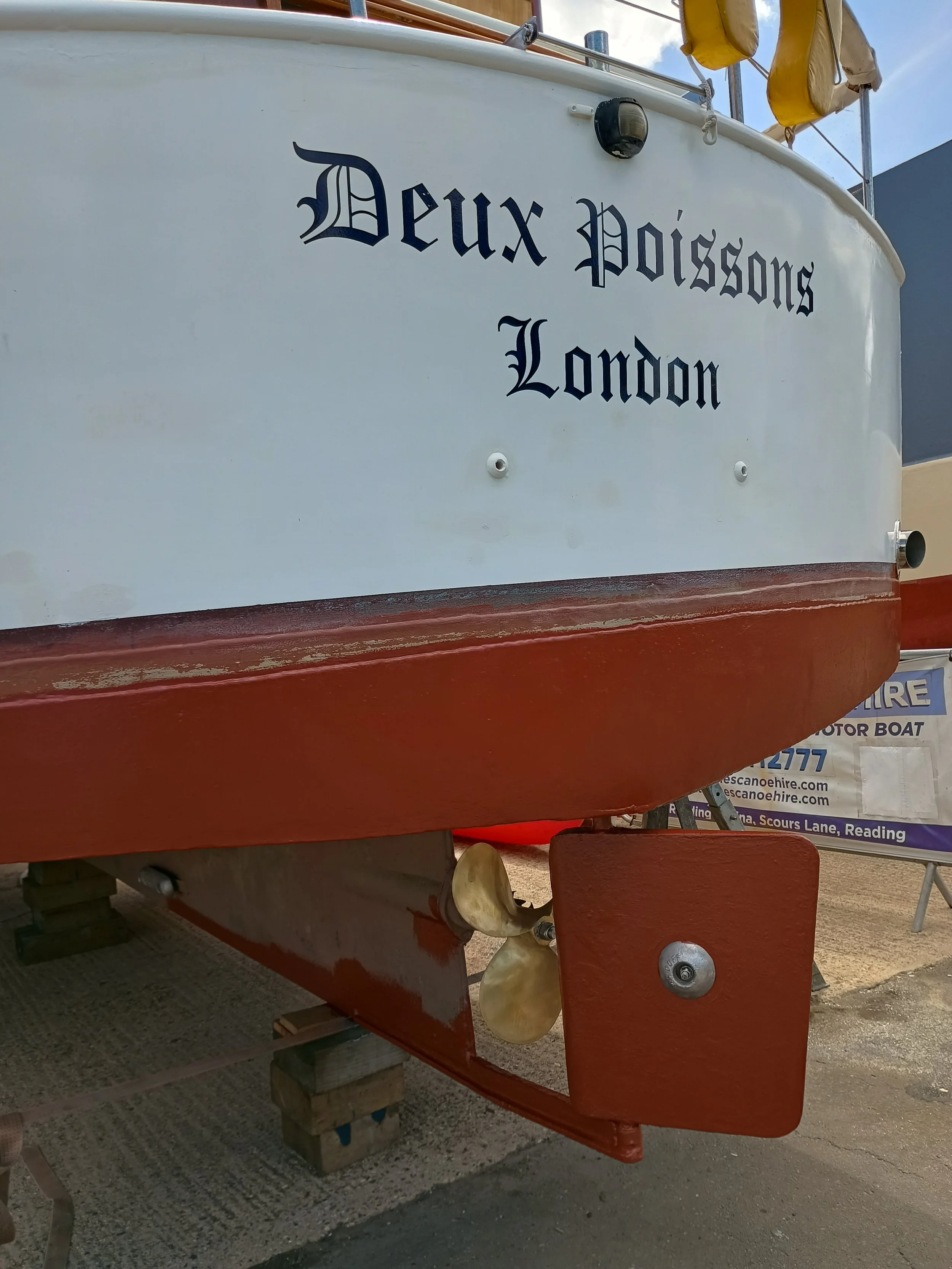
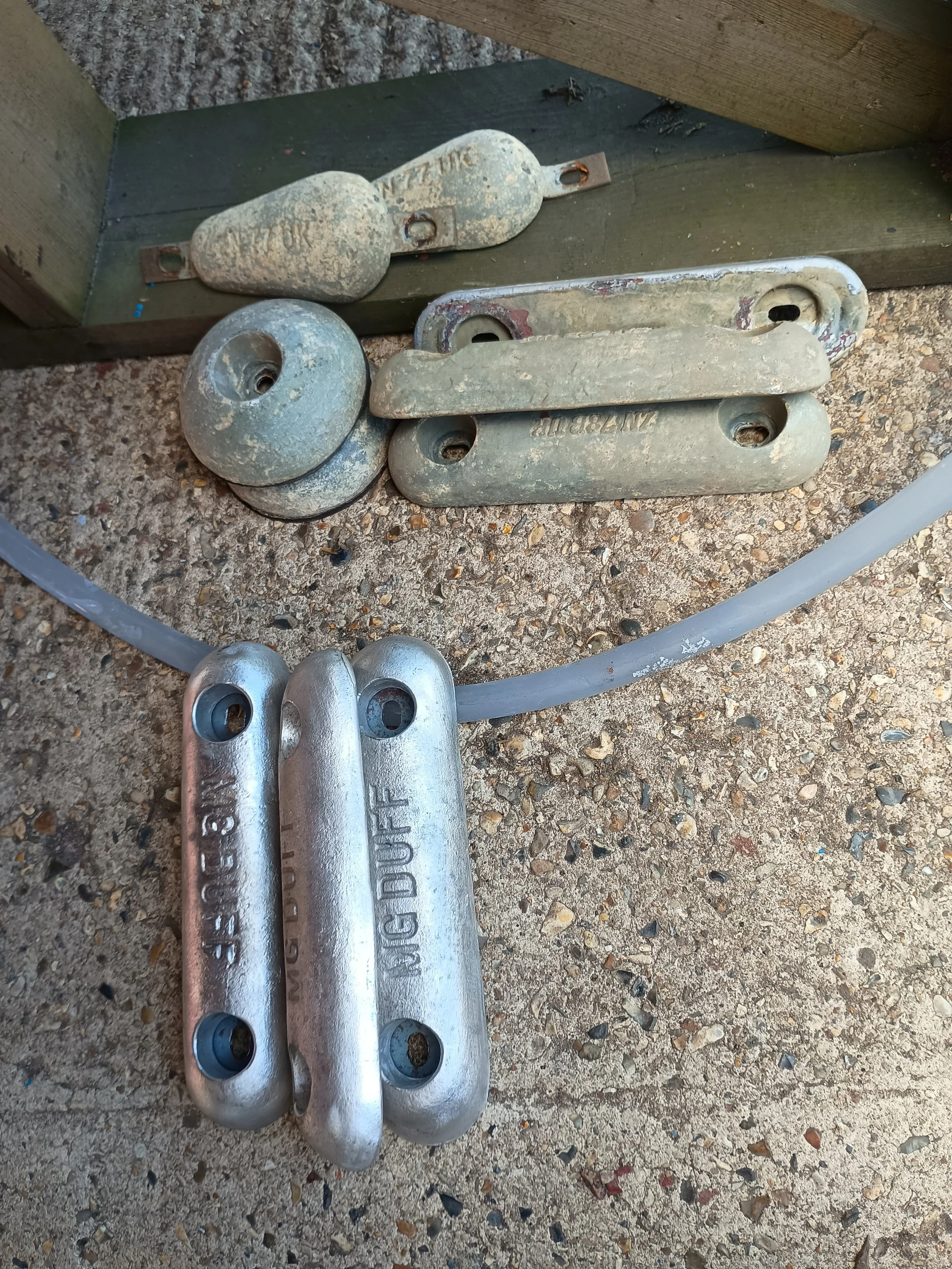
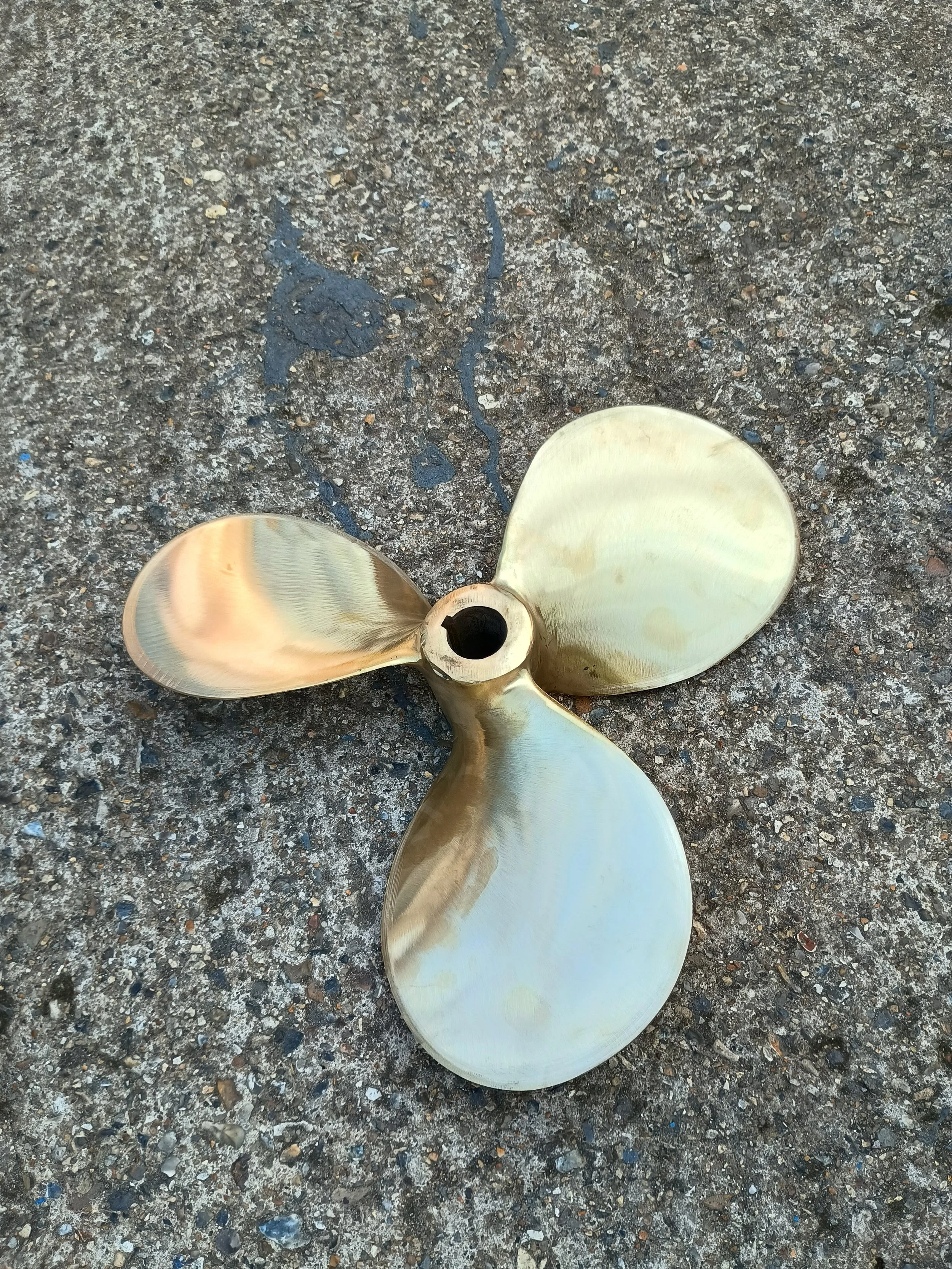
Over the next few days, the engineers got the prop and rudder off, with a lot of huffing and puffing – the summer temperature was really hot by now. The old shaft came out, the new one went in. The exhaust was huge but was fitted and the “destruction” of the lockers and cupboards wasn't too bad. This was not our first rodeo with Deux Poissons. We had lived through many dismantles and refittings so we took that in our stride. We took advantage of the boat being out of the water and did some jobs that were on our to-do list. I gave the galley cupboards a fresh coat of paint. Patrick replaced the salt water anodes with fresh water ones as we are spending all our time on rivers and canals. He did some paint patching on the hull. Same procedure as normal….. Once cleaned and any flaky paint removed, first coat epoxy, then a coat of underwater primer and then a coat of antifouling. Patrick also cleaned and polished the topsides while I varnished everything twice and repainted the cream decks.
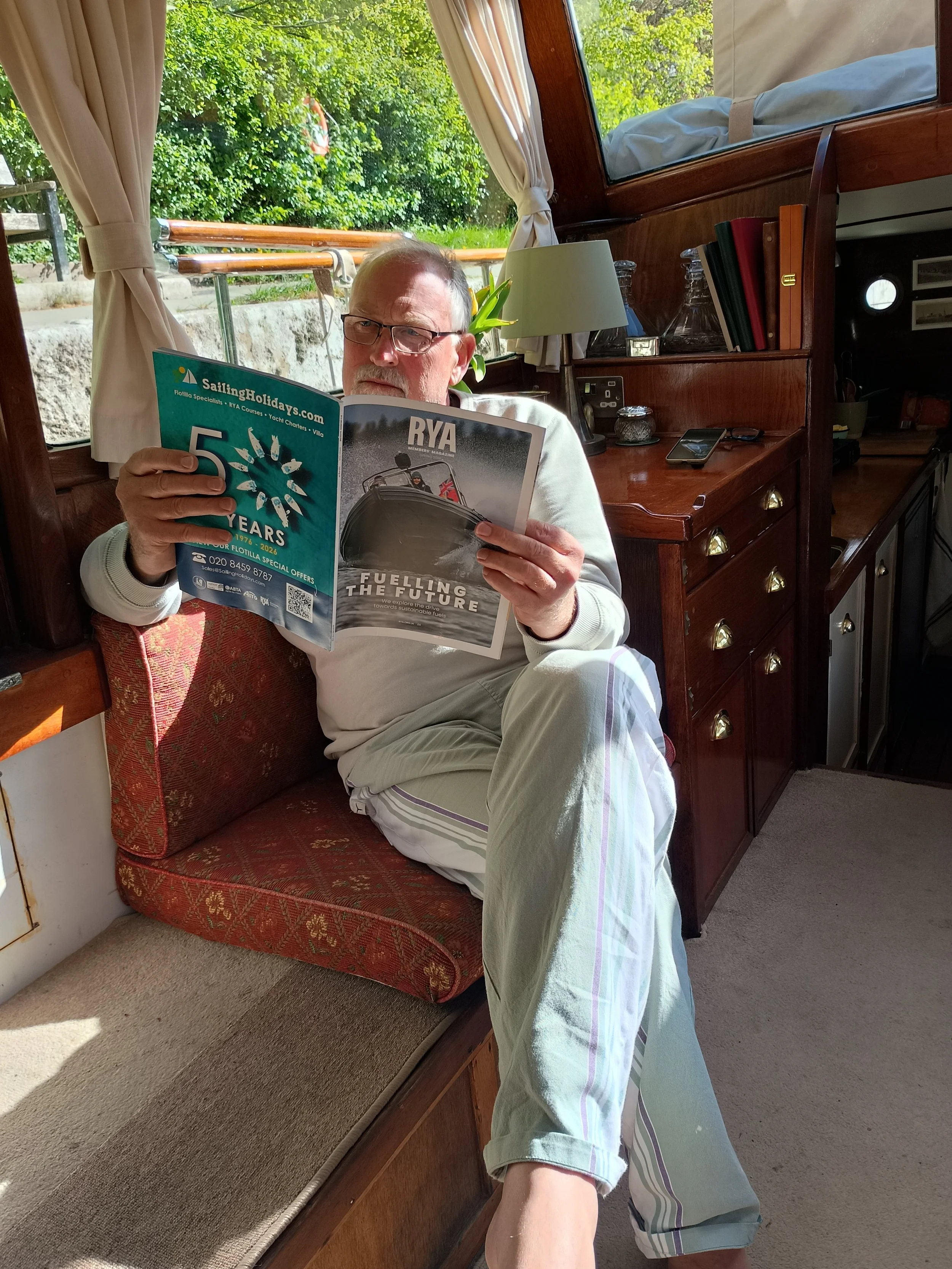
The thrust bearing plate was fitted onto the bearers and the thrust bearing put in situ. The crane man was summoned back and Deux was slowly lowered back into the water.
After an hour in the slings and confirmation that all the water remained outside of the boat, the crane man was sent away. As much as I liked him, I didn’t really want to see him again.
Then the engine fitting was scheduled. A few days later the Nanni was lowered through the ceiling and settled into the engine bay. The exhaust fitting proved to be a challenge but once that was completed and all the other vital parts were fitted and connected, the start key was turned. She started first turn and both Patrick and I were amazed at how quiet she was. We could even talk to each other.
The generator still needed to be refitted and connected up, but we could manage without it (for now). We had a working engine! A quiet, reliable one. And the summer heat wave promised to continue for some time. So we agreed to a little test run the next day and then Patrick and I sat and planned a few days upriver. We will need to come back to have the oil checked and replaced and generator re-fitted but we were so pleased to get away for a while!